

- Updated: June 26, 2026
- 6 min read
Nous: A Predictive World Model for Long-Term Agent Memory
Direct Answer
Nous introduces a predictive world‑model memory architecture that treats knowledge as a set of probability distributions rather than static facts. By storing only the belief‑updates (deltas) about entity‑attribute pairs, the system can forget gracefully, resolve identities through mutual information, and scale without external vector databases.
Background: Why This Problem Is Hard
Long‑term memory for autonomous agents has three intertwined challenges:
- Scalability. Traditional approaches store every observed fact as a separate record, vector embedding, or graph triple. As conversations grow, indexing and retrieval become bottlenecks.
- Staleness and Forgetting. Fixed representations do not decay naturally, forcing engineers to implement ad‑hoc pruning or time‑based eviction policies.
- Identity Ambiguity. When multiple mentions refer to the same entity (e.g., “the CEO”, “Alice”), deterministic stores struggle to merge or split representations without explicit linking logic.
Existing memory systems—such as vector‑database‑backed retrieval, knowledge‑graph caches, or episodic buffers—address one symptom but not the underlying principle that an agent’s knowledge is fundamentally a set of expectations about the world. This mismatch leads to brittle recall, high latency, and costly infrastructure.
What the Researchers Propose
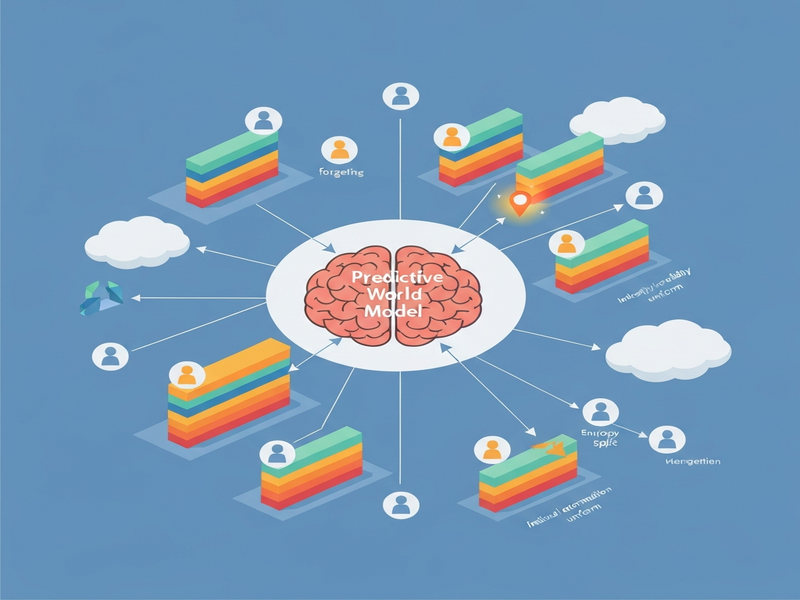
Nous reframes memory as a predictive world model. The core idea is simple yet powerful: for every observed entity‑attribute pair, the system maintains a categorical probability distribution—called a dimension</strong—over possible values. When a new observation arrives, the system computes its surprise (information‑theoretic loss) and updates the dimension using a closed‑form Bayesian posterior. The only persistent artifact is the delta, i.e., the shift from prior to posterior belief.
Key components of the architecture are:
- Dimension Store. A lightweight map from (entity, attribute) keys to probability vectors.
- Surprise Engine. Calculates
S = -log₂ P(obs | D)to quantify how unexpected an observation is. - Bayesian Updater. Applies a mathematically exact posterior update, producing a new distribution and a delta record.
- Entropy Decay Scheduler. Periodically nudges each dimension toward a uniform distribution, implementing natural forgetting.
- Identity Resolver. Uses mutual information across dimensions to cluster keys that likely belong to the same real‑world entity.
How It Works in Practice
The operational flow can be visualized as a four‑step pipeline:
- Observation Ingestion. The agent receives a conversational turn (e.g., “Alice bought a laptop”). The NLP front‑end extracts entity‑attribute pairs: (Alice, purchase) → laptop.
- Surprise Scoring. The Surprise Engine looks up the current dimension for (Alice, purchase) and computes the log‑probability of “laptop”. A high surprise indicates that the observation deviates from the agent’s existing belief.
- Bayesian Update. The updater blends the prior distribution with the new evidence, yielding a posterior distribution that reflects both history and the latest fact. The delta (difference vector) is stored as the canonical memory record.
- Maintenance. Entropy decay gradually flattens stale dimensions, while the Identity Resolver monitors cross‑dimensional mutual information to merge or split entity keys as needed.
This design eliminates the need for a separate vector database or graph engine; the entire memory lives in a compact, probabilistic table.
Evaluation & Results
To validate the approach, the authors benchmarked Nous on LoCoMo—a long‑term conversational memory suite that tests single‑hop, multi‑hop, temporal, and open‑domain question answering across ten multi‑turn dialogues (1,540 questions). The backbone LLM was GPT‑4o‑mini.
Key findings:
- Nous achieved an F1 of 63.5 on single‑hop queries, surpassing the prior state‑of‑the‑art A‑MEM by a noticeable margin.
- On multi‑hop reasoning, the model scored 55.3, again outperforming A‑MEM’s reported numbers.
- Temporal recall (questions that depend on the order of events) reached 58.6, demonstrating that entropy decay does not erase useful chronology.
- Open‑domain performance settled at 62.5, confirming that the predictive model can handle diverse topics without external retrieval.
When compared against the original Nous paper on arXiv, the authors also reported higher scores than BeliefMem, a contemporaneous belief‑based memory system, though they caution that uncontrolled evaluation differences limit a strict apples‑to‑apples comparison.
Overall, the experiments demonstrate that a purely probabilistic memory can retain factual consistency, support multi‑step inference, and forget gracefully—all without the engineering overhead of traditional storage layers.
Why This Matters for AI Systems and Agents
For practitioners building enterprise‑grade agents, Nous offers a concrete pathway to:
- Reduce Infrastructure Complexity. By removing the need for external vector stores or graph databases, deployment footprints shrink, and latency improves.
- Enable Adaptive Forgetting. Entropy decay provides a mathematically grounded mechanism for memory pruning, which is essential for compliance (e.g., GDPR “right to be forgotten”) and cost control.
- Improve Identity Management. Mutual‑information‑driven resolution sidesteps brittle rule‑based entity linking, making agents more robust in noisy, multi‑user environments.
- Facilitate Seamless Orchestration. Because the memory surface is a set of probability tables, other modules (planning, reasoning, or retrieval) can query belief confidence directly, enabling risk‑aware decision making.
These capabilities align closely with the UBOS platform overview, which emphasizes modular AI pipelines that can plug in custom memory back‑ends without heavyweight data stores. Moreover, developers can combine Nous‑style memory with the Workflow automation studio to create end‑to‑end conversational bots that automatically prune outdated context.
What Comes Next
While Nous marks a significant step forward, several open challenges remain:
- Scalability of High‑Cardinality Dimensions. As the number of unique entity‑attribute pairs grows, the dimensionality of the probability tables can become large. Sparse representations or hierarchical clustering may be needed.
- Integration with Retrieval‑Augmented Generation. Combining a predictive model with external knowledge bases could boost factual accuracy for rare or out‑of‑distribution queries.
- Robustness to Noisy Observations. Bayesian updates assume well‑calibrated likelihoods; noisy or adversarial inputs could skew distributions unless guarded by confidence thresholds.
- User‑Controlled Forgetting Policies. Business applications often require explicit retention schedules; exposing entropy decay parameters as configurable policies would increase adoption.
Future research directions include exploring continuous‑space embeddings for dimensions, leveraging hierarchical Bayesian models for multi‑level abstraction, and benchmarking against larger LLM backbones (e.g., GPT‑4o‑Turbo). From an application standpoint, Nous‑style memory could power AI marketing agents that maintain long‑term customer context without bloated CRM databases, or enable ChatGPT and Telegram integration scenarios where conversational history is kept lightweight yet semantically rich.
In summary, by treating knowledge as a dynamic belief state rather than a static record, Nous opens a new design space for memory‑efficient, self‑organizing AI agents—an evolution that could reshape how enterprises deploy long‑term conversational assistants.
Andrii Bidochko
CTO UBOS
Andrii Bidochko is an AI entrepreneur and researcher focused on AI agents, reinforcement learning, and autonomous systems. He writes about the technologies shaping the future of machine intelligence, from frontier models and agent architectures to real-world AI applications.