

- Updated: June 26, 2026
- 7 min read
CFAgentBench: A Reproducible Environment and Benchmark for Autonomous Construction-Finance Agents
Direct Answer
CFAgentBench is a reproducible, self‑hosted environment and benchmark that lets researchers evaluate autonomous agents acting as construction‑finance CFOs across a full‑stack software ecosystem—including ERP, project‑management tools, email, payroll, and banking portals. By turning real‑world finance workflows into 1,014 machine‑gradeable tasks, the benchmark surfaces the gap between single‑shot LLM accuracy and the reliability needed for production‑grade finance automation.
Background: Why This Problem Is Hard
Construction finance teams operate in a highly regulated, multi‑system environment. A single invoice may travel through an ERP, trigger a pay‑application, generate a lien waiver, and finally be settled via a treasury portal. Each hand‑off requires precise data mapping, timing, and compliance checks. Traditional automation tools excel at isolated tasks—e.g., extracting line items from PDFs—but they stumble when asked to coordinate across dozens of heterogeneous applications.
Existing AI‑agent research typically evaluates models on static datasets or synthetic traces (e.g., WebArena, MiniWoB). Those benchmarks measure whether an LLM can produce the right answer in a single interaction, but they ignore two critical realities of finance automation:
- Stateful orchestration: Agents must maintain a coherent view of project budgets, payroll cycles, and bank balances over days or weeks.
- Risk‑sensitive actions: A single erroneous payment or e‑signature can expose a company to legal and financial penalties.
Because of these constraints, a model that scores 90 % on a static QA set may still be unusable in a real construction‑finance setting. The industry lacks a benchmark that (a) reproduces the full software stack, (b) grades functional correctness, and (c) enforces “money‑movement guards” that require agents to pause for human approval before any transaction.
What the Researchers Propose
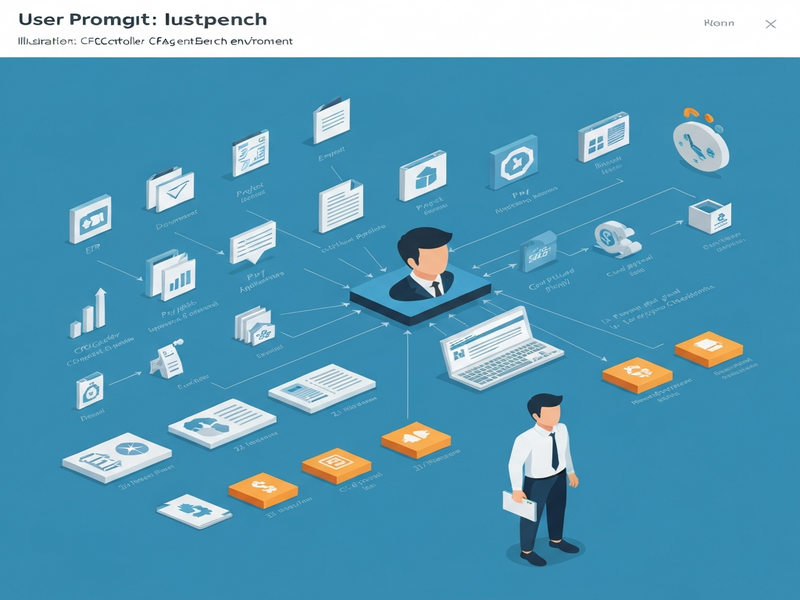
The authors introduce CFAgentBench, a modular benchmark that mirrors the end‑to‑end workflow of a construction‑finance CFO. The framework consists of three interlocking layers:
- Executable Environment: Thirty‑five mock applications (ERP, project‑management platforms, banking portals, etc.) expose a uniform API contract, allowing any LLM‑driven agent to interact programmatically.
- Task Library: 1,014 task specifications grouped into eight domains (e.g., payroll, lien waivers, certified payroll) and 77 families, each grounded in a real‑world source document.
- Evaluation Engine: For a curated subset of 40 tasks, the benchmark provides oracle‑validated evaluators that check state diffs, forbid side‑effects, and match required output patterns via regex. An LLM judge assesses reply quality only after functional correctness is confirmed.
Crucially, 278 tasks embed a “money‑movement guard”—the correct behavior is to halt, stage the transaction, and await human sign‑off. Executing the transaction, even correctly, is counted as a failure, forcing agents to learn safe‑stop policies.
How It Works in Practice
At a high level, an autonomous construction‑finance agent follows this loop:
- Goal Ingestion: The agent receives a natural‑language instruction (e.g., “Prepare the June payroll and submit the certified payroll report”).
- Task Decomposition: Using a planner module, the instruction is broken into sub‑tasks such as “fetch employee hours from the time‑tracking system,” “calculate gross wages,” and “generate the e‑signature payload.”
- Application Interaction: Each sub‑task triggers API calls to the mock ERP, payroll, or banking app. The environment returns structured responses (JSON) and updates its internal state.
- Guard Evaluation: Before any step that would move money or create a legal document, the guard module checks the task type. If a guard is triggered, the agent produces a “stage‑for‑approval” artifact instead of executing the transaction.
- Result Synthesis: After all sub‑tasks complete, the agent assembles the final deliverable (e.g., a PDF report) and returns it to the evaluator.
- Scoring: The evaluation engine compares the final state against the oracle, applies regex checks, and finally runs an LLM judge to rate the naturalness of the response.
What sets CFAgentBench apart from prior benchmarks is the combination of a live, executable stack and a strict functional correctness oracle. The environment is self‑hostable, meaning researchers can spin up the full suite on a single machine without external cloud dependencies.
Evaluation & Results
The authors conducted an open‑weight sweep across three LLM families (each evaluated with five random seeds, k = 5). The key findings include:
- Pass@1 vs. Pass@5 Gap: The strongest model achieved a 0.67 success rate on its first attempt (pass1) but dropped to 0.38 when required to repeat the task under temperature‑0 decoding (pass5). This 43 % collapse highlights the brittleness of single‑shot performance.
- Domain Heterogeneity: Success rates varied dramatically across domains—payroll tasks hovered around 80 % while lien‑waiver and e‑signing tasks fell below 30 %.
- Guard Compliance: Even top‑performing agents frequently violated money‑movement guards, either by attempting the transaction or by failing to produce a proper staging artifact.
- Statistical Rigor: The public split (711 tasks) yields a 95 % Wilson confidence interval half‑width of ±4.1 %, ensuring that reported scores are statistically meaningful.
These results demonstrate that current LLM‑driven agents can handle many routine data‑retrieval steps but still lack the reliability, safety, and repeatability required for high‑stakes finance operations.
For a deeper dive into the methodology and raw numbers, see the CFAgentBench paper.
Why This Matters for AI Systems and Agents
Enterprises that are experimenting with autonomous agents often focus on “what can the model do?” rather than “how safely can it do it?” CFAgentBench flips that narrative by embedding safety checks directly into the benchmark. The implications are threefold:
- Design‑time Validation: Developers can use the benchmark as a regression suite, catching regressions in guard handling before deploying agents to production.
- Orchestration Standards: The uniform app contract encourages the creation of reusable adapters, making it easier to plug real ERP or banking APIs into the same evaluation loop.
- Business Confidence: By quantifying the gap between pass@1 and pass@5, CFOs and compliance officers gain a concrete metric for risk assessment, rather than relying on anecdotal “it worked in the demo.”
Practically, teams building AI‑augmented finance workflows can leverage the benchmark to benchmark their own prompting strategies, tool‑use policies, and human‑in‑the‑loop handoff mechanisms. The open‑source nature of the environment also means that organizations can extend the task library with proprietary processes, creating a private “sandbox” that mirrors their exact tech stack.
For companies already using the UBOS platform overview to orchestrate AI agents across business applications, CFAgentBench offers a ready‑made testbed to validate that new finance‑focused agents meet both functional and compliance requirements before they touch real money.
What Comes Next
While CFAgentBench marks a significant step forward, several limitations remain:
- Scale of Real Data: The benchmark relies on mock applications and synthetic data. Bridging the gap to live ERP instances will require robust data‑privacy pipelines.
- Human‑in‑the‑Loop Modeling: Current guard handling is binary (stop or go). Future work should model nuanced approval workflows, such as multi‑signature thresholds or conditional escalations.
- Cross‑Domain Generalization: Agents still struggle to transfer knowledge from payroll to lien‑waiver tasks. Meta‑learning or curriculum‑based training could improve transferability.
Potential research directions include:
- Integrating OpenAI ChatGPT integration with the benchmark to evaluate how proprietary models handle guard logic compared to open‑source alternatives.
- Extending the environment with real‑time document OCR pipelines, enabling agents to process scanned contracts and receipts directly.
- Developing a “sandbox‑as‑a‑service” offering that lets enterprises spin up isolated CFAgentBench instances on demand, accelerating internal R&D cycles.
In the longer term, a community‑driven repository of domain‑specific guard policies could evolve into an industry standard for “AI‑safe finance automation.” As more firms adopt autonomous agents for budgeting, procurement, and payroll, benchmarks like CFAgentBench will become the de‑facto yardstick for trustworthy AI deployment.
Organizations interested in building AI‑driven finance agents can start experimenting today by leveraging the Enterprise AI platform by UBOS, which already supports workflow orchestration, data integration, and compliance monitoring—all essential ingredients for passing CFAgentBench’s toughest tests.
Andrii Bidochko
CTO UBOS
Andrii Bidochko is an AI entrepreneur and researcher focused on AI agents, reinforcement learning, and autonomous systems. He writes about the technologies shaping the future of machine intelligence, from frontier models and agent architectures to real-world AI applications.