

- Updated: June 26, 2026
- 8 min read
AgentRiskBOM: A Risk‑Scoping Security Bill of Materials for Agentic AI Systems
Direct Answer
AgentRiskBOM introduces a machine‑readable “risk‑scoping” Bill of Materials that captures an agentic AI system’s runtime authority—what it can access, remember, modify, delegate, and prove after execution. By layering this artifact on top of existing SBOM, AIBOM, and MLBOM records, the framework gives developers and auditors a concrete way to assess and contain the security surface of autonomous agents before they cause harm.
Background: Why This Problem Is Hard
Modern AI agents are no longer static models that answer a single query. They retrieve private context, invoke external tools, write files, call APIs, and even coordinate with peer agents—all while operating with varying degrees of autonomy. This dynamic behavior creates three intertwined challenges:
- Capability opacity: Traditional software SBOMs list libraries and versions, but they do not describe what an AI can do at runtime (e.g., “can read user emails” or “can execute shell commands”).
- Authority drift: An agent’s permissions may evolve after deployment through configuration changes, credential updates, or new tool integrations, making it hard to track the current attack surface.
- Auditability gap: When an incident occurs, investigators lack a structured record of which tools, memories, or credentials the agent actually used, hampering root‑cause analysis and compliance reporting.
Existing artifacts—Software Bill of Materials (SBOM), AI‑focused BOMs (AIBOM, MLBOM)—address supply‑chain provenance but stop short of describing runtime authority. As enterprises adopt “agentic AI” for coding assistants, retrieval‑augmented generation (RAG), and autonomous orchestration, the missing visibility becomes a critical security blind spot.
What the Researchers Propose
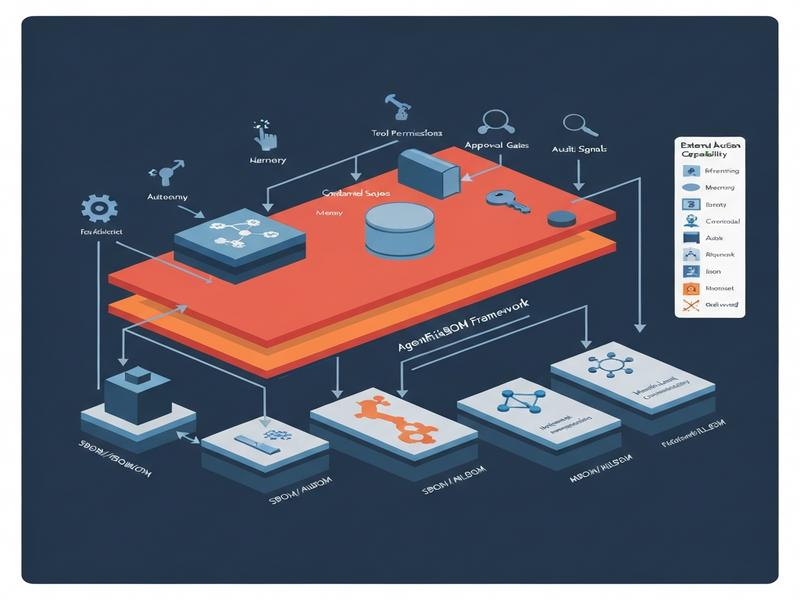
The authors present AgentRiskBOM, a structured, JSON‑schema artifact that augments traditional BOMs with a set of runtime‑authority fields. The framework is deliberately additive: it references existing SBOM/AIBOM/MLBOM entries where they already provide authoritative data, and it adds new layers that answer the following questions for each deployed agent:
- Autonomy level: Is the agent fully autonomous, human‑in‑the‑loop, or constrained to specific triggers?
- Tool permissions: Which external tools (e.g., code interpreters, web scrapers, database connectors) may the agent invoke?
- Memory scope: What persistent storage (vector stores, file systems) can the agent read or write?
- Credential scope: Which API keys, OAuth tokens, or service accounts are exposed to the agent?
- Approval gates: Are there human‑approval checkpoints before high‑impact actions?
- Audit signals: Which logs, provenance records, or cryptographic proofs are emitted?
- Inter‑agent communication: Does the agent exchange messages with peers, and under what protocols?
- External action capability: Can the agent trigger real‑world effects (e.g., sending emails, provisioning cloud resources)?
These fields collectively form a “risk‑scoping” view that can be automatically compared across deployments, scored for risk, and diffed when configurations change.
How It Works in Practice
Conceptual Workflow
- Artifact Generation: During CI/CD, a tooling pipeline extracts static metadata (libraries, model hashes) and combines it with a declarative description of the agent’s intended runtime authority.
- Schema Validation: The combined document is validated against the AgentRiskBOM JSON schema, ensuring completeness and type safety.
- Risk Scoring: A built‑in scorer assigns a numeric risk level based on the breadth of permissions, autonomy, and credential exposure.
- Deployment Diffing: When a new version is rolled out, the diff detector flags any change in authority fields (e.g., added tool permission or expanded credential scope).
- Runtime Enforcement (optional): Orchestration platforms can ingest the BOM to enforce policy—blocking disallowed tool calls or requiring additional human approval.
Component Interaction
| Component | Role | Key Interaction |
|---|---|---|
| Static Analyzer | Collects SBOM/AIBOM/MLBOM data | Feeds library versions, model IDs into the AgentRiskBOM builder |
| Authority Declarator | Developer‑authored YAML/JSON describing runtime permissions | Supplies autonomy, tool, memory, credential fields |
| JSON‑Schema Validator | Ensures the final artifact conforms to the specification | Rejects incomplete or malformed entries before deployment |
| Risk Scorer | Applies a penalty‑based model to compute a risk score | Outputs a numeric rating used for gating or reporting |
| Diff Detector | Compares two AgentRiskBOM versions | Highlights authority drift (e.g., new tool added) |
| Policy Engine (optional) | Enforces constraints at runtime | Blocks disallowed actions based on the BOM |
What Sets This Approach Apart
Unlike prior BOMs that stop at supply‑chain provenance, AgentRiskBOM captures the dynamic security posture of an AI agent. It is:
- Machine‑readable: JSON schema enables automated tooling and integration with CI pipelines.
- Extensible: New authority fields can be added without breaking existing validators.
- Actionable: The diff detector provides immediate feedback when a deployment changes its risk profile.
Evaluation & Results
Test Corpus and Scenarios
The researchers assembled a reproducible corpus of 13 open‑source agents spanning three archetypes:
- Code‑generation assistants (e.g., Copilot‑style bots)
- Retrieval‑augmented generation (RAG) agents that query external knowledge bases
- Multi‑agent orchestration frameworks that coordinate several specialized bots
They also defined 52 risk scenarios across 14 categories, such as “credential leakage,” “unauthorized file write,” and “cross‑agent data exfiltration.” Each scenario maps to one or more AgentRiskBOM fields.
Coverage and Scoring Findings
Key quantitative takeaways:
- The AgentRiskBOM schema validated all 13 corpus artifacts without errors.
- When measured against 16 capability dimensions (e.g., tool use, memory access), AgentRiskBOM achieved a native‑equivalent score of 14**, compared to 1 for SBOM, 1.5 for AIBOM, and 2 for MLBOM.
- Visibility into risk categories rose to 100% for AgentRiskBOM, versus 10.5% for SBOM‑like views and 20.9% for AIBOM‑like views.
- The diff detector correctly identified the change type for all 33 injected deployment mutations, demonstrating reliable authority‑drift detection.
- A secondary penalty‑based scorer correlated with the primary scorer at a Spearman coefficient of 0.73, confirming that the scoring methodology is robust while still requiring human‑tuned thresholds.
Interpretation of Results
These results show that a focused risk‑scoping BOM can surface security‑relevant properties that traditional BOMs miss entirely. The perfect detection rate of the diff detector suggests that organizations can automate compliance checks for authority changes, reducing the window of exposure after a configuration slip.
Why This Matters for AI Systems and Agents
For AI security architects and CTOs, AgentRiskBOM offers a concrete artifact that bridges the gap between development‑time provenance and runtime governance. By exposing the exact set of tools, credentials, and memory stores an agent may touch, teams can:
- Integrate risk scoring into CI/CD pipelines, preventing high‑risk agents from reaching production.
- Enforce least‑privilege policies via orchestration platforms that read the BOM before granting tool access.
- Generate audit trails that satisfy regulatory requirements (e.g., GDPR, SOC 2) by proving which data an agent accessed.
- Facilitate cross‑team communication: product managers, compliance officers, and engineers all reference the same structured document.
In practice, a company deploying an autonomous customer‑support bot could publish an AgentRiskBOM that explicitly lists “read‑only access to CRM API” and “no file‑system write permission.” If a later update mistakenly adds a file‑write capability, the diff detector would flag the change, prompting a manual review before the bot can be redeployed.
Adopting AgentRiskBOM aligns with broader Enterprise AI platform by UBOS strategies that emphasize secure, auditable AI pipelines.
What Comes Next
While the initial study validates the concept, several avenues remain open:
- Standardization: Engaging standards bodies (e.g., ISO/IEC) to formalize the AgentRiskBOM schema could drive industry‑wide adoption.
- Tooling Ecosystem: Building plug‑ins for popular orchestration frameworks (Kubernetes, Airflow) to automatically enforce BOM‑derived policies.
- Dynamic Updates: Extending the model to capture runtime‑generated authority (e.g., credentials fetched on‑the‑fly) and feeding them back into a mutable BOM.
- Human‑in‑the‑Loop Controls: Researching optimal placement of approval gates to balance autonomy with safety.
- Cross‑Agent Trust Models: Defining how multiple agents can share or delegate authority without violating the original risk scope.
Addressing these challenges will require collaboration between AI researchers, security engineers, and platform vendors. Organizations interested in piloting the framework can join the UBOS partner program to gain early access to tooling, templates, and community support.
Conclusion
AgentRiskBOM fills a critical transparency gap for agentic AI systems by providing a machine‑readable, risk‑focused Bill of Materials that captures runtime authority. The authors demonstrate that the schema can fully describe diverse open‑source agents, expose 100% of defined risk categories, and reliably detect authority drift. For enterprises building autonomous agents, the framework offers a practical path to proactive security governance, auditability, and compliance.
As autonomous AI becomes a cornerstone of modern software stacks, adopting a risk‑scoping BOM will likely shift from best practice to regulatory expectation. The research community and industry stakeholders are invited to extend, standardize, and embed AgentRiskBOM into the next generation of secure AI platforms.
References
Andrii Bidochko
CTO UBOS
Andrii Bidochko is an AI entrepreneur and researcher focused on AI agents, reinforcement learning, and autonomous systems. He writes about the technologies shaping the future of machine intelligence, from frontier models and agent architectures to real-world AI applications.