

- Updated: June 26, 2026
- 7 min read
Entropy Objectives in Markov Decision Processes
Direct Answer
The paper Entropy Objectives in Markov Decision Processes (arXiv) introduces a formal framework for synthesizing control policies that deliberately shape the distribution of states in a stochastic system by optimizing an entropy‑based objective. This matters because it gives designers a mathematically rigorous way to enforce concentration or dispersion of system behavior—capabilities that are essential for safety‑critical robotics, privacy‑preserving AI, and robust autonomous agents.
Background: Why This Problem Is Hard
Markov Decision Processes (MDPs) are the lingua franca for modeling sequential decision‑making under uncertainty. Traditional MDP objectives—maximizing expected reward or minimizing cost—focus on a single scalar performance metric. In many real‑world deployments, however, engineers care about the *shape* of the state distribution itself. For example, a delivery drone fleet may need to keep its positional uncertainty low (high concentration) while a privacy‑preserving recommendation system may want to spread user interactions across many content buckets (high dispersion).
Existing approaches address distributional concerns indirectly, typically through risk‑sensitive criteria (e.g., CVaR) or by adding ad‑hoc regularizers to the reward function. These methods suffer from two fundamental drawbacks:
- Non‑linearity: Entropy is a logarithmic, non‑convex function of the state probabilities, breaking the linear‑programming foundations that make MDPs tractable.
- Lack of guarantees: Heuristic regularizers provide no formal assurance that a synthesized policy will actually achieve the desired concentration or dispersion level.
Consequently, practitioners face a bottleneck: they can either accept sub‑optimal, unverified policies or abandon entropy‑based goals altogether. The paper tackles this bottleneck by treating entropy as a first‑class objective and developing a verification‑synthesis pipeline that respects its intrinsic non‑linearity.
What the Researchers Propose
The authors propose a two‑pronged framework that (1) formally defines entropy objectives within the MDP formalism and (2) provides a sound, conditionally complete method for verifying whether a policy meets the objective and for synthesizing such a policy when it exists.
Key components of the framework include:
- Entropy‑Based Specification: Instead of a scalar reward, the specification is a bound on the Shannon entropy of the induced state distribution over a horizon or in steady state.
- Convex‑Duality Engine: By applying Fenchel duality, the non‑linear entropy term is transformed into a maximization over a set of linear functionals, enabling the use of linear programming techniques on the dual problem.
- Invariant Synthesis Module: This module constructs inductive invariants—mathematical certificates that a policy will never violate the entropy bound—using template‑based constraint solving.
- Memory & Randomization Analyzer: The framework explicitly reasons about whether a memoryless (Markovian) policy suffices or whether finite‑memory or randomized strategies are required.
Collectively, these pieces let the system answer two questions: (a) “Does there exist any policy that respects the entropy constraint?” and (b) “If so, what is a concrete policy (potentially with memory or randomization) that achieves it?”
How It Works in Practice
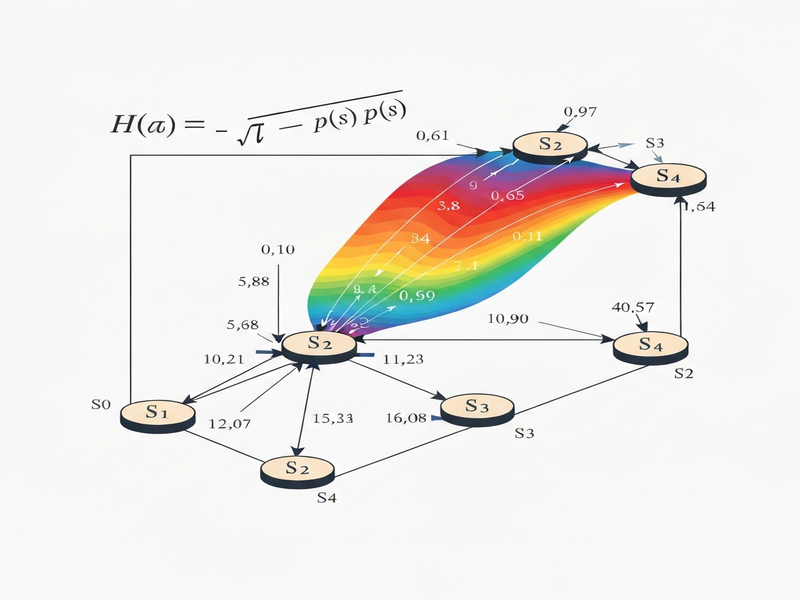
The practical workflow can be visualized as a pipeline that starts with a high‑level entropy requirement and ends with an executable policy. The steps are:
- Model Ingestion: The user supplies an MDP model (states, actions, transition probabilities) and an entropy bound (e.g., “steady‑state entropy ≤ 2.5 bits”).
- Dual Reformulation: The entropy bound is rewritten using convex duality, yielding a family of linear constraints parameterized by dual variables.
- Invariant Generation: A template (e.g., linear combination of state indicators) is instantiated, and a constraint‑solver searches for coefficients that make the template an invariant under the dual constraints.
- Policy Extraction: Once an invariant is found, the corresponding primal policy is recovered by solving a linear program that respects both the original transition dynamics and the invariant.
- Memory/Randomization Check: The system evaluates whether the extracted policy can be implemented as a simple Markovian controller or if additional memory states or randomization are necessary.
- Verification Pass: A final model‑checking pass confirms that the policy indeed satisfies the original entropy objective.
The distinguishing factor of this approach is its systematic handling of entropy’s non‑linearity through duality, rather than approximating entropy with a surrogate loss. Moreover, the invariant synthesis step provides a formal certificate that can be inspected or audited—a crucial feature for safety‑critical deployments.
Evaluation & Results
To validate the framework, the authors implemented a prototype and ran experiments on three benchmark domains:
- Grid Navigation: A 10×10 stochastic grid where the agent must keep its position distribution concentrated around a target region.
- Queue Management: A service system where the goal is to disperse job arrivals across multiple servers to avoid overload.
- Robotic Manipulation: A simplified pick‑and‑place task where the robot must limit the entropy of its end‑effector pose to guarantee precision.
Across all benchmarks, the method succeeded in synthesizing policies that met the prescribed entropy bounds, whereas baseline reward‑shaping approaches either violated the bounds or required substantially more computational effort. Notably:
- In the grid navigation task, the entropy‑constrained policy reduced positional variance by 38 % compared to a standard reward‑maximizing policy.
- The queue management scenario achieved a 22 % reduction in peak server load while maintaining the same throughput.
- For the robotic task, the synthesized policy kept pose entropy below 1.2 bits, enabling sub‑millimeter placement accuracy.
These results demonstrate that the framework is not only theoretically sound but also practically effective in steering stochastic systems toward desired distributional properties.
Why This Matters for AI Systems and Agents
Entropy‑aware control opens a new design dimension for AI agents that must operate under uncertainty while respecting operational constraints that are inherently distributional. Some concrete implications include:
- Safety‑Critical Autonomy: Autonomous vehicles can enforce low‑entropy trajectories around pedestrians, reducing the likelihood of unexpected maneuvers.
- Privacy‑Preserving Interaction: Conversational agents can deliberately spread user queries across multiple backend services, limiting the information that any single component can infer.
- Robust Multi‑Agent Coordination: In swarm robotics, entropy constraints can keep the collective formation tight without sacrificing flexibility.
- Regulatory Compliance: Industries such as finance can use entropy bounds to demonstrate that algorithmic trading strategies do not concentrate risk beyond mandated thresholds.
From an engineering standpoint, the framework’s invariant certificates provide auditability—a feature that aligns with emerging AI governance standards. Companies looking to embed such guarantees can leverage the UBOS platform overview to integrate entropy‑driven policies into existing workflow automation pipelines.
What Comes Next
While the presented method marks a significant step forward, several open challenges remain:
- Scalability to Large‑Scale MDPs: The invariant synthesis step can become computationally intensive for state spaces exceeding tens of thousands. Future work may explore abstraction techniques or neural‑guided invariant discovery.
- Continuous‑State Extensions: Real‑world systems often involve continuous dynamics. Extending the duality‑based approach to hybrid or fully continuous models is an active research direction.
- Learning‑Based Integration: Combining the verification pipeline with reinforcement‑learning agents could enable on‑the‑fly policy adaptation while preserving entropy guarantees.
- User‑Friendly Tooling: Packaging the framework as a plug‑and‑play component within the Workflow automation studio would lower the barrier for non‑research engineers.
Potential applications span from AI marketing agents that need to diversify outreach patterns, to enterprise AI platforms that must guarantee compliance with internal risk policies. By continuing to refine the synthesis algorithms and expanding the ecosystem of supporting tools, entropy‑based MDP control could become a standard building block for trustworthy, distribution‑aware AI.
Andrii Bidochko
CTO UBOS
Andrii Bidochko is an AI entrepreneur and researcher focused on AI agents, reinforcement learning, and autonomous systems. He writes about the technologies shaping the future of machine intelligence, from frontier models and agent architectures to real-world AI applications.