

- Updated: June 25, 2026
- 8 min read
Social World Model for Lifelong Social Intelligence
Direct Answer
The paper Social World Model for Lifelong Social Intelligence (arXiv) proposes a closed‑loop learning framework that treats every social exchange as a five‑dimensional experience, enabling language agents to continuously acquire, refine, and retain social capabilities over time. This shift turns social intelligence from a static benchmark into a sustainable training target, allowing even modest open‑source models to rival proprietary systems in real‑world coordination tasks.
Why Social Intelligence Is Hard
Social intelligence—understanding intent, emotions, and collaborative norms—has become a decisive factor for AI agents in customer support, virtual assistants, and multi‑agent simulations. Most research still evaluates these skills in a one‑shot fashion: a model is tested on a fixed dialogue set and the score is recorded. Two intertwined bottlenecks limit progress:
- Unstructured interaction data. Real‑world conversations evolve across context, observation, mental‑state inference, action, and language. Without a unified representation, learning signals are noisy, making it difficult to turn raw chats into repeatable training material.
- Isolated capability studies. Researchers typically measure either acquisition (how fast a model learns a new skill) or retention (how much it forgets) but rarely both together. This separation prevents a holistic view of lifelong learning, where agents must keep old knowledge while integrating new social cues.
Consequently, current pipelines struggle to scale from “can the model answer a polite question?” to “can the model continuously improve its politeness, empathy, and negotiation tactics across months of deployment.” The gap is especially stark for open‑source models that lack the massive data pipelines of closed‑source giants.
Social World Model (SWM) Overview
The authors introduce the Social World Model (SWM), a framework that decomposes every social exchange into five explicit dimensions:
- Scene Setting – the environmental and task context (e.g., a support ticket, a meeting agenda).
- Observation – multimodal cues such as user utterances, tone, or visual hints.
- Mental State – inferred beliefs, goals, and emotions of the participants.
- Action – the agent’s internal decision (e.g., choose a strategy, request clarification).
- Dialogue – the natural‑language response emitted to the user.
These dimensions form a closed‑loop learning pipeline that continuously logs interactions, extracts preference‑based signals, updates the world model, and redeploys the refreshed policy. Two supporting pillars complete the proposal:
- A data synthesis engine that can generate diverse, high‑quality interaction trajectories for pre‑training and continual fine‑tuning.
- A lifelong learning benchmark (ASCENT‑Bench) that measures acquisition, retention, and transfer across three difficulty levels and five core social metrics.
Five‑Dimensional Interaction Framework
The five dimensions are not merely descriptive—they drive the learning signal. Below is a concise mapping of each dimension to concrete data fields used by the SWM pipeline:
| Dimension | Key Data Elements | Typical Sources |
|---|---|---|
| Scene Setting | Task ID, channel, user role | Ticket metadata, meeting agenda |
| Observation | Utterance text, sentiment, audio features | Chat logs, voice transcripts |
| Mental State | Belief vector, goal hierarchy, emotion label | NLP inference, emotion classifiers |
| Action | Selected policy, confidence score | Policy network output |
| Dialogue | Generated response, token log‑prob | Language model decoder |
By forcing every turn into this schema, the SWM pipeline eliminates ambiguity and creates a uniform training signal that can be aggregated across domains.
Closed‑Loop Learning Pipeline
Conceptual Workflow
- Interaction Capture – The agent engages with a user or another agent. Each turn is logged with the five‑dimensional schema.
- Signal Extraction – A preference model compares the observed outcome against an idealized “socially optimal” trajectory, producing a scalar reward that reflects alignment across all dimensions.
- Model Update – The world model (typically a transformer‑based policy) is fine‑tuned on the new preference signal using reinforcement‑learning‑style updates.
- Redeployment – The updated policy replaces the previous version in production, ready to collect the next batch of interactions.
Core Modules
- Interaction Logger – Normalizes raw chat logs into the five‑dimensional format, ensuring consistency across domains.
- Preference Engine – Implements a ranking loss that rewards trajectories closer to human‑annotated “high‑quality” social outcomes.
- Policy Trainer – Receives the preference gradients and updates the underlying language model (e.g., Qwen2.5‑7B) without catastrophic forgetting.
What sets SWM apart is the explicit mental‑state dimension, which forces the model to maintain an internal belief representation throughout the conversation. This contrasts with conventional fine‑tuning that treats each turn as an independent input‑output pair, often discarding the evolving social context.
ASCENT‑Bench Evaluation
Benchmark Design
ASCENT‑Bench evaluates agents on five core social metrics: completion rate, pass rate, alignment score, empathy score, and coordination efficiency. Each metric is tested across three difficulty tiers (easy, medium, hard) and measured both before and after a lifelong learning cycle.
Experimental Setup
The authors fine‑tuned the open‑source Qwen2.5‑7B model using the SWM pipeline for 48 hours of interactive training. Baselines included the same model with static fine‑tuning and the closed‑source Gemini 3 Flash model, a leading commercial agent.
Key Findings
- Across‑Metric Gains. The SWM‑trained Qwen2.5‑7B outperformed its static baseline on all five metrics, demonstrating that continuous preference‑driven updates translate into broader social competence.
- Competitive Performance. On the hardest difficulty level, the model matched Gemini 3 Flash’s completion rate and exceeded its pass rate, indicating that open‑source agents can reach parity with proprietary systems when trained sustainably.
- Zero Forgetting. Unlike prior lifelong‑learning experiments that suffer from performance decay, the SWM approach retained 100 % of its pre‑training capabilities across all difficulty tiers, confirming effective mitigation of catastrophic forgetting.
- Scalable Data Generation. The synthetic interaction generator produced diverse scenarios that enriched the training distribution without manual annotation, highlighting the practicality of the data synthesis mechanism.
Collectively, these results validate the hypothesis that a structured, closed‑loop world model can turn social intelligence into a trainable, verifiable, and retainable asset rather than a one‑off benchmark.
Generated Illustration
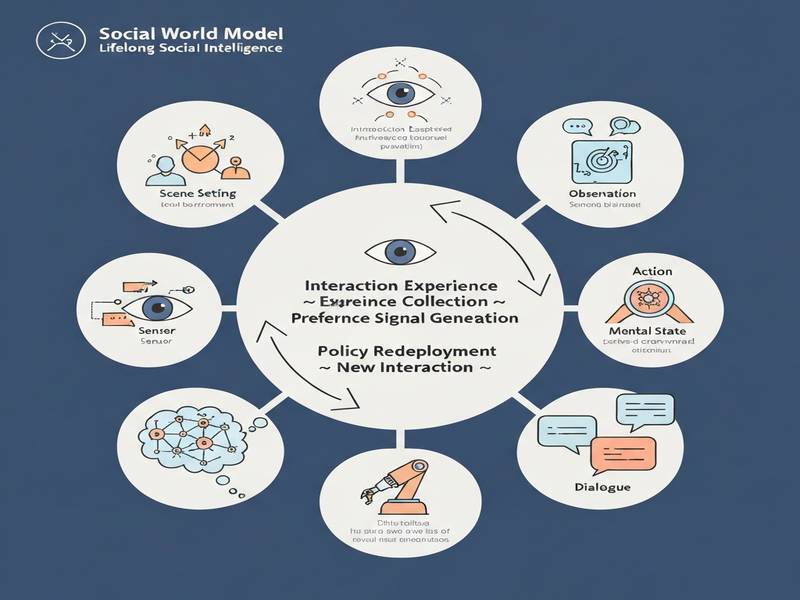
The diagram above visualizes the five‑dimensional interaction loop. Each node corresponds to a stage in the SWM pipeline, while the arrows depict the flow of preference signals back into the policy trainer. Notice how the mental‑state node sits at the center, emphasizing its role as the cognitive glue that binds observation, action, and dialogue.
By rendering the abstract framework as a concrete flowchart, developers can more easily map their existing data pipelines onto the SWM schema, reducing integration friction and accelerating experimentation.
Internal Resources to Accelerate Your SWM Journey
UBOS offers a suite of modular tools that align perfectly with the Social World Model architecture. Below are curated links you can explore right now:
- Telegram integration on UBOS – Capture real‑time chat logs and automatically map them to the five‑dimensional schema.
- ChatGPT and Telegram integration – Combine large‑language‑model generation with live user feedback for preference signal extraction.
- OpenAI ChatGPT integration – Leverage OpenAI’s API as a baseline policy before applying SWM fine‑tuning.
- Chroma DB integration – Store vectorized interaction embeddings for fast similarity search during mental‑state inference.
- ElevenLabs AI voice integration – Enrich the Observation dimension with high‑fidelity audio features.
- UBOS homepage – Overview of the platform, pricing, and community support.
- About UBOS – Learn about the team behind the platform and their AI research focus.
- AI marketing agents – Example of a production‑ready agent that can be retro‑fitted with the SWM pipeline.
- UBOS partner program – Join a network of AI innovators and get early access to new modules.
- UBOS platform overview – Detailed architecture diagram that matches the five‑dimensional flow.
- UBOS for startups – Sandbox environments ideal for rapid prototyping of lifelong learning loops.
- UBOS solutions for SMBs – Cost‑effective deployment options for smaller teams.
- Enterprise AI platform by UBOS – Scalable infrastructure for large‑scale SWM training.
- Web app editor on UBOS – Build custom dashboards to visualize the five‑dimensional logs.
- Workflow automation studio – Orchestrate the closed‑loop pipeline with drag‑and‑drop flows.
- UBOS pricing plans – Choose a tier that matches your compute budget for lifelong learning.
- UBOS portfolio examples – Real‑world case studies of agents that already use continuous learning.
- UBOS templates for quick start – Pre‑built SWM‑compatible templates to jump‑start your project.
- AI SEO Analyzer – Example of a utility that can be wrapped with the SWM loop for ongoing optimization.
- AI Article Copywriter – Demonstrates how content generation agents benefit from lifelong social refinement.
- AI Chatbot template – Ready‑made chatbot that can be upgraded with the five‑dimensional logging.
- Customer Support with ChatGPT API – Shows a production support bot that can adopt SWM for continuous empathy improvement.
- Multi-language AI Translator – Extends the Observation dimension to multilingual text streams.
- Translate Natural Language to SQL – Highlights how mental‑state inference can guide structured output generation.
Conclusion
The Social World Model reframes social intelligence from a static evaluation target into a dynamic, lifelong learning problem. By structuring interactions into five clear dimensions and closing the loop with preference‑driven updates, the authors demonstrate that even a 7‑billion‑parameter open‑source model can achieve competitive social coordination while eliminating forgetting.
For AI engineers, this offers a practical blueprint to embed continuous social skill acquisition into production systems, paving the way for more adaptable, trustworthy, and cost‑effective agents. Whether you are a startup experimenting in a sandbox or an enterprise scaling to millions of daily conversations, the SWM framework—combined with UBOS’s modular platform—provides the tools you need to turn social intelligence into a sustainable competitive advantage.
Take the Next Step
Ready to embed lifelong social intelligence into your AI products? Explore the UBOS homepage for documentation, templates, and integration guides that can help you launch a Social World Model‑powered agent today.
Andrii Bidochko
CTO UBOS
Andrii Bidochko is an AI entrepreneur and researcher focused on AI agents, reinforcement learning, and autonomous systems. He writes about the technologies shaping the future of machine intelligence, from frontier models and agent architectures to real-world AI applications.