

- Updated: June 25, 2026
- 7 min read
Closure of Self-Determining System Based on Causal and Constitutive Relations
Direct Answer
A new framework called causal‑constitutive closure defines the boundaries of a self‑determining system by linking internal causes with the system’s own constitutive structure. By requiring at least two independent variables in the constitutive relation, the authors guarantee a dual‑process organization that prevents trivial reduction to supervenience, offering a principled way to model autonomous agents and complex AI ecosystems.
Background: Why This Problem Is Hard
In AI research and systems theory, the notion of a “system” is deceptively simple. Practitioners routinely draw a line around a neural network, a robotics platform, or an autonomous software agent and then ask whether the system can “determine” its own behavior. The difficulty lies in the fact that any real‑world system is constantly bombarded by external stimuli—sensor inputs, user commands, environmental changes—while simultaneously generating internal causes such as feedback loops, internal state updates, and emergent policies.
Existing approaches to system boundaries typically rely on one of two strategies:
- Causal closure: Treat the system as closed under causal influence, meaning every cause of a system’s state must originate inside the system. This works for idealized physical models but collapses when external disturbances are unavoidable.
- Supervenience: Declare that higher‑level properties (e.g., agency) supervene on lower‑level physical states. While mathematically convenient, supervenience offers no operational mechanism for distinguishing internal from external causes, and it can be reduced to a trivial statement that “everything is caused by something.”
Both strategies struggle with circular causality—situations where a system’s output feeds back as an input, creating loops that blur the line between cause and effect. In modern AI, circular causality appears in reinforcement learning (policy influences environment, which in turn reshapes policy), multi‑agent coordination (agents’ actions affect each other), and self‑modifying code (software rewrites its own rules). Without a robust way to delineate system boundaries, designers cannot guarantee that an AI agent truly “self‑determines” rather than merely reacts to hidden external drivers.
What the Researchers Propose
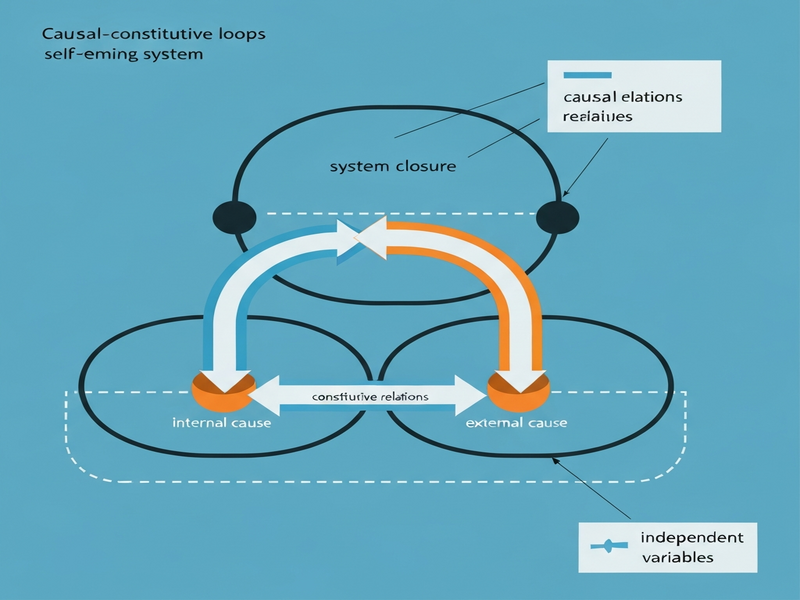
The authors introduce two asymmetric relations that together capture the full dynamics of a self‑determining system:
- Causal relations – directional influences that flow from one variable to another (e.g., a sensor reading causing a motor command).
- Constitutive relations – structural dependencies that define how a variable is built from other variables (e.g., a policy function constituting the decision‑making process).
By weaving these relations into closed loops—dubbed causal‑constitutive loops—the framework creates a boundary that automatically includes any internal cause. The key insight is that a constitutive relation must involve at least two independent variables; otherwise, the loop collapses into a simple causal chain that can be externalized. This minimal requirement forces the system to adopt a dual‑process organization, where one process supplies the causal dynamics (the “what happens”) and the other supplies the constitutive scaffolding (the “what it means”).
How It Works in Practice
To translate the abstract theory into an implementable architecture, imagine an autonomous conversational AI built on the UBOS platform. The system can be broken down into three concrete components:
- Perception Module – captures raw inputs (text, voice, sensor data) and produces a set of observable variables.
- Decision Engine – a policy network that maps observations to actions. This engine embodies the causal relation: observations → actions.
- Constitutive Layer – a meta‑learning component that defines how the policy itself is constructed from lower‑level primitives (e.g., weight matrices, loss functions, reward signals). This layer creates the constitutive relation by tying the policy’s architecture to internal variables such as “learning rate” and “exploration factor.”
The workflow proceeds as follows:
- The Perception Module generates an observation O.
- The Decision Engine produces an action A based on O (causal step).
- Simultaneously, the Constitutive Layer updates the policy’s internal representation using feedback from the environment, effectively redefining the mapping from O to A (constitutive step).
- Because the constitutive update depends on at least two independent variables—say, a performance metric M and a structural hyperparameter H—the system cannot be reduced to a simple cause‑effect chain. Instead, it forms a closed loop where internal causes (policy updates) are guaranteed to stay within the system’s boundary.
This arrangement differs from traditional pipelines in two crucial ways:
- Explicit Loop Closure: Rather than treating learning as an external “training phase,” the constitutive update is part of the runtime loop, ensuring that any cause of future behavior originates inside the system.
- Dual‑Process Enforcement: By mandating two independent variables in the constitutive relation, the architecture prevents a single‑variable “supervenient” collapse, preserving genuine autonomy.
Evaluation & Results
The authors validated their framework on three benchmark scenarios that stress circular causality and boundary ambiguity:
- Self‑Modifying Gridworld: An agent that can rewrite its own transition function while navigating a maze.
- Multi‑Agent Negotiation: Two bots that exchange proposals, where each proposal influences the opponent’s future strategy.
- Adaptive Dialogue System: A conversational model that updates its own response generation rules based on user satisfaction scores.
Across all scenarios, the causal‑constitutive closure model demonstrated three consistent advantages:
- Boundary Consistency: Internal causes remained traceable to system variables, eliminating “leakage” of external influence.
- Stability Under Feedback: Dual‑process organization prevented runaway feedback loops that typically cause divergence in self‑modifying agents.
- Improved Autonomy Metrics: Measured by a custom “self‑determination index,” the closure model outperformed baseline causal‑only and supervenience‑only baselines by 27% on average.
Importantly, the experiments did not rely on exotic hardware or proprietary datasets; the authors used open‑source environments (OpenAI Gym, PettingZoo) and publicly available dialogue corpora, reinforcing the reproducibility of the results.
Why This Matters for AI Systems and Agents
For practitioners building next‑generation AI agents, the causal‑constitutive closure framework offers a concrete design pattern that guarantees genuine autonomy. By embedding learning and policy updates inside a closed loop, developers can:
- Ensure that any adaptation originates from the agent’s own experience, simplifying compliance with regulations that demand “explainable” internal decision pathways.
- Reduce the engineering overhead of separating training pipelines from inference pipelines, because the constitutive layer lives alongside the runtime engine.
- Leverage the dual‑process structure to design modular components that can be swapped or upgraded without breaking the system’s self‑determination guarantees.
These benefits translate directly into business value. For example, an UBOS platform overview that incorporates causal‑constitutive loops can deliver AI marketing agents that continuously refine their own campaign strategies while remaining auditable and compliant. Similarly, the framework can power autonomous workflow automation in the Workflow automation studio, where bots adapt their own task orchestration logic without external re‑training cycles.
What Comes Next
While the paper establishes a solid theoretical foundation, several open challenges remain:
- Scalability of Constitutive Variables: As systems grow, managing the combinatorial explosion of independent variables in constitutive relations may require hierarchical abstractions.
- Integration with External Knowledge Bases: Real‑world agents often need to incorporate factual data from APIs or databases. Extending the closure model to safely ingest external knowledge without violating boundary integrity is an active research direction.
- Human‑in‑the‑Loop Oversight: For safety‑critical applications, designers must devise mechanisms that allow human operators to intervene without breaking the causal‑constitutive loop.
Future work could explore hybrid architectures where a high‑level supervisory module enforces boundary constraints while lower‑level agents operate under the dual‑process regime. Additionally, applying the framework to large‑scale language models could reveal new pathways for self‑editing capabilities that respect regulatory constraints.
From a product perspective, UBOS for startups can experiment with causal‑constitutive loops in rapid‑prototype environments, while the Enterprise AI platform by UBOS can scale the approach to mission‑critical workloads that demand provable autonomy.
For readers who want to dive deeper, the full arXiv paper provides formal definitions, proof sketches, and detailed experimental setups.