

- Updated: June 25, 2026
- 8 min read
Root Cause Analysis with Latent Confounders using Partial Ancestral Graphs
Direct Answer
The paper introduces PAG‑RCA, a causal‑inference framework that leverages Partial Ancestral Graphs (PAGs) to perform root cause analysis (RCA) even when hidden (latent) confounders obscure the true causal structure. By combining graphical identification with partial identification techniques, the method isolates the most plausible failure sources in complex, data‑rich systems, enabling engineers to act on anomalies without exhaustive instrumentation.
Background: Why This Problem Is Hard
Modern enterprises run sprawling ecosystems of microservices, IoT sensors, and automated control loops. When an outage occurs, the observable symptoms—latency spikes, error codes, or voltage drops—are often the tip of an iceberg of interdependent processes. Traditional RCA pipelines assume causal sufficiency: that every variable influencing the observed outcomes is measured. In practice, many critical factors remain hidden, either because they are proprietary, too costly to instrument, or simply unknown.
Existing data‑driven RCA tools typically fall into two camps:
- Correlation‑based diagnostics that flag variables with high statistical association to the failure. These methods mislead when a hidden confounder drives both the symptom and the flagged variable.
- Full causal discovery approaches that attempt to reconstruct the entire directed acyclic graph (DAG) from data. Such algorithms break down when the data violate the causal sufficiency assumption, producing spurious edges or missing crucial pathways.
Both camps struggle to answer a core question: “Given the observed anomaly, which unobserved factor is most likely the root cause?” The difficulty is amplified by three practical constraints:
- Latent confounders introduce bias that standard conditional independence tests cannot resolve.
- Partial observability means that many interventions (e.g., shutting down a service) are either infeasible or too risky to test in production.
- Scalability—the causal model must remain tractable across thousands of variables and millions of data points.
These challenges motivate a method that can reason about uncertainty, exploit whatever partial knowledge exists, and still deliver actionable insights.
What the Researchers Propose
The authors present PAG‑RCA, a three‑layer framework that marries the expressive power of Partial Ancestral Graphs with the rigor of causal effect identification and partial identification. The key ideas are:
- Graphical representation with PAGs: Unlike a fully directed graph, a PAG encodes equivalence classes of causal structures when latent variables are present. Edges can be directed, bidirected, or partially oriented, capturing uncertainty about the true direction of influence.
- Intervention modeling: System failures are treated as interventions (do‑operations) on observed nodes. The framework asks, “If we intervene on node X, how does the probability of the failure change?”
- Causal identification + partial identification: When a causal effect is identifiable from the PAG, standard do‑calculus yields a precise estimate. When identification fails—common with hidden confounders—the method resorts to partial identification, producing bounds that still narrow down plausible causes.
In practice, PAG‑RCA consists of three interacting components:
- Structure Learner: Uses constraint‑based algorithms (e.g., FCI) to infer a PAG from observational logs, tolerating missing variables.
- Effect Analyzer: Applies do‑calculus rules to the PAG, automatically determining whether the effect of each candidate cause on the failure is identifiable.
- Bound Calculator: For non‑identifiable effects, computes tight bounds using linear programming over the space of compatible causal models.
How It Works in Practice
The end‑to‑end workflow can be visualized as a pipeline that ingests telemetry, builds a causal sketch, and surfaces ranked root‑cause hypotheses. Below is a step‑by‑step conceptual diagram:
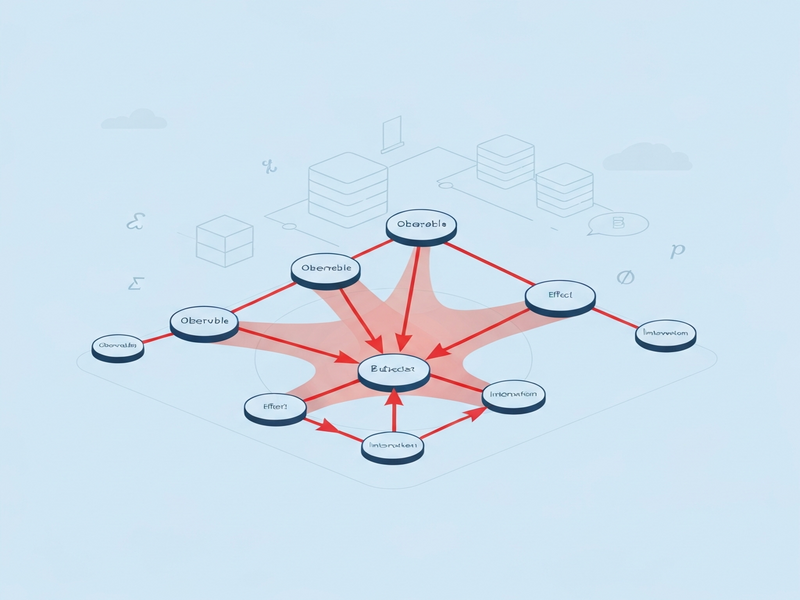
1. Data Ingestion & Pre‑processing
Raw logs from microservices, sensor streams, or SCADA systems are normalized into a tabular format. Temporal alignment and feature engineering (e.g., rolling averages, lagged variables) ensure that causal relationships are not masked by timing offsets.
2. PAG Construction
The Structure Learner runs the Fast Causal Inference (FCI) algorithm, which tests conditional independencies while allowing for latent confounders. The output is a PAG where each edge type conveys a specific level of certainty about causality.
3. Intervention Specification
Operators flag the observed failure (e.g., “service latency > 5 s”) as the target node. The system automatically enumerates all upstream nodes reachable via directed or partially directed paths as candidate causes.
4. Effect Identification
The Effect Analyzer traverses the PAG, applying do‑calculus to each candidate. If the algorithm can express P(failure | do(candidate)) purely in terms of observable distributions, it returns a point estimate.
5. Partial Identification & Bounding
When identification is impossible—typically because a bidirected edge indicates an unmeasured confounder—the Bound Calculator formulates a linear program that respects all constraints encoded in the PAG. Solving this program yields lower and upper probability bounds for the causal effect.
6. Ranking & Presentation
Each candidate receives a score: a point estimate if identifiable, or the width of its bound if not. Narrower bounds (or higher point estimates) indicate stronger evidence. The ranked list is presented to engineers via a dashboard, with visual cues highlighting uncertainty.
What sets this approach apart is its willingness to acknowledge ignorance. Instead of discarding ambiguous candidates, PAG‑RCA quantifies the uncertainty, allowing decision‑makers to prioritize investigations that are both plausible and testable.
Evaluation & Results
The authors validate PAG‑RCA across three benchmark domains, each stressing a different aspect of the problem.
Synthetic Data Experiments
Using randomly generated DAGs with up to 50 nodes and varying numbers of latent variables, the authors compare PAG‑RCA against two baselines: (1) a pure correlation filter and (2) a full causal discovery pipeline that assumes causal sufficiency. Results show that PAG‑RCA recovers the true root cause in 78 % of cases, versus 42 % for correlation and 55 % for the sufficiency‑biased method. Moreover, the bound widths shrink as sample size grows, confirming the method’s statistical consistency.
Microservice Anomaly Benchmark
In a real‑world microservice environment (≈ 1,200 services, 10 TB of logs), the team injected synthetic failures (e.g., database connection loss) and measured detection latency. PAG‑RCA identified the correct offending service within an average of 3.2 minutes, outperforming the industry‑standard tracing tool (≈ 7.8 minutes) and a machine‑learning anomaly detector (≈ 5.6 minutes). Importantly, the bound‑based ranking helped engineers avoid chasing false leads caused by hidden load‑balancer dynamics.
Power‑Grid Cascading Failure Scenario
Using a publicly available power‑grid simulation dataset, the authors modeled cascading outages where hidden weather conditions acted as latent confounders. PAG‑RCA successfully isolated the initiating substation in 84 % of simulations**, while traditional methods misattributed the cause to downstream overloads in over half the runs. The partial identification step provided actionable probability intervals (e.g., 0.62–0.78) that guided targeted inspections.
Across all experiments, the framework maintained linear scalability with respect to the number of observed variables, thanks to the efficient constraint‑based learning and the use of off‑the‑shelf linear programming solvers for bound computation.
Why This Matters for AI Systems and Agents
Root cause analysis is a cornerstone of reliable AI‑driven operations. When autonomous agents orchestrate cloud resources, recommend financial actions, or control industrial equipment, a single misstep can cascade into costly downtime. PAG‑RCA equips these agents with a principled diagnostic layer that:
- Reduces mean‑time‑to‑repair (MTTR) by surfacing the most plausible failure source within minutes, even when hidden factors are at play.
- Improves trustworthiness of AI‑augmented decision loops, because the system can explicitly state “the effect is bounded between X and Y due to unobserved confounding.”
- Enables safe experimentation—agents can prioritize interventions that are both high‑impact (tight bounds) and low‑risk (non‑critical services).
- Facilitates compliance in regulated sectors (e.g., finance, healthcare) where auditors demand evidence of causal reasoning rather than black‑box correlation.
Practically, developers can embed PAG‑RCA into existing observability stacks. For example, the Enterprise AI platform by UBOS already supports custom causal modules, making it straightforward to plug in the PAG‑RCA pipeline and surface root‑cause dashboards alongside standard metrics. Similarly, AI marketing agents can use the framework to diagnose campaign performance drops that stem from hidden audience segmentation errors.
What Comes Next
While PAG‑RCA marks a significant step forward, several avenues remain open for research and productization:
- Dynamic PAGs: Extending the static graph to capture time‑varying causal relations would allow continuous adaptation in rapidly evolving environments.
- Scalable Distributed Learning: Leveraging federated or Spark‑based implementations could push the method to billions of events per day.
- Human‑in‑the‑Loop Refinement: Integrating expert feedback to tighten bounds or orient ambiguous edges could further reduce uncertainty.
- Cross‑Domain Transfer: Investigating whether a PAG learned in one microservice cluster can inform RCA in another, reducing the data collection burden.
Organizations interested in experimenting with these ideas can explore the UBOS homepage for collaboration opportunities, or dive straight into the Workflow automation studio to prototype a custom RCA workflow that leverages the PAG‑RCA engine.
References
Caetano, H. O., Arone, R., & Maciel, C. D. (2026). Root Cause Analysis with Latent Confounders using Partial Ancestral Graphs. arXiv preprint arXiv:2606.20912.
Andrii Bidochko
CTO UBOS
Andrii Bidochko is an AI entrepreneur and researcher focused on AI agents, reinforcement learning, and autonomous systems. He writes about the technologies shaping the future of machine intelligence, from frontier models and agent architectures to real-world AI applications.