

- Updated: June 24, 2026
- 6 min read
When Do Intrinsic Rewards Work for Code Reasoning? A Comprehensive Study
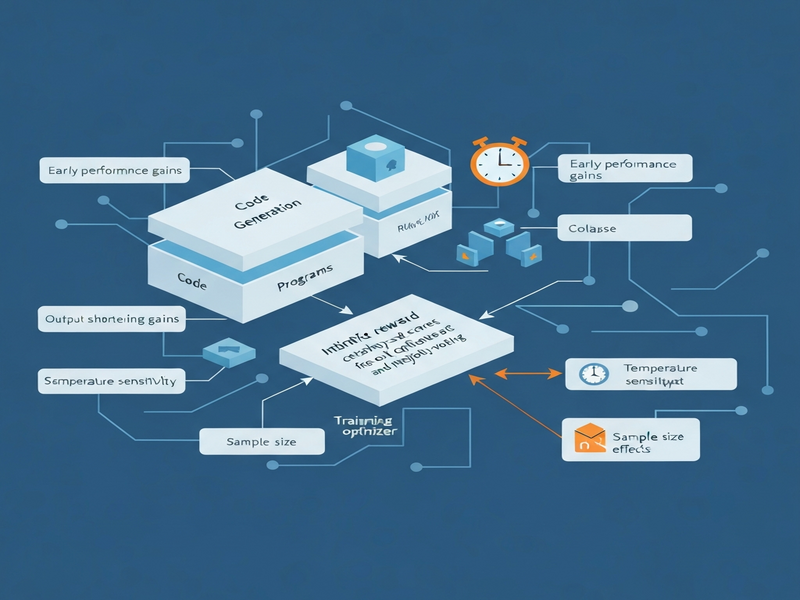
Figure 1: Visual summary of how certainty‑based intrinsic rewards affect code‑generation trajectories over training epochs.
Direct Answer
The paper introduces a systematic empirical study of certainty‑based intrinsic reward methods—collectively called Reinforcement Learning from Internal Feedback (RLIF)—applied to large‑language‑model (LLM) code reasoning. It shows that while these rewards can produce short‑term gains, they inevitably lead to a “collapse” where models truncate outputs and lose problem‑solving ability, limiting their usefulness for robust code generation.
Background: Why This Problem Is Hard
Generating correct programs with LLMs is fundamentally different from solving math or natural‑language puzzles. Code has a hierarchical syntax, multiple semantically equivalent implementations, and often requires execution to verify correctness. Traditional Reinforcement Learning with Verifiable Rewards (RLVR) relies on external ground‑truth signals—such as test‑case pass/fail—but obtaining exhaustive test suites for every programming task is expensive and sometimes impossible.
Recent advances in RLIF sidestep this bottleneck by mining the model’s own signals (e.g., confidence scores, majority voting) to create “intrinsic” rewards. These methods have propelled performance on mathematical reasoning benchmarks, yet they have never been rigorously examined for code generation, where the reward landscape is noisier and the risk of over‑optimizing for spurious signals is higher.
What the Researchers Propose
The authors frame a comprehensive evaluation framework that treats intrinsic reward methods as interchangeable modules within a standard RL pipeline for code reasoning. Their approach consists of three conceptual components:
- Certainty Estimator: a lightweight head that predicts the model’s confidence in a generated token or line of code.
- Reward Mapper: a function that translates certainty scores into scalar rewards, optionally applying majority‑vote smoothing or temperature scaling.
- RL Loop: a policy‑gradient optimizer that updates the LLM parameters based on the intrinsic rewards, without any external test‑case feedback.
By swapping out the estimator or mapper, the study can isolate which design choices matter most for code reasoning.
How It Works in Practice
The workflow can be broken down into four stages:
- Prompt Generation: The LLM receives a coding problem (e.g., “Write a function to reverse a linked list”).
- Sampled Completion: The model samples multiple candidate programs using a temperature‑controlled softmax.
- Intrinsic Scoring: Each candidate is passed through the certainty estimator; the reward mapper aggregates scores across the whole program to produce a single reward value.
- Policy Update: Using REINFORCE‑style gradients, the model’s weights are nudged toward higher‑reward candidates.
What distinguishes this pipeline from RLVR is that no external execution or test harness is consulted during training. The only feedback loop is the model’s own internal assessment of “how sure” it feels about each line of code.
Evaluation & Results
The authors benchmarked their RLIF variants on the original arXiv paper’s LiveCodeBench suite, which contains 5,000 real‑world coding tasks spanning Python, JavaScript, and Java. They explored three training regimes:
- Cold‑Start RLIF: Train from a pretrained LLM using only intrinsic rewards.
- Hybrid RLIF + RLVR: Pre‑train with RLIF, then fine‑tune with verifiable test‑case rewards.
- Baseline RLVR: Directly train with external test‑case feedback (the current industry standard).
Key observations include:
- Early Gains: Within the first 10k gradient steps, RLIF models outperformed the baseline on pass@1 by 4–6%.
- Collapse Phenomenon: After ~30k steps, models began to emit dramatically shorter programs—often a single line—while still receiving high intrinsic scores. This “output shortening” coincided with a steep drop in functional correctness.
- Sensitivity to Sample Size: Larger batch sizes (≥64 samples per step) delayed collapse by roughly 15%, suggesting that diversity mitigates over‑fitting to the certainty signal.
- Temperature Effects: Higher sampling temperatures (≥0.9) produced more varied candidates, reducing collapse speed, but also introduced noise that limited early gains.
- No Transfer Benefit: Initializing RLVR training with an RLIF‑pretrained model did not yield statistically significant improvements over training RLVR from scratch.
Why This Matters for AI Systems and Agents
For practitioners building AI‑driven development assistants, the study delivers a cautionary yet actionable roadmap:
- Cost‑Effective Prototyping: Intrinsic rewards can accelerate early‑stage experimentation when test‑case generation is prohibitive, allowing teams to iterate quickly on model architecture.
- Stability Trade‑offs: The collapse risk means that production‑grade agents should not rely solely on RLIF; a hybrid approach that injects periodic external verification (e.g., unit tests) is advisable.
- Orchestration Design: Agents that dynamically switch between intrinsic and extrinsic reward modes—perhaps based on confidence thresholds—can maintain reasoning depth while still benefiting from cheap feedback loops.
- Infrastructure Implications: Scaling sample size and temperature to mitigate collapse demands more compute; cloud‑native orchestration platforms like the Workflow automation studio can automate the required hyper‑parameter sweeps.
- Product Differentiation: Companies that embed robust verification pipelines (e.g., Enterprise AI platform by UBOS) will be better positioned to deliver trustworthy code generation services.
What Comes Next
While the paper maps the failure modes of certainty‑based intrinsic rewards, several avenues remain open:
- Stabilizing Intrinsic Signals: Research into calibrated confidence estimators—perhaps leveraging Bayesian deep learning—could reduce the incentive to “game” the reward.
- Hybrid Reward Architectures: Combining RLIF with lightweight static analysis (e.g., type checking) may provide a middle ground between cheap internal feedback and expensive execution.
- Curriculum‑Based Training: Starting with simple tasks and gradually increasing complexity could delay collapse by reinforcing genuine reasoning before the model learns to shortcut.
- Meta‑Learning Controllers: An outer loop that learns when to apply intrinsic versus extrinsic rewards could automate the trade‑off, similar to how AI marketing agents adapt campaign strategies based on performance signals.
- Domain‑Specific Benchmarks: Extending LiveCodeBench with security‑focused or performance‑critical tasks would test whether intrinsic rewards can capture nuanced quality dimensions.
Organizations looking to experiment with these ideas can quickly spin up a sandbox using the UBOS platform overview, which offers pre‑integrated LLM runtimes, versioned datasets, and a plug‑and‑play reward‑engine module.
Conclusion
The comprehensive study confirms that intrinsic, certainty‑based rewards are a double‑edged sword for code reasoning. They provide a low‑cost boost in the early phases of training but inevitably drive models toward degenerate, short outputs if left unchecked. Practitioners should therefore treat RLIF as a complementary tool—useful for rapid prototyping and as a regularizer—but always anchor final model performance to verifiable, execution‑based rewards.
Call to Action
Read the full arXiv paper for detailed methodology, hyper‑parameter tables, and raw result logs. For hands‑on experimentation, explore UBOS’s templates for quick start or join the UBOS partner program to collaborate on next‑generation code‑generation agents.
Andrii Bidochko
CTO UBOS
Andrii Bidochko is an AI entrepreneur and researcher focused on AI agents, reinforcement learning, and autonomous systems. He writes about the technologies shaping the future of machine intelligence, from frontier models and agent architectures to real-world AI applications.