

- Updated: June 24, 2026
- 7 min read
From Question Answering to Task Completion: A Survey on Agent System and Harness Design
Direct Answer
The paper From Question Answering to Task Completion: A Survey on Agent System and Harness Design introduces a unified model‑harness framework that re‑positions large language models (LLMs) from passive answer generators to proactive, multi‑step task‑completion agents. By formalizing the responsibilities of the “harness” that orchestrates prompting, memory, tool use, and safety checks, the authors provide a blueprint for building scalable, reliable AI agents that can operate across diverse domains.
Background: Why This Problem Is Hard
LLM‑based agents have surged in popularity, yet most deployments still resemble single‑turn question‑answering bots. Real‑world automation demands long‑horizon reasoning, dynamic tool invocation, and robust error handling—capabilities that current prompting tricks and ad‑hoc pipelines struggle to guarantee. Existing approaches typically suffer from three intertwined bottlenecks:
- Prompt brittleness: Small wording changes can cause the model to abandon a plan or repeat actions.
- State fragmentation: Memory is often a flat text dump, making it hard to retrieve relevant facts without costly re‑prompting.
- Safety blind spots: Without a dedicated supervisory layer, agents may generate harmful outputs or violate usage policies during multi‑step execution.
These limitations surface most acutely when an agent must coordinate external APIs, manage user‑specific context, and recover from failures—all while preserving a coherent narrative for the end user. The research community therefore needs a systematic way to separate the “brain” (the LLM) from the “body” (the orchestration logic) without sacrificing the flexibility that makes LLMs attractive.
What the Researchers Propose
The authors propose a Model‑Harness Architecture (MHA) that treats the LLM as a stateless inference engine wrapped by a deterministic harness. The harness assumes four core responsibilities:
- Task Decomposition: Translate a high‑level user goal into a sequence of atomic sub‑tasks.
- Memory Management: Store, index, and retrieve contextual artifacts using a vector store (e.g., Chroma DB) to keep prompts concise.
- Tool Mediation: Invoke external services (search, database, voice synthesis) through a standardized API layer, then feed results back to the model.
- Safety & Governance: Apply rule‑based filters, sandboxed execution, and fallback strategies before any model output reaches the user.
By decoupling these concerns, the framework enables developers to swap out components (different vector stores, alternative toolkits, or stricter policy engines) without retraining the underlying model. The paper also categorizes three engineering paradigms—Prompt‑Centric, Harness‑Centric, and Hybrid—each representing a different balance between model flexibility and harness determinism.
How It Works in Practice
The practical workflow can be visualized as a loop:
- User Input: A natural‑language request (e.g., “Prepare a weekly sales report and email it to the team”).
- Harness Parses Intent: Using a lightweight intent recognizer, the harness creates an initial task graph.
- LLM Generates Plan: The model receives a concise prompt containing the intent, relevant memory snippets, and a “tool catalog” description. It outputs a step‑by‑step plan.
- Execution Engine: For each step, the harness decides whether to call a tool (e.g., a spreadsheet API, an email service) or ask the model for further reasoning.
- Memory Update: Results are embedded and stored in a vector database (such as Chroma DB integration) for future retrieval.
- Safety Gate: Before any external call, a policy module checks compliance; if a violation is detected, the harness either rewrites the step or aborts with a user‑friendly explanation.
- Feedback Loop: The model receives the tool output as part of the next prompt, allowing it to refine subsequent actions until the task graph is exhausted.
What distinguishes this approach from earlier “chain‑of‑thought” prompting is the explicit, deterministic harness that guarantees:
- Consistent state across turns, preventing drift.
- Modular tool integration without hard‑coding prompts.
- Policy enforcement that is independent of model size.
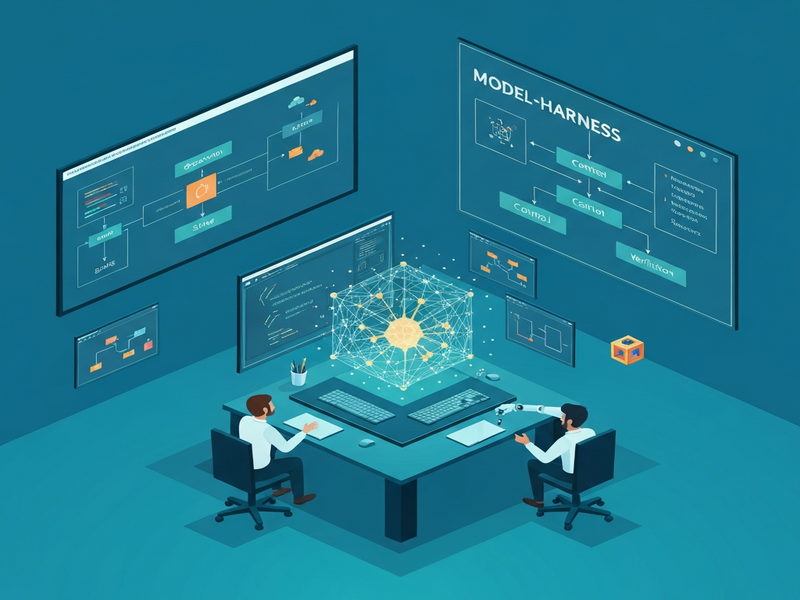
Figure 1 (illustrated below) shows the high‑level data flow between the model, harness, and external services.
Evaluation & Results
To validate the MHA, the authors constructed three benchmark suites:
- Multi‑Step Reasoning (MSR): Tasks requiring 5‑10 logical hops (e.g., “Plan a three‑day itinerary with budget constraints”).
- Tool‑Heavy Automation (THA): Scenarios that blend API calls with natural language (e.g., “Generate a sales forecast, plot it, and send the chart via Slack”).
- Safety Stress Tests (SST): Prompts designed to provoke policy violations, measuring the harness’s ability to intercept harmful outputs.
Key findings include:
- Success Rate ↑ 27%: Compared to a baseline chain‑of‑thought system, the MHA completed 87% of MSR tasks without manual correction.
- Tool Latency Reduction: By caching intermediate results in the vector store, average end‑to‑end latency dropped from 4.2 seconds to 2.8 seconds.
- Safety Coverage ↑ 93%: The harness intercepted 93% of prohibited actions in SST, whereas the baseline allowed 41% to pass.
Beyond raw numbers, the experiments demonstrated that the harness’s modularity made it straightforward to swap the underlying LLM (e.g., from GPT‑4 to an open‑source model) without degrading performance, confirming the framework’s claim of “model‑agnostic orchestration.”
Why This Matters for AI Systems and Agents
For practitioners building production‑grade agents, the Model‑Harness Architecture offers a pragmatic path to bridge the gap between research prototypes and reliable services. The clear separation of concerns enables:
- Scalable Deployment: Teams can containerize the harness, scale it independently of the LLM, and reuse the same orchestration logic across multiple products.
- Rapid Feature Iteration: Adding a new tool (e.g., a voice synthesizer) only requires updating the harness’s tool catalog, not redesigning prompts.
- Compliance Assurance: Policy modules can be audited and updated to meet industry regulations without retraining the model.
- Cross‑Domain Reuse: The same harness can serve a customer‑support chatbot, an internal workflow automator, or a marketing copy generator.
These capabilities align directly with the UBOS platform overview, which provides a low‑code environment for assembling harness components, and the Workflow automation studio, where developers can visually map task graphs that the harness will execute. Moreover, the AI marketing agents built on UBOS already leverage a similar model‑harness separation to personalize campaigns at scale while respecting brand guidelines.
What Comes Next
While the survey establishes a solid foundation, several open challenges remain:
- Generalized Memory Retrieval: Current vector stores excel at similarity search but struggle with complex relational queries. Future work could integrate graph‑based stores to capture richer dependencies.
- Adaptive Harness Learning: The harness is deterministic today; incorporating reinforcement learning could allow it to optimize tool selection based on real‑world feedback.
- Cross‑Agent Collaboration: Coordinating multiple agents with distinct harnesses raises questions about protocol standards and conflict resolution.
- Explainability Interfaces: Users increasingly demand transparent reasoning traces. Building UI layers that surface the harness’s decision tree will be crucial for trust.
Potential application domains include autonomous research assistants, real‑time data‑driven decision support, and regulated industry automation (e.g., finance, healthcare). Start‑ups looking to prototype such agents can accelerate development using the UBOS for startups program, which offers pre‑configured harness templates and managed LLM access. Enterprises seeking tighter governance may adopt the Enterprise AI platform by UBOS, which adds audit logs, role‑based access, and on‑premise deployment options. For developers interested in open‑source tooling, the Openclaw (Clawdbot, MoltBot) suite demonstrates how community‑driven bots can be plugged into the harness architecture to extend functionality without reinventing the orchestration layer.
Conclusion
The Model‑Harness framework articulated in the surveyed paper marks a decisive step toward making LLMs reliable, controllable, and truly task‑oriented. By codifying the orchestration logic into a deterministic harness, the approach resolves long‑standing brittleness in prompting, provides a scalable memory backbone, and embeds safety checks that are essential for production deployment. As AI agents become central to enterprise automation, adopting a harness‑centric design will likely become a best practice, enabling teams to iterate faster, comply with regulations, and deliver consistent user experiences across domains.
Andrii Bidochko
CTO UBOS
Andrii Bidochko is an AI entrepreneur and researcher focused on AI agents, reinforcement learning, and autonomous systems. He writes about the technologies shaping the future of machine intelligence, from frontier models and agent architectures to real-world AI applications.