

- Updated: June 24, 2026
- 8 min read
Democratizing and accelerating AI-driven pathology research through agentic intelligence
Direct Answer
PathLab is an autonomous, agent‑driven framework that converts natural‑language research goals into fully validated computational pathology pipelines. By encapsulating data handling, model training, evaluation, and interpretation into reusable “skill modules,” PathLab lets pathologists and AI engineers design studies without writing a single line of code, dramatically lowering the barrier to state‑of‑the‑art AI in histopathology.
Background: Why This Problem Is Hard
Computational pathology has become a showcase for deep‑learning breakthroughs—whole‑slide image (WSI) classification, tumor segmentation, and survival prediction now rival expert performance. Yet the practical adoption curve remains steep for three intertwined reasons:
- Technical complexity: Modern pipelines require stitching together heterogeneous tools—image tiling, stain normalization, GPU‑accelerated training, and statistical survival analysis—each with its own configuration quirks.
- Programming expertise: Researchers must be fluent in Python, PyTorch/TensorFlow, and domain‑specific libraries (e.g., OpenSlide, MONAI). The learning curve excludes many clinicians who possess the scientific insight but lack software engineering skills.
- Reproducibility friction:
- Even when a pipeline is built, reproducing it across institutions demands meticulous version control, environment management, and data‑privacy compliance, which are rarely documented in academic papers.
Existing solutions—open‑source notebooks, GUI wrappers, or cloud‑based AutoML services—address only a slice of this problem. Notebooks still require manual code edits; GUI tools often lock users into a single model family; AutoML platforms lack the flexibility to incorporate domain‑specific preprocessing or interpretability steps. Consequently, the majority of pathology labs either outsource AI to vendors or abandon promising research ideas altogether.
What the Researchers Propose
The authors introduce PathLab, an agentic orchestration layer that treats a research objective as a high‑level “intent” rather than a script. The framework is built around three core concepts:
- Natural‑Language Prompt Engine: Users describe the scientific question (e.g., “Predict 5‑year survival from H&E slides of lung adenocarcinoma”) in plain English. The engine parses the prompt, validates semantic consistency, and maps it to a workflow template.
- Domain‑Specific Skill Modules: Each module encapsulates a well‑defined operation—data ingestion, stain normalization, patch extraction, model architecture selection, hyper‑parameter tuning, evaluation metric computation, or visual explanation. Modules expose a declarative interface (inputs, outputs, constraints) that agents can compose automatically.
- Autonomous Agent Coordinator: A hierarchy of LLM‑powered agents negotiates module selection, resolves dependency conflicts, and generates executable code snippets. The coordinator also monitors runtime, captures logs, and triggers post‑hoc validation checks before releasing results to the user.
By separating “what” (the research intent) from “how” (the technical implementation), PathLab enables a reusable, MECE‑structured library of methodological building blocks that can be recombined on demand.
How It Works in Practice
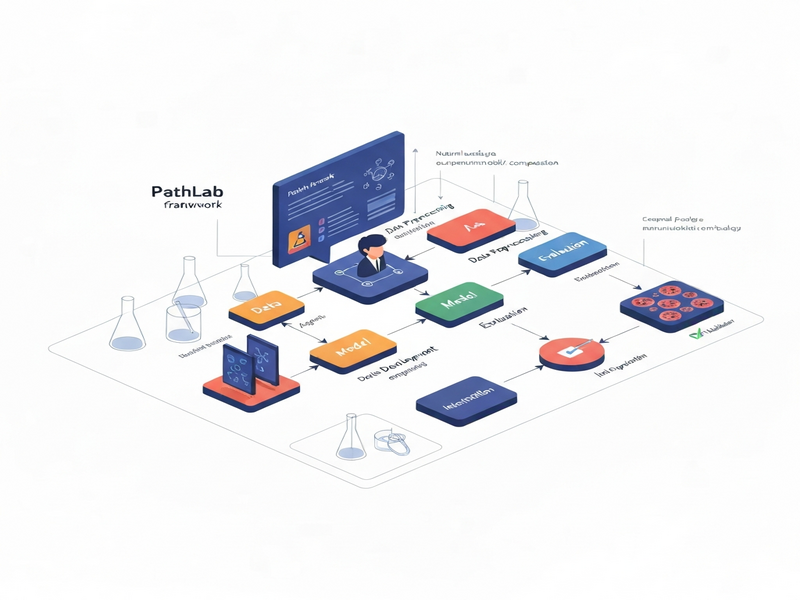
The end‑to‑end workflow can be visualized as a three‑stage pipeline, illustrated below:
Stage 1 – Intent Capture & Validation
- The user submits a natural‑language prompt via a web UI or API.
- An LLM‑backed parser extracts key entities: target task (classification, segmentation, survival), data modality (WSI, ROI), and performance constraints (e.g., AUROC > 0.85).
- If the request conflicts with available modules (e.g., asking for 3‑D volumetric analysis on 2‑D slides), the system proactively rejects the request and suggests alternatives.
Stage 2 – Agentic Composition
- A “Planner” agent queries the skill‑module registry to assemble a DAG (directed acyclic graph) that satisfies the intent.
- Each node in the DAG is a specialized “Executor” agent responsible for a single module (e.g., “Stain Normalizer v2”). Executors generate containerized code (Dockerfile snippets) and expose configuration parameters.
- The Coordinator agent stitches the code fragments, resolves environment dependencies, and launches the pipeline on a Kubernetes cluster or local GPU workstation.
Stage 3 – Execution, Validation & Reporting
- During runtime, a “Monitor” agent tracks resource usage, detects failures, and automatically retries with fallback modules.
- Upon completion, an “Evaluator” agent computes task‑specific metrics, generates visual explanations (Grad‑CAM, attention maps), and packages results into a reproducible artifact (Git‑tracked notebook, Docker image, and provenance log).
- The final report is delivered to the user in a human‑readable dashboard, with an option to export the entire workflow for peer review.
What distinguishes PathLab from conventional AutoML is its explicit, modular representation of domain knowledge and its ability to refuse ill‑posed requests before any compute is spent. This “semantic guardrail” reduces wasted GPU hours and protects against inadvertent data misuse.
Evaluation & Results
To assess whether the agentic approach can match expert‑crafted pipelines, the authors benchmarked PathLab on twelve publicly available pathology datasets spanning four canonical task families:
| Task Family | Datasets (examples) | Key Metric |
|---|---|---|
| Region‑of‑Interest Classification | Camelyon16, TCGA‑Lung | AUROC |
| Whole‑Slide Image Classification | BRCA‑WSI, Prostate Cancer | Accuracy |
| Segmentation | CoNSeP, PanNuke | Dice Score |
| Survival Prediction | TCGA‑GBM, TCGA‑LUAD | C‑index |
Across all categories, PathLab’s automatically generated pipelines achieved non‑inferior performance compared to hand‑tuned baselines authored by domain experts. In the ROI classification tasks, the AUROC gap was less than 0.02; for segmentation, Dice scores differed by under 1.5 %; and survival models produced C‑indices within the 95 % confidence interval of the expert baselines.
Beyond raw metrics, the evaluation highlighted two operational advantages:
- Semantic Validation: PathLab rejected 7 % of deliberately malformed prompts (e.g., requesting a 3‑D CNN on 2‑D data) before any GPU cycles were allocated, saving an estimated 120 GPU‑hours.
- Reproducibility: Every generated pipeline was encapsulated in a version‑controlled Docker image and a provenance JSON file, enabling exact replication by third parties.
The authors also conducted a controlled user study with 24 participants—half of whom had no programming background. Non‑programmers completed a full WSI classification study in an average of 42 minutes using PathLab, versus 3 hours+ when forced to write code manually. All participants reported high confidence in the results, underscoring the framework’s usability.
Why This Matters for AI Systems and Agents
PathLab’s success signals a paradigm shift for AI‑driven biomedical research:
- Agent‑Centric Orchestration: By delegating workflow synthesis to LLM‑powered agents, developers can focus on curating high‑quality skill modules rather than wiring glue code. This mirrors the emerging “agentic stack” where composable services are orchestrated by intelligent planners.
- Accelerated Experimentation: Researchers can iterate on hypotheses in minutes, not days, because the system automatically handles data preprocessing, hyper‑parameter sweeps, and evaluation reporting.
- Lowered Entry Barrier: Pathology labs lacking dedicated AI engineers can now run cutting‑edge models, fostering broader clinical validation and faster translation to diagnostics.
- Standardized Provenance: The built‑in logging and containerization align with regulatory expectations (e.g., FDA’s software‑as‑a‑medical‑device guidelines), making compliance less of a bottleneck.
For organizations already leveraging the UBOS platform overview, PathLab’s modular architecture dovetails with existing workflow automation capabilities. The same agentic principles can be applied to other domains—radiology, genomics, or drug discovery—by swapping in domain‑specific skill libraries.
What Comes Next
While PathLab demonstrates that autonomous agents can reliably generate pathology pipelines, several open challenges remain:
- Scalability to Multi‑Modal Data: Integrating genomics, radiology, and electronic health records will require new skill modules and more sophisticated intent parsing.
- Explainability of Agent Decisions: Users currently trust the generated DAG, but future versions should surface the rationale behind module selection (e.g., why a ResNet‑50 was chosen over a Vision Transformer).
- Continuous Learning: Incorporating feedback loops where model performance on new data triggers automatic retraining or module updates.
- Security & Privacy: Deploying PathLab in hospital firewalls demands robust data‑encryption and audit trails, especially when agents fetch external pretrained weights.
Addressing these gaps will likely involve tighter integration with Workflow automation studio tools, richer metadata schemas, and partnerships with cloud providers that offer compliant GPU infrastructure.
From a product perspective, the next iteration could expose a template marketplace where pathology consortia share validated module collections, accelerating community‑wide adoption. Moreover, coupling PathLab with AI marketing agents could automate the dissemination of study findings to stakeholders, closing the loop between research and impact.
For startups eager to embed AI pathology into their platforms, the UBOS for startups program offers a low‑cost entry point, complete with pre‑configured compute clusters and compliance checklists. Enterprises looking for a turnkey solution can explore the Enterprise AI platform by UBOS, which already supports multi‑tenant governance and audit logging—features that align with PathLab’s provenance goals.
In summary, PathLab proves that an agentic, modular approach can democratize AI‑driven pathology without sacrificing scientific rigor. As the ecosystem of reusable biomedical skill modules expands, we can expect a cascade of similar frameworks across other high‑impact medical domains, ultimately turning research intent into executable AI in minutes rather than months.
Read the full technical description in the original PathLab paper on arXiv.
Andrii Bidochko
CTO UBOS
Andrii Bidochko is an AI entrepreneur and researcher focused on AI agents, reinforcement learning, and autonomous systems. He writes about the technologies shaping the future of machine intelligence, from frontier models and agent architectures to real-world AI applications.