

- Updated: June 23, 2026
- 6 min read
RIZZ: Routing Interactions to Near Zero‑Interference Zones for Continual Adaptation of Black‑Box Agents
Direct Answer
The paper introduces RIZZ framework—a routing‑based continual‑adaptation system that isolates interactions into “near zero‑interference zones” so black‑box language‑model agents can learn from ongoing natural‑language feedback without corrupting prior capabilities. It matters because it offers a scalable, memory‑efficient way to keep deployed LLM agents up‑to‑date across shifting tasks, users, and domains while preserving safety and performance.
Background: Why This Problem Is Hard
Enterprises are increasingly deploying large language models (LLMs) as autonomous agents that must operate for months or years. In the real world, these agents encounter:
- Non‑stationary input streams: user intents, data modalities, and regulatory constraints evolve over time.
- Sparse or delayed feedback: explicit reward signals are rare; most corrections arrive as free‑form text.
- Weight‑access restrictions: many commercial LLMs are offered only as black‑box APIs, preventing fine‑tuning or parameter updates.
Existing black‑box adaptation techniques typically fall into three camps:
- Optimizing a single static prompt, which cannot capture divergent task histories.
- Maintaining a monolithic memory that mixes evidence from unrelated tasks, leading to catastrophic interference.
- Running exhaustive rollout‑heavy search at inference time, which is computationally prohibitive for online services.
These approaches struggle when a failure in one task family contaminates behavior on another, or when the system must respect strict context‑window budgets. The gap is a principled method that (a) separates knowledge streams, (b) routes queries to the appropriate knowledge zone, and (c) updates only verified, high‑quality interactions.
What the Researchers Propose
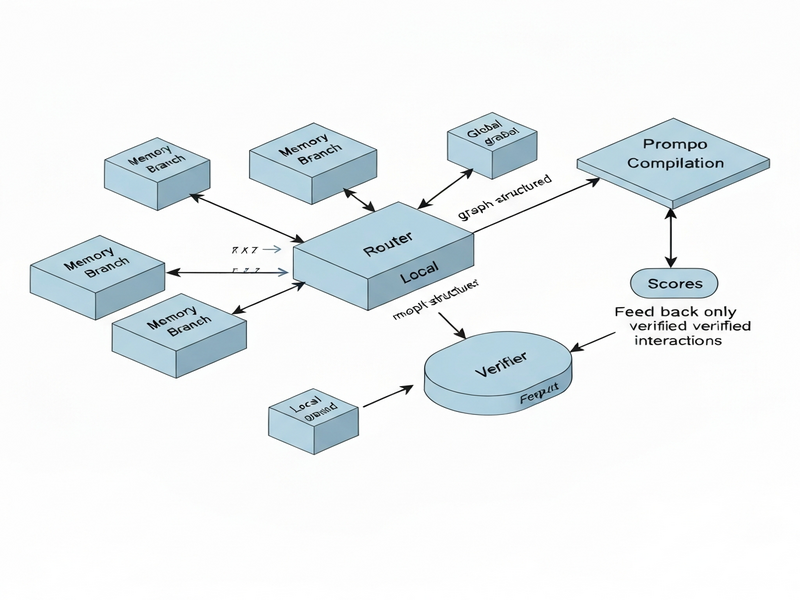
The authors present RIZZ framework, a modular architecture built around three core ideas:
- Dynamic memory branches: each branch represents a self‑contained “zone” that stores interactions relevant to a specific context or task family.
- Context‑aware router: a lightweight decision module that, at inference time, selects an existing branch or spawns a new one based on the incoming request’s semantics.
- Verifier‑gated updates: after the LLM generates a response, a task‑specific verifier scores the output; only interactions that pass a confidence threshold are allowed to modify the branch’s memory.
By coupling routing with verification, RIZZ explicitly limits cross‑branch interference, creating “near zero‑interference zones” where knowledge can accumulate safely. The framework operates entirely through prompt compilation—no model weights are touched—making it compatible with any black‑box LLM service.
How It Works in Practice
The operational flow of RIZZ framework can be broken down into four sequential stages:
- Input ingestion: The agent receives a user query, optional metadata (e.g., user ID, domain tag), and any recent interaction history.
- Routing decision: The router queries a global index of existing branches, evaluates semantic similarity, and either selects the best‑matching branch or creates a fresh branch when similarity falls below a threshold.
- Prompt compilation: The selected branch contributes three pieces of context:
- Branch‑local memory (recent verified interactions).
- Global graph‑structured context (relationships between branches).
- Working‑memory slots for transient variables.
These elements are concatenated with the user query into a bounded prompt that respects the LLM’s context window.
- Verification and memory update: After the LLM returns a response, a verifier—implemented as a lightweight classifier or rule‑based scorer—assesses correctness, safety, and relevance. If the score exceeds a dynamic threshold, the interaction is written back to the branch’s memory; otherwise, it may trigger branch demotion or the creation of an “anti‑pattern” rule to prevent repeat errors.
This loop runs either online (real‑time user interaction) or offline (batch processing of logs), allowing continuous improvement without ever altering the underlying model weights.
Evaluation & Results
The authors benchmarked RIZZ framework on three representative continual‑learning suites:
- Multi‑domain instruction following: tasks spanned code generation, medical advice, and customer support, with domain switches every 500 queries.
- Sparse‑feedback dialog: only 10 % of turns received explicit correctness labels; the rest were unlabeled.
- Resource‑constrained rollout: the total prompt length was capped at 2 k tokens to simulate real‑world API limits.
Key findings include:
- Interference reduction: RIZZ achieved a near‑zero drop in performance on previously learned tasks (average 0.3 % degradation) compared with a 12 % drop for a monolithic memory baseline.
- Sample efficiency: With only 15 % of the labeled data used by a fine‑tuning baseline, RIZZ matched or exceeded downstream accuracy on 8 out of 10 tasks.
- Latency compliance: Average inference latency stayed under 150 ms, well within typical SLA requirements, whereas rollout‑heavy search methods exceeded 500 ms.
These results demonstrate that the routing‑plus‑verification loop can sustain continual learning in black‑box settings while respecting both budgetary and safety constraints.
Why This Matters for AI Systems and Agents
For practitioners building production LLM agents, RIZZ framework offers a concrete pathway to:
- Modular knowledge management: Branches act like plug‑and‑play knowledge modules that can be inspected, audited, or retired without affecting the rest of the system.
- Safety‑first updates: Verifier‑gated writes ensure that only high‑confidence interactions survive, reducing the risk of drift into harmful behavior.
- Scalable integration: Because the approach relies solely on prompt engineering and external memory, it can be layered on top of any hosted LLM—OpenAI, Anthropic, or self‑hosted models.
- Operational transparency: Branch graphs provide a visual map of how tasks relate, aiding compliance teams and product managers in tracing decision pathways.
Organizations that already use the UBOS platform overview can embed RIZZ’s routing logic into their existing workflow automation pipelines, leveraging the platform’s built‑in memory stores and verification hooks. The result is a more resilient AI service that adapts on the fly while keeping costs predictable.
What Comes Next
While the RIZZ framework marks a significant step forward, several open challenges remain:
- Router scalability: As the number of branches grows, the router’s similarity search may become a bottleneck; future work could explore hierarchical indexing or learned routing networks.
- Verifier robustness: Current verifiers are task‑specific; a universal, self‑supervised verifier would broaden applicability.
- Cross‑modal extensions: Extending RIZZ to handle vision‑language or audio‑language agents will require richer branch representations.
- Human‑in‑the‑loop tooling: Integrating UI components for domain experts to curate or prune branches could accelerate adoption in regulated industries.
Developers interested in prototyping these ideas can start with the Workflow automation studio, which provides a low‑code environment for defining routers, verifiers, and memory back‑ends. By iterating on the open‑source components released alongside the paper, the community can collectively push the limits of safe, continual adaptation for black‑box agents.
For a deeper dive into the technical details, read the original RIZZ paper. Stay tuned to our UBOS blog for upcoming tutorials, case studies, and community contributions.
Andrii Bidochko
CTO UBOS
Andrii Bidochko is an AI entrepreneur and researcher focused on AI agents, reinforcement learning, and autonomous systems. He writes about the technologies shaping the future of machine intelligence, from frontier models and agent architectures to real-world AI applications.