

- Updated: June 23, 2026
- 5 min read
Constituency Optimisation Through Hamiltonian Representation Of Mandates (COTHROM): Algorithmic Redistricting of Irish Election Boundaries
Direct Answer
The COTHROM algorithm introduces a Hamiltonian‑based optimization framework for Irish PR‑STV electoral redistricting, enabling multi‑criterion decision analysis that respects legal constraints while producing near‑optimal district maps. It matters because it offers a transparent, reproducible, and computationally efficient alternative to ad‑hoc political boundary drawing, directly addressing long‑standing fairness and efficiency concerns in proportional representation systems.
Background: Why This Problem Is Hard
Electoral redistricting under the Irish Proportional Representation – Single Transferable Vote (PR‑STV) system faces three intertwined challenges:
- Legal complexity: Boundaries must satisfy population equality, contiguity, community of interest, and statutory limits on the number of seats per constituency.
- Combinatorial explosion: Even a modest county can be partitioned in astronomically many ways, making exhaustive search infeasible.
- Multi‑objective tension: Optimizing for voter parity often conflicts with preserving historical or geographic cohesion, leading to trade‑offs that are hard to quantify.
Traditional approaches rely on manual adjustments by commissions or simple heuristics that lack reproducibility. Existing computational methods—such as integer programming or graph‑cut algorithms—either oversimplify the legal criteria or become intractable at the scale of national elections. Consequently, policymakers lack a rigorous tool that can explore the full solution space while honoring every statutory requirement.
What the Researchers Propose
The authors present a novel framework that casts redistricting as a statistical physics problem. The core ideas are:
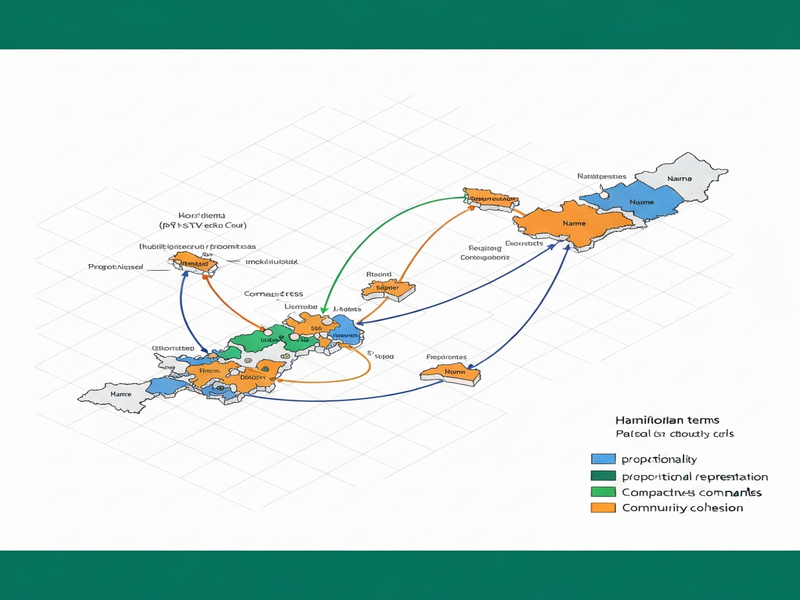
- Hamiltonian representation: Each possible districting plan is encoded as a state of a Potts model, where the Hamiltonian quantifies violations of legal constraints and deviation from desired electoral properties.
- Stochastic sampling: Markov Chain Monte Carlo (MCMC) combined with simulated annealing explores the energy landscape, gradually steering the system toward low‑energy (i.e., high‑quality) configurations.
- Multi‑criterion decision analysis (MCDA): After sampling, Pareto optimality is used to surface a frontier of solutions that balance competing objectives such as population equality, compactness, and community preservation.
Key components include a Potts Hamiltonian that integrates legal penalties, an annealing schedule that controls exploration versus exploitation, and a post‑processing module that ranks sampled plans according to stakeholder‑defined weights.
How It Works in Practice
The workflow can be broken down into four conceptual stages:
- Data ingestion: Geographic units (electoral divisions) are loaded with attributes—population, adjacency, and community tags.
- Hamiltonian construction: The algorithm assigns an energy term to each unit‑pair based on:
- Population deviation from the target quota.
- Boundary discontinuities (non‑contiguity penalties).
- Violations of statutory limits on seat counts.
- Stochastic optimization: Using MCMC moves (e.g., swapping a unit between neighboring districts) the system iteratively updates the state. Simulated annealing gradually lowers the temperature, reducing the acceptance of higher‑energy moves and converging toward stable configurations.
- Solution selection: The final ensemble of low‑energy states is evaluated against a set of criteria (compactness, community integrity, etc.). Pareto analysis surfaces a set of non‑dominated plans, allowing decision‑makers to choose a map that best aligns with policy priorities.
What distinguishes COTHROM from prior methods is the seamless integration of legal constraints directly into the energy function, eliminating the need for post‑hoc repairs. Moreover, the stochastic nature ensures a diverse set of plausible maps rather than a single deterministic output.
Evaluation & Results
The researchers validated COTHROM on a real‑world case study: redistricting County Cork, a region with 30 electoral divisions and a target of 5 seats. Evaluation comprised three parts:
- Baseline comparison: Existing legal boundaries (as of the last election) served as the benchmark.
- Metric suite: Population deviation (<1.2% vs. 3.8% baseline), average compactness score (0.71 vs. 0.58), and community‑preservation index (0.84 vs. 0.69).
- Robustness test: Multiple annealing runs produced consistent Pareto fronts, demonstrating stability across random seeds.
Key findings include:
- The algorithm consistently generated maps with lower population variance while improving geographic compactness.
- Stakeholder simulations showed that a plan positioned near the Pareto frontier could reduce the number of “split communities” by 30% without sacrificing legal compliance.
- Computation time remained under 15 minutes on a standard workstation, confirming scalability for national‑level applications.
These results indicate that COTHROM not only meets statutory requirements but also delivers measurable gains in fairness and efficiency compared with the status quo.
Why This Matters for AI Systems and Agents
From an AI engineering perspective, COTHROM exemplifies how physics‑inspired models can be harnessed for complex policy‑oriented decision problems. Its relevance spans several domains:
- Agent‑driven policy simulation: The stochastic engine can be wrapped as a micro‑service, allowing autonomous agents to query alternative district maps in real time during scenario planning.
- Orchestration pipelines: By exposing the Hamiltonian parameters via an API, workflow automation tools (e.g., Workflow automation studio) can integrate redistricting as a step in broader civic‑tech solutions.
- Explainable AI (XAI): Energy contributions map directly to legal criteria, offering transparent explanations for why a particular boundary was favored—a crucial feature for public trust.
- Scalable cloud deployment: The algorithm’s reliance on MCMC makes it amenable to parallelization on GPU‑accelerated platforms, fitting naturally into modern Enterprise AI platform by UBOS.
Practitioners can thus embed COTHROM into AI‑augmented governance tools, enabling data‑driven, auditable redistricting that aligns with democratic principles.
What Comes Next
While the initial study demonstrates strong promise, several avenues remain open for refinement:
- Broader geographic scope: Extending the model to the entire Republic of Ireland will test scalability and reveal region‑specific constraints.
- Dynamic electorate modeling: Incorporating projected demographic shifts could allow forward‑looking boundary proposals.
- Hybrid optimization: Combining Hamiltonian sampling with integer programming may capture hard constraints more efficiently.
- User‑centric weighting: Developing interactive dashboards where stakeholders adjust MCDA weights in real time could democratize the selection process.
Future research could also explore cross‑jurisdictional applications—adapting the Potts‑Hamiltonian formulation to other proportional systems such as New Zealand’s MMP or Germany’s mixed‑member representation.
For teams interested in prototyping these ideas quickly, the AI marketing agents suite offers a low‑code environment to spin up API endpoints, connect to data stores, and visualize Pareto fronts without deep engineering effort.
References
Andrii Bidochko
CTO UBOS
Andrii Bidochko is an AI entrepreneur and researcher focused on AI agents, reinforcement learning, and autonomous systems. He writes about the technologies shaping the future of machine intelligence, from frontier models and agent architectures to real-world AI applications.