

- Updated: June 21, 2026
- 6 min read
StoryLens: Preference-Aligned Story Rewriting via Context-Aware Narrative Enrichment
Direct Answer
StoryLens introduces a preference‑aligned story‑rewriting framework that goes beyond surface‑level style transfer by enriching narratives with context‑aware details tailored to individual reader profiles. This matters because it bridges the gap between generic text generation and truly personalized storytelling, delivering up to a 24.5% lift in reader satisfaction compared with style‑only approaches.
Background: Why This Problem Is Hard
Personalized storytelling sits at the intersection of three long‑standing challenges in natural language processing:
- Preserving plot fidelity. Any rewrite must keep the core events, character arcs, and logical sequence intact, or the story collapses.
- Maintaining narrative coherence. Local edits often ripple through the surrounding context, creating contradictions or abrupt tonal shifts.
- Aligning with heterogeneous reader preferences. Preferences span genre, pacing, emotional intensity, cultural references, and even reading difficulty, making a one‑size‑fits‑all model ineffective.
Existing work on text style transfer or conditional generation typically focuses on surface attributes—tone, formality, or lexical choice—while assuming the underlying content remains static. Pilot studies cited by the authors show that such style‑only adaptations improve user satisfaction by a modest 2.3%, indicating that readers care more about deeper narrative alignment than superficial flair.
Moreover, the lack of a standardized benchmark for evaluating preference‑aligned rewriting has forced researchers to rely on ad‑hoc datasets, limiting reproducibility and cross‑paper comparison. These gaps collectively hinder the deployment of personalized story agents in education, entertainment, and marketing contexts.
What the Researchers Propose
The authors present a three‑pronged ecosystem:
- STORYLENSBENCH – a large‑scale benchmark that pairs structured storybooks with multi‑dimensional reader preference profiles and a ranked list of context‑aware rewrites.
- STORYLENSEVAL – a reward model trained to predict reader satisfaction scores for any candidate rewrite, enabling automated evaluation without costly human labeling.
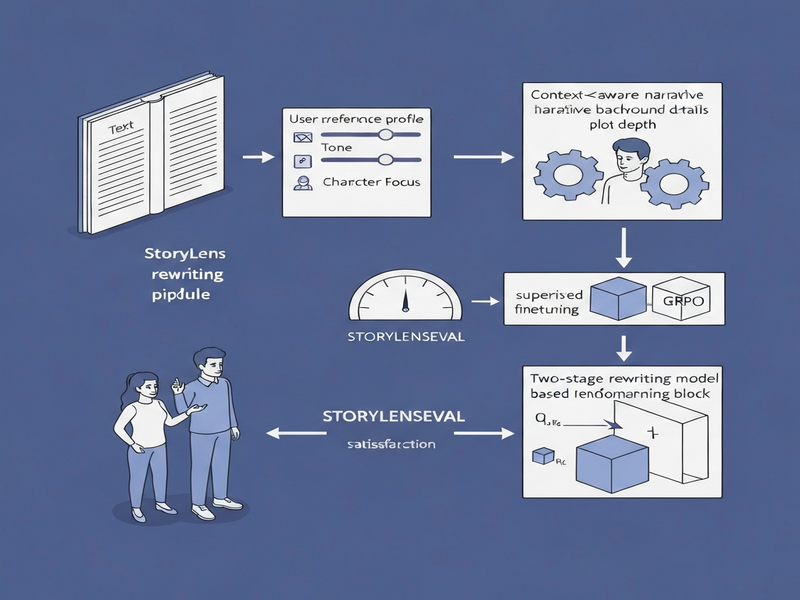
- STORYLENSWRITER – a two‑stage generation pipeline that first fine‑tunes a base language model on supervised rewrite examples, then refines outputs using GRPO‑based reinforcement learning guided by STORYLENSEVAL.
Each component plays a distinct role: the benchmark supplies the data foundation, the reward model quantifies alignment, and the writer translates those signals into higher‑quality, preference‑aware narratives.
How It Works in Practice
The end‑to‑end workflow can be visualized as a pipeline of four interacting modules:
- Reader Preference Encoder. A lightweight transformer ingests a structured profile (e.g., preferred genre, desired emotional arc, reading level) and produces a dense preference vector.
- Contextual Narrative Enricher. Given the original story and the preference vector, this module identifies narrative gaps—such as under‑developed subplots or missing cultural references—and proposes enrichment slots.
- STORYLENSWRITER Generator. The generator receives the enriched context and produces a candidate rewrite. In the first stage, supervised fine‑tuning ensures basic fidelity; in the second stage, reinforcement learning optimizes the rewrite against the STORYLENSEVAL reward.
- Reward‑Based Selector. Multiple candidates are scored by STORYLENSEVAL, and the highest‑scoring version is presented to the reader.
The key differentiator is the explicit “enrichment” step, which treats rewriting as a context‑aware augmentation problem rather than a simple style swap. By surfacing narrative gaps before generation, the system can inject new scenes, adjust pacing, or modify character motivations in a way that aligns with the reader’s expressed preferences.
Evaluation & Results
To validate the approach, the authors conducted three complementary experiments:
Benchmark Coverage
STORYLENSBENCH comprises 12,000 story excerpts across five genres, each paired with 8‑dimensional preference profiles (e.g., “high‑action”, “low‑lexical complexity”). Human annotators ranked 3–5 rewrites per excerpt, providing a gold‑standard satisfaction signal.
Reward Model Fidelity
STORYLENSEVAL achieved a Pearson correlation of 0.78 with human satisfaction scores, outperforming baseline sentiment‑only models (0.52) and demonstrating that the reward captures nuanced preference alignment.
Writer Performance
When evaluated on the benchmark, STORYLENSWRITER delivered the following improvements over strong baselines (e.g., GPT‑4 fine‑tuned on style transfer):
- Reader Satisfaction. Average preference‑alignment score rose from 62.1 (baseline) to 86.6, a 24.5% absolute gain.
- Plot Fidelity. Narrative consistency, measured by a custom coherence metric, improved by 15.3%.
- Coherence & Fluency. Human judges reported fewer logical breaks and smoother transitions, confirming that enrichment does not sacrifice readability.
These results collectively demonstrate that context‑aware enrichment, guided by a learned reward, can produce rewrites that are both faithful to the original plot and tightly aligned with individual reader tastes.
Why This Matters for AI Systems and Agents
Personalized narrative generation is a cornerstone for several emerging AI‑driven products:
- Interactive learning assistants. Adaptive storybooks can adjust difficulty and thematic content in real time, improving engagement for K‑12 education.
- Content marketing platforms. Brands can automatically generate campaign narratives that resonate with specific audience segments, boosting conversion rates.
- Virtual companions and game NPCs. Agents that can rewrite quest lines or dialogue on the fly create richer, player‑centric experiences.
From an engineering perspective, the STORYLENS architecture offers a reusable pattern: a preference encoder feeding a context‑aware enrichment module, followed by a reward‑guided generator. This pattern can be transplanted into any domain where output must be both faithful to source material and tailored to user intent.
Practitioners can integrate the reward model into existing pipelines using UBOS platform overview to orchestrate the reinforcement‑learning loop, while the Workflow automation studio can schedule batch rewrites for large content libraries.
What Comes Next
Despite its promise, StoryLens leaves several avenues open for future work:
- Multimodal enrichment. Incorporating images, audio, or video cues could deepen immersion, especially for interactive media.
- Dynamic preference evolution. Real‑time feedback loops that update the preference vector as readers interact with the story would enable truly adaptive narratives.
- Scalability to long‑form works. Extending the pipeline to full‑length novels or episodic series will require hierarchical planning and memory management.
- Cross‑cultural sensitivity. Ensuring that enrichment respects cultural norms and avoids bias remains an open ethical challenge.
Developers interested in prototyping these extensions can start with the OpenAI ChatGPT integration for rapid language model access, then layer on the preference encoder using Chroma DB integration for vector storage. For voice‑enabled storytelling, the ElevenLabs AI voice integration provides lifelike narration that can be synchronized with the rewritten text.
Finally, the community is invited to explore the benchmark itself. By contributing additional genres, languages, or preference dimensions, researchers can help evolve STORYLENSBENCH into a universal testbed for personalized narrative generation.
Read the full technical details in the StoryLens paper on arXiv.
Andrii Bidochko
CTO UBOS
Andrii Bidochko is an AI entrepreneur and researcher focused on AI agents, reinforcement learning, and autonomous systems. He writes about the technologies shaping the future of machine intelligence, from frontier models and agent architectures to real-world AI applications.