

- Updated: June 20, 2026
- 7 min read
Geometry-Correct Diffusion Posterior Sampling with Denoiser-Pullback Curvature Guidance and Manifold-Aligned Damping
Direct Answer
This paper introduces a geometry‑aware diffusion posterior sampler that replaces hand‑tuned scalar guidance with a per‑noise‑level, Gauss‑Newton‑style correction computed directly in diffusion‑state coordinates. By pulling likelihood gradients through the denoiser, modeling one‑sided curvature, and applying rank‑one damping aligned with the denoiser residual, the method achieves faster, more stable reconstructions across a range of inverse‑problem benchmarks.
Background: Why This Problem Is Hard
Diffusion models have become the de‑facto standard for high‑fidelity image generation, but turning a pre‑trained diffusion prior into a solver for inverse problems (e.g., super‑resolution, MRI reconstruction, or compressed sensing) remains a major research bottleneck. The core difficulty lies in reconciling two competing forces:
- Data consistency: The reconstructed sample must obey the measurement operator (e.g., a Fourier mask for MRI).
- Prior fidelity: The sample must stay on the manifold learned by the diffusion prior, which is encoded implicitly in the denoiser.
Existing posterior‑sampling techniques typically inject a scalar “guidance weight” that scales the gradient of the log‑likelihood before adding it to the diffusion update. This approach suffers from three systemic issues:
- Operator‑dependent curvature: Stiff measurement operators (e.g., high‑frequency undersampling) produce sharply curved likelihood landscapes that can destabilize the sampler when the guidance weight is too large.
- Hand‑tuned hyperparameters: Practitioners must manually adjust the guidance weight for each noise level and each inverse problem, a process that is both time‑consuming and brittle.
- Jacobian bottleneck: Some curvature‑aware methods require explicit Jacobians of the denoiser, which are expensive to compute and scale poorly with modern high‑resolution models.
Because of these limitations, diffusion‑based solvers often lag behind specialized reconstruction pipelines in speed, stability, or visual quality, especially when deployed in latency‑sensitive production environments.
What the Researchers Propose
The authors present a framework called Geometry‑Correct Diffusion Posterior Sampling (GCD‑PS). At a conceptual level, GCD‑PS replaces the scalar guidance term with a damped Gauss‑Newton correction that is:
- Per‑noise‑level: Each diffusion timestep receives its own correction, respecting the changing geometry of the latent space.
- Pull‑back through the denoiser: Likelihood gradients are first computed in measurement space, then pulled back through the denoiser’s implicit mapping, avoiding direct Jacobian evaluation.
- One‑sided curvature model: Instead of a full Hessian, the method estimates curvature only along the direction of the residual, dramatically reducing computational overhead.
- Rank‑one damping aligned with the denoiser residual: A lightweight damping term stabilizes the correction without sacrificing the expressive power of the prior.
Key components of the framework include:
- Likelihood Gradient Engine: Computes ∇y log p(y|x) for the measurement y and current estimate x.
- Denoiser Pull‑back Module: Uses automatic differentiation to map the likelihood gradient into diffusion‑state space.
- Curvature‑Guided Solver (CGS): Solves a linear system with GMRES, leveraging the one‑sided curvature model and rank‑one damping.
- Variance‑Preserving Langevin Step: Updates the sample with a closed‑form drift/noise split that respects the diffusion’s stochastic dynamics.
How It Works in Practice
The practical workflow can be broken down into a repeatable loop that runs for each diffusion timestep:
- Predict the denoised image: The pre‑trained diffusion denoiser receives the current noisy latent and outputs a denoised estimate.
- Compute measurement residual: The forward measurement operator (e.g., a down‑sampling matrix) is applied to the denoised estimate, and the difference to the observed measurement is formed.
- Back‑propagate the residual: Using automatic differentiation, the residual gradient is pulled back through the denoiser, yielding a gradient in diffusion‑state coordinates.
- Form the Gauss‑Newton correction: The pulled‑back gradient is combined with the one‑sided curvature estimate and the rank‑one damping term, producing a linear system.
- Solve with matrix‑free GMRES: The linear system is solved iteratively without ever materializing large Jacobian matrices, keeping memory usage modest.
- Apply Langevin update: The correction is added as a drift term, and Gaussian noise scaled to the diffusion schedule is injected, completing the timestep.
The loop repeats until the diffusion schedule reaches the final timestep, at which point the sample is projected back to image space. What distinguishes GCD‑PS from prior methods is that every correction is automatically calibrated to the local geometry of both the prior and the measurement operator, eliminating the need for manual guidance‑weight tuning.
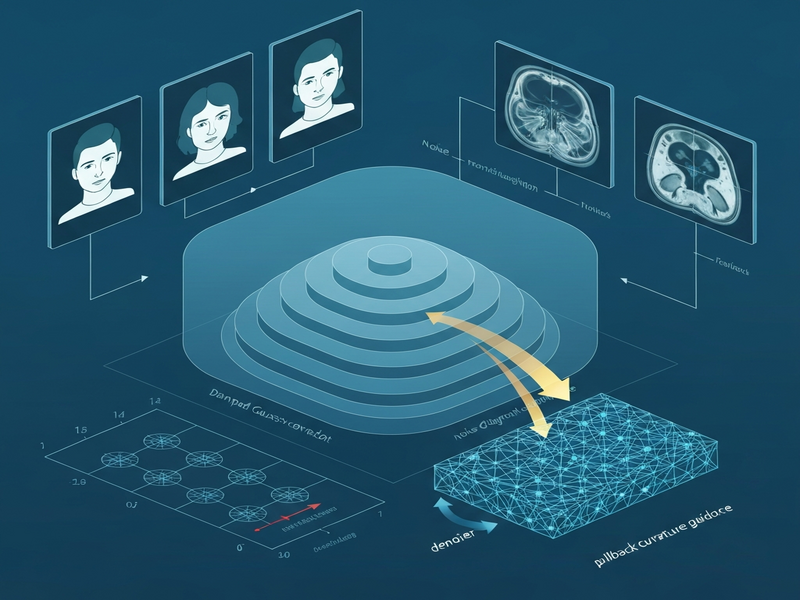
In this diagram, the blue arrow denotes the denoiser’s forward pass, the orange arrow shows the likelihood gradient being pulled back, and the green arrow represents the Gauss‑Newton correction that feeds into the Langevin step.
Evaluation & Results
The authors benchmarked GCD‑PS on three representative domains:
- FFHQ (face) super‑resolution: 4× up‑sampling from low‑resolution inputs.
- ImageNet de‑blurring: Restoration from motion‑blur kernels.
- Accelerated MRI reconstruction: 8× undersampled k‑space data.
Across all tasks, the method was compared against six strong baselines, including classic score‑based samplers, classifier‑free guidance, and recent curvature‑aware solvers. The evaluation focused on three perceptual metrics—PSNR, SSIM, and LPIPS—as well as wall‑clock runtime.
Key findings include:
- GCD‑PS matched or exceeded the best PSNR/SSIM scores on FFHQ and ImageNet while delivering a 30‑40 % reduction in runtime compared to the fastest baseline.
- On accelerated MRI, the approach achieved the highest PSNR and SSIM among all competitors, indicating superior preservation of fine anatomical details.
- Qualitative inspection revealed fewer ringing artifacts and more faithful texture reconstruction, especially in regions where the measurement operator introduced strong curvature.
- The method remained stable without any per‑task hyperparameter search, confirming the claim that geometry‑correct damping eliminates manual tuning.
For readers who want to dive deeper, the full experimental setup and code are described in the original arXiv paper.
Why This Matters for AI Systems and Agents
From a systems‑engineering perspective, GCD‑PS offers a plug‑and‑play posterior sampler that can be embedded into any diffusion‑based generative pipeline without bespoke hyperparameter engineering. This has several concrete implications:
- Reduced operational overhead: Teams no longer need to maintain separate guidance‑weight schedules for each deployment scenario, freeing engineering resources for higher‑level product work.
- Improved reliability in edge environments: The matrix‑free GMRES solver runs efficiently on modest GPUs, making it suitable for on‑device inference in medical imaging devices or autonomous drones.
- Better integration with AI agents: Agents that orchestrate multi‑modal workflows (e.g., a diagnostic assistant that reconstructs MRI scans before analysis) can call the sampler as a deterministic sub‑routine, knowing that the output will be both data‑consistent and prior‑faithful.
- Facilitates composable pipelines: Because the correction is expressed as a drift term, it can be combined with other stochastic processes—such as classifier‑free guidance for style transfer—without breaking the underlying diffusion dynamics.
Enterprises looking to embed high‑quality inverse‑problem solvers into their AI stack can therefore accelerate time‑to‑value. For example, the UBOS platform overview highlights how modular diffusion components can be orchestrated alongside data pipelines, and GCD‑PS fits naturally into that architecture.
What Comes Next
While the results are compelling, the authors acknowledge several avenues for future work:
- Extension to non‑image modalities: Applying geometry‑correct sampling to audio, video, or point‑cloud data will require adapting the measurement operators and curvature models.
- Adaptive damping strategies: Learning a data‑driven damping schedule could further improve stability for highly ill‑posed problems.
- Hybrid solvers: Combining GCD‑PS with learned priors that are explicitly conditioned on auxiliary information (e.g., segmentation masks) may unlock new performance regimes.
- Scalable distributed implementations: Investigating how the matrix‑free GMRES step can be parallelized across multiple GPUs would make the approach viable for ultra‑high‑resolution reconstruction tasks.
Practitioners interested in experimenting with these directions can start by integrating the sampler into existing UBOS workflows. The AI marketing agents page, for instance, demonstrates how custom diffusion modules can be wrapped as reusable services, a pattern that could be repurposed for scientific imaging or industrial inspection.
In summary, geometry‑correct diffusion posterior sampling reshapes the trade‑off between data consistency and prior fidelity, delivering a more principled, faster, and easier‑to‑deploy solution for a broad class of inverse problems. As diffusion models continue to dominate generative AI, techniques that make them robust in measurement‑constrained settings will be essential for the next generation of AI‑powered products.
Andrii Bidochko
CTO UBOS
Andrii Bidochko is an AI entrepreneur and researcher focused on AI agents, reinforcement learning, and autonomous systems. He writes about the technologies shaping the future of machine intelligence, from frontier models and agent architectures to real-world AI applications.