

- Updated: June 20, 2026
- 7 min read
Pressure-Testing Deception Probes in LLMs: Scaling, Robustness, and the Geometry of Deceptive Representations
Direct Answer
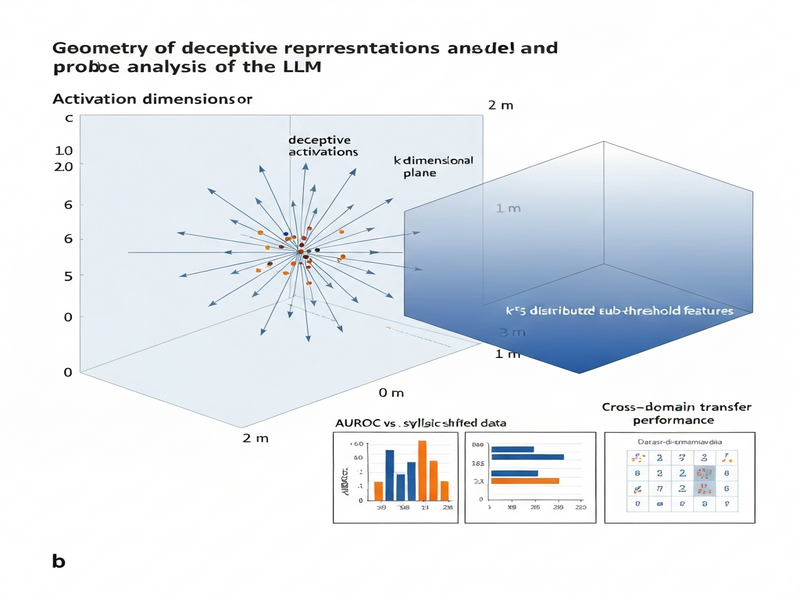
The paper Pressure-Testing Deception Probes in LLMs shows that linear probes can appear to detect deceptive language in large language models (LLMs) with near‑perfect AUROC on clean data, yet they collapse when the input style shifts. By systematically probing four geometric hypotheses, the authors reveal that deception is not encoded in a single linear direction or a low‑dimensional subspace; instead, it lives in a distributed, high‑dimensional pattern that only emerges when probes are trained on style‑augmented data.
Background: Why This Problem Is Hard
LLM deception detection has become a cornerstone of AI safety research. Enterprises that deploy conversational agents need reliable signals that a model is fabricating, exaggerating, or otherwise misleading a user. The most common approach today is to train linear probes—simple logistic regressors—on hidden activations of a frozen LLM and treat the probe’s output as a deception score.
Despite impressive clean‑benchmark results (AUROC > 0.96), practitioners have observed sudden failures when the model encounters new prompts, domain‑specific jargon, or stylistic variations such as sarcasm, formal business language, or code snippets. This brittleness raises two fundamental questions:
- Is the probe capturing a genuine, model‑intrinsic deception signal, or is it overfitting to superficial patterns in the training distribution?
- If a signal exists, what is its geometric nature inside the high‑dimensional activation space?
Existing literature offers limited insight. Prior work assumes a single linear direction (a “deception vector”) or a low‑dimensional subspace, but these assumptions have never been rigorously stress‑tested across model scales, domains, or stylistic shifts. Without such validation, any safety pipeline that relies on probe‑based metrics risks false confidence—a dangerous prospect for regulated industries like finance or healthcare.
What the Researchers Propose
To move beyond anecdotal failure reports, the authors design a comprehensive pressure‑test framework that evaluates four competing hypotheses about how deception might be represented in LLM activations:
- Single‑Direction Hypothesis: Deception aligns with one dominant linear vector.
- Multi‑Dimensional Subspace Hypothesis: Deception occupies a low‑dimensional linear subspace (k > 1).
- Convex Conic‑Hull Hypothesis: Deception forms a convex cone, implying that any positive combination of certain basis vectors signals deception.
- Entropy‑Proxy Hypothesis: Deception correlates with activation entropy, suggesting a simple statistical proxy.
The framework introduces three methodological innovations:
- Cross‑Domain Transfer Matrices: Probes trained on one style are evaluated on eight unseen stylistic shifts (e.g., formal email, code comments, meme‑style prompts) to test geometric robustness.
- Permutation‑Based Null Baselines: Multi‑dimensional probes are compared against randomly permuted activation labels, ensuring that any observed AUROC gain exceeds chance.
- Entropy Residualization: The authors regress out activation entropy before probing to isolate any residual deception signal.
How It Works in Practice
The experimental pipeline can be visualized as a four‑stage workflow:
- Data Collection & Style Augmentation: A base deception dataset (synthetic prompts labeled “deceptive” vs. “truthful”) is expanded with eight stylistic transformations using prompt‑engineering templates.
- Activation Extraction: For each model in the Gemma‑3 family (1B, 4B, 7B, 27B parameters), hidden states from every transformer layer are cached.
- Probe Training: Linear probes are trained under each hypothesis:
- Single‑direction probes learn a single weight vector.
- Multi‑dimensional probes learn k orthogonal vectors (k varies from 1 to 10).
- Conic‑hull probes learn a set of basis vectors whose non‑negative span defines the decision region.
- Entropy‑proxy probes first compute per‑token activation entropy, then fit a simple logistic model.
- Evaluation & Transfer: Probes are tested on clean data, on each stylistic shift, and on cross‑model transfer (e.g., a probe trained on 4B evaluated on 27B). AUROC, precision‑recall, and Δ‑AUROC after entropy residualization are recorded.
What distinguishes this approach from prior work is the explicit focus on *distributional robustness* rather than raw classification accuracy. By treating style changes as a controlled perturbation, the authors can attribute probe failure to geometric misalignment rather than to superficial overfitting.
Evaluation & Results
The authors report a striking dichotomy:
- Clean‑Benchmark Performance: All probe families achieve AUROC ≥ 0.998 on the original style, confirming that the signal is learnable when the distribution is narrow.
- Stylistic Shift Collapse: Single‑direction probes drop to AUROC ≈ 0.61–0.80, failing to generalize across any of the eight new styles.
- Style‑Augmented Probes: When training data includes a mixture of styles, multi‑dimensional probes (k ≥ 5) recover near‑perfect detection (mean AUROC = 0.979–0.983) even on unseen styles.
- Cross‑Domain Transfer Failure: Probes trained on one style cannot be transferred to another without a substantial performance hit, indicating that the deception geometry is *style‑specific* rather than model‑specific.
- Entropy‑Proxy Rejection: Correlation between activation entropy and deception labels never exceeds |ρ| = 0.454, and residualizing entropy changes AUROC by at most 0.004, effectively ruling out entropy as a proxy.
- Subspace Analysis: Per‑domain optimal subspace dimensionality k* is zero, meaning no low‑dimensional linear subspace captures deception. Only when aggregating across styles does a higher‑dimensional distributed representation emerge.
Importantly, the inverse scaling pattern reported in earlier literature—where larger models appeared *worse* at deception detection—disappears once style‑augmented probes are used. Both the 4B and 27B models achieve comparable AUROC, suggesting that earlier observations were artifacts of narrow training distributions rather than intrinsic scale limitations.
Why This Matters for AI Systems and Agents
For practitioners building conversational agents, the findings carry three immediate takeaways:
- Probe‑Based Safety Metrics Need Diversity: Relying on a probe trained on a single prompt style can give a false sense of security. Incorporating a broad set of stylistic variations during probe training dramatically improves robustness.
- Model Scale Is Not a Silver Bullet: Investing in larger LLMs will not automatically solve deception detection. Instead, engineering the training distribution of the probe matters more.
- Design of Orchestration Pipelines: Systems that route user queries to safety monitors should treat deception scores as *context‑aware* signals. A multi‑probe ensemble—each specialized for a style cluster—can be orchestrated via a lightweight routing layer.
These insights can be operationalized on platforms that already support modular AI workflows. For example, the Workflow automation studio enables developers to chain a style‑augmented probe, a fallback rule‑engine, and a human‑in‑the‑loop reviewer into a single safety pipeline. Similarly, the OpenAI ChatGPT integration can be extended with custom probe modules that automatically switch based on detected prompt style, ensuring that deceptive content is flagged regardless of phrasing.
What Comes Next
While the study settles several open questions, it also opens new research avenues:
- Dynamic Style Detection: Developing a lightweight classifier that predicts the stylistic family of an incoming prompt could enable on‑the‑fly selection of the most appropriate probe.
- Beyond Linear Probes: Exploring non‑linear classifiers (e.g., shallow MLPs or kernel methods) may capture higher‑order interactions that linear probes miss, potentially reducing the need for extensive style augmentation.
- Cross‑Model Generalization: Investigating whether a probe trained on one architecture (e.g., Gemma‑3) can transfer to fundamentally different models (e.g., LLaMA, Claude) would inform the universality of the discovered geometry.
- Real‑World Deployment Studies: Longitudinal monitoring of probe performance in production chatbots will reveal how distributional drift (new slang, emerging memes) impacts detection over time.
Enterprises looking to embed these next‑generation safety checks can start by leveraging the UBOS templates for quick start, which include pre‑configured pipelines for style‑augmented probing and automated alerting. For startups, the UBOS for startups program offers sandbox environments to experiment with multi‑probe ensembles before scaling to production.
In the longer term, the community may converge on a shared benchmark suite that explicitly encodes stylistic diversity, making it easier to compare safety metrics across research groups and commercial vendors.
Conclusion
The pressure‑testing framework presented in this paper demonstrates that deception detection in LLMs is far more nuanced than a single linear direction or low‑dimensional subspace. By exposing the fragility of clean‑benchmark probes and offering a robust, style‑augmented alternative, the authors provide a practical roadmap for building trustworthy AI agents. As organizations increasingly rely on LLMs for customer‑facing interactions, integrating such robust detection mechanisms will be essential to mitigate misinformation, comply with emerging regulations, and maintain user trust.
Andrii Bidochko
CTO UBOS
Andrii Bidochko is an AI entrepreneur and researcher focused on AI agents, reinforcement learning, and autonomous systems. He writes about the technologies shaping the future of machine intelligence, from frontier models and agent architectures to real-world AI applications.