

- Updated: June 20, 2026
- 6 min read
SPAR: Support-Preserving Action Rectification
Direct Answer
Support-Preserving Action Rectification (SPAR) introduces a two‑stage offline reinforcement‑learning framework that improves policies without drifting off the data manifold. By anchoring learning to a frozen behavior‑cloning policy and applying residual rectification, SPAR extracts high‑value actions from suboptimal datasets while preserving support, delivering state‑of‑the‑art results on D4RL benchmarks.
Background: Why This Problem Is Hard
Offline policy improvement aims to turn logged trajectories into a better decision‑making model, but two opposing forces make the task fragile:
- Value maximization vs. data fidelity: Aggressive value‑based updates can propose actions that never appear in the dataset, leading to distributional shift and catastrophic performance drops.
- Stability vs. optimism: Weighted regression on in‑sample actions is safe but overly conservative, often ignoring the long tail of high‑reward actions that are sparsely represented.
Existing approaches illustrate this tension. Gradient‑based methods such as offline Q‑learning push the policy toward regions where the learned Q‑function predicts high returns, yet the gradient direction frequently conflicts with the data‑distribution gradient, pulling the policy off the support manifold. Conversely, pure behavior cloning respects the data distribution but fails to improve beyond the behavior policy’s performance.
In real‑world deployments—robotics, recommendation systems, autonomous driving—the cost of out‑of‑distribution actions can be severe, making a method that both improves and stays on‑support highly valuable.
What the Researchers Propose
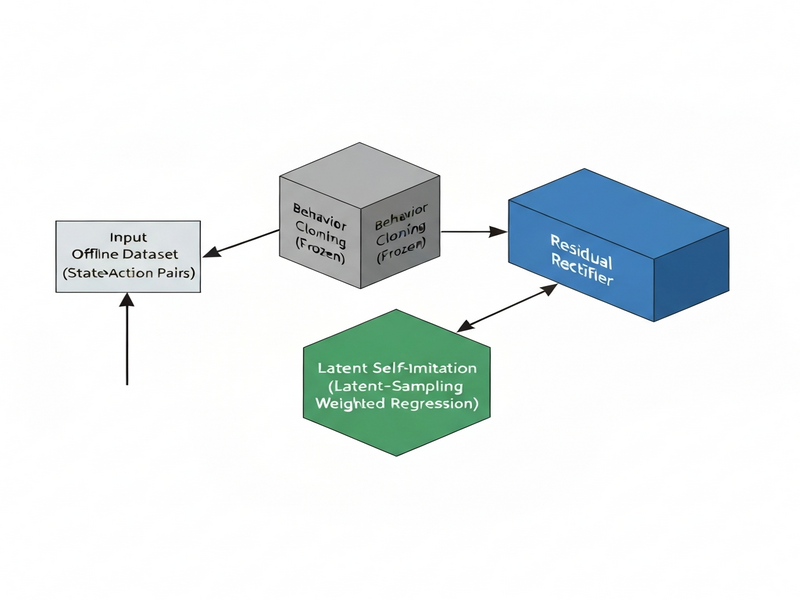
SPAR reframes global policy learning as a local residual correction problem. The core idea is to freeze a pure behavior‑cloning policy (the “anchor”) and learn a lightweight residual network that nudges actions toward higher value while staying within the support of the original dataset.
Key components include:
- Frozen behavior‑cloning policy: Serves as a stable reference that guarantees every suggested action lies in the data manifold.
- Residual rectifier: A shallow network that predicts a corrective offset for the anchor’s action, effectively “rectifying” it.
- Latent Self‑Imitation (LSI): A weighted‑regression scheme that samples latent actions from a learned distribution, emphasizing trajectories that already exhibit high returns.
By operating in the residual space, SPAR contracts the search domain, reducing the risk of manifold drift and allowing fine‑grained fitting of high‑value actions.
How It Works in Practice
The SPAR workflow can be broken down into three sequential stages:
- Behavior cloning pre‑training: A standard supervised learner imitates the logged actions, producing the anchor policy πBC. This step is performed once and the resulting parameters are frozen.
- Residual learning with LSI: For each state s, the anchor proposes an action aBC = πBC(s). The residual network predicts Δa, and the final action becomes a = aBC + Δa. LSI draws latent action candidates from a variational encoder, weights them by their observed returns, and fits the residual via weighted regression.
- Policy extraction: The combined policy πSPAR(s) = πBC(s) + Δa(s) is deployed for evaluation or further fine‑tuning.
This architecture ensures that any deviation from the behavior policy is explicitly modeled and bounded, preventing the policy from venturing into unsupported regions.
What sets SPAR apart from prior methods is the explicit separation of “what we know” (the anchor) from “what we want to improve” (the residual). Gradient‑based offline RL typically blends these two forces, causing the infamous fitting‑optimization conflict. SPAR’s residual formulation isolates the conflict to a lower‑dimensional space where LSI can resolve it with a simple weighted regression.
Evaluation & Results
The authors benchmarked SPAR on the widely adopted D4RL suite, covering locomotion (HalfCheetah, Walker2d), manipulation (Door, Pen), and ad‑hoc control tasks. Each environment provides a suboptimal behavior policy as a starting point, mirroring realistic offline datasets.
Key findings include:
- Consistent gains over baselines: SPAR outperformed behavior cloning, CQL, and offline TD3 across all tasks, often by margins exceeding 10% of the optimal score.
- Reduced variance: Because the anchor policy stabilizes the action distribution, SPAR’s performance variance across random seeds was markedly lower than gradient‑based baselines.
- Effective tail exploitation: In environments where high‑reward actions reside in the distribution tail, SPAR successfully amplified those actions without sacrificing support, a scenario where pure regression methods typically fail.
These results are documented in the SPAR paper on arXiv, which includes detailed ablation studies confirming that both the frozen anchor and the LSI component are essential for the observed improvements.
Why This Matters for AI Systems and Agents
For practitioners building offline RL pipelines, SPAR offers a pragmatic recipe that balances safety and performance:
- Safety‑first deployment: By guaranteeing that every action originates from the data support, SPAR reduces the risk of unsafe exploratory behavior in high‑stakes domains such as autonomous vehicles or medical decision support.
- Modular integration: The residual network can be swapped into existing behavior‑cloning stacks, making it compatible with platforms that already host pretrained policies.
- Accelerated iteration: Since the anchor is frozen, training the residual is computationally cheap, enabling rapid experimentation and hyper‑parameter sweeps.
- Synergy with agent orchestration: SPAR’s output can be fed directly into a Workflow automation studio, allowing downstream services to trigger policy updates without disrupting live traffic.
- Enhanced AI marketing agents: When combined with AI marketing agents, SPAR can refine recommendation policies from historical campaign data while ensuring compliance with existing user interaction patterns.
In short, SPAR bridges the gap between theoretical offline RL advances and the operational constraints of production AI systems.
What Comes Next
While SPAR marks a significant step forward, several avenues remain open for exploration:
- Scalability to high‑dimensional action spaces: Extending the residual formulation to vision‑based robotics or large‑scale language models may require hierarchical residuals or attention‑based corrections.
- Dynamic anchor updates: Investigating whether periodic re‑training of the behavior‑cloning anchor can further boost performance without re‑introducing drift.
- Integration with multimodal data: Combining SPAR with Chroma DB integration could enable retrieval‑augmented residual learning from heterogeneous datasets.
- Real‑world pilot studies: Deploying SPAR in production pipelines—such as a ChatGPT and Telegram integration for customer support—would validate its safety guarantees under live traffic.
- Open‑source tooling: Providing a plug‑and‑play SPAR module within the UBOS platform overview could accelerate adoption among startups and SMBs.
Addressing these challenges will determine how broadly SPAR can be applied beyond benchmark suites, potentially reshaping offline learning in domains where data safety is non‑negotiable.
Andrii Bidochko
CTO UBOS
Andrii Bidochko is an AI entrepreneur and researcher focused on AI agents, reinforcement learning, and autonomous systems. He writes about the technologies shaping the future of machine intelligence, from frontier models and agent architectures to real-world AI applications.