

- Updated: June 20, 2026
- 7 min read
Snippet-Driven Supply Chain Discovery with LLMs: Scaling Visibility in China
Direct Answer
The paper introduces a snippet‑driven pipeline that leverages large language models (LLMs) to extract inter‑firm relationships from web‑search snippets, building a large‑scale supply‑chain knowledge graph (SCKG) for Chinese companies. This approach dramatically reduces the computational cost of full‑text mining while delivering coverage that far exceeds traditional disclosure‑based databases, unlocking hidden links in China’s opaque supply‑chain ecosystem.
Background: Why This Problem Is Hard
Accurate supply‑chain visibility is a cornerstone of financial analysis, risk management, and policy making. In China, the official disclosure regime only obliges listed firms to report a handful of major partners, leaving a massive “long tail” of unlisted firms and indirect relationships undocumented. Researchers and analysts therefore rely on commercial databases that aggregate these disclosures, but such sources suffer from three systemic limitations:
- Coverage gaps: Unlisted firms and lower‑tier suppliers are rarely captured, creating blind spots in risk assessments.
- Stale data: Disclosure updates lag behind real‑time market dynamics, especially for fast‑moving consumer goods and technology components.
- High acquisition cost: Commercial datasets are expensive and often lack transparent provenance, making auditability difficult.
Public web sources—press releases, government notices, trade‑media articles—contain the missing pieces, but extracting structured relationships from millions of web pages is computationally prohibitive. Full‑text crawling consumes massive token budgets when fed to LLMs, and many pages are behind paywalls or rendered in formats that resist automated parsing. Consequently, the industry lacks a scalable, cost‑effective method to turn unstructured web evidence into a reliable, auditable supply‑chain graph.
What the Researchers Propose
The authors present a snippet‑driven discovery framework that treats search‑engine snippets as a lightweight evidence layer. The pipeline consists of three logical components:
- Seed generation: A curated list of 130,685 Chinese firms (including Shanghai/Shenzhen‑listed and large unlisted entities) serves as the entry point for web queries.
- Snippet retrieval: For each seed, a targeted query is issued to a commercial search engine. The returned snippets—short, query‑biased summaries—are harvested instead of the full pages.
- LLM‑based relationship extraction: A fine‑tuned LLM processes each snippet, identifies mentions of supplier‑customer pairs, and assigns a relationship type (e.g., “provides components to,” “distributes for”). The extracted triples are stored as edges in the SCKG, while the original snippet is retained as provenance metadata.
This design deliberately separates “evidence collection” (cheap, high‑volume snippet harvesting) from “semantic interpretation” (expensive LLM inference), achieving a favorable trade‑off between coverage and token consumption.
How It Works in Practice
The operational workflow can be visualized as a four‑stage pipeline:
1. Seed List Construction
Analysts compile a master list of target firms using public registries, stock exchange filings, and industry reports. The list is enriched with metadata such as industry classification, headquarters location, and market cap.
2. Query Formulation & Snippet Harvesting
For each firm, the system generates a set of templated queries (e.g., “Company A supplier relationship”, “Company B partnership”). The queries are dispatched to a search engine API, which returns the top‑N snippets (typically 10–20 per query). Because snippets are limited to a few dozen characters, the token cost per query is negligible.
3. LLM‑Powered Extraction
A pre‑trained LLM (e.g., GPT‑4‑Turbo) is prompted with a concise instruction set that asks it to:
- Identify any firm names mentioned in the snippet.
- Determine the directionality of the relationship (who is supplier, who is customer).
- Classify the relationship type using a predefined taxonomy.
- Return the result in a structured JSON format.
Because the input is a short snippet, the model can process thousands of queries per minute on modest hardware, keeping the overall token budget ~250× lower than a full‑text approach.
4. Graph Assembly & Provenance Storage
Extracted triples are ingested into a graph database where each node represents a firm and each edge encodes a supplier‑customer link. The original snippet, query string, and LLM confidence score are attached as edge attributes, enabling downstream auditors to trace any claim back to its source.
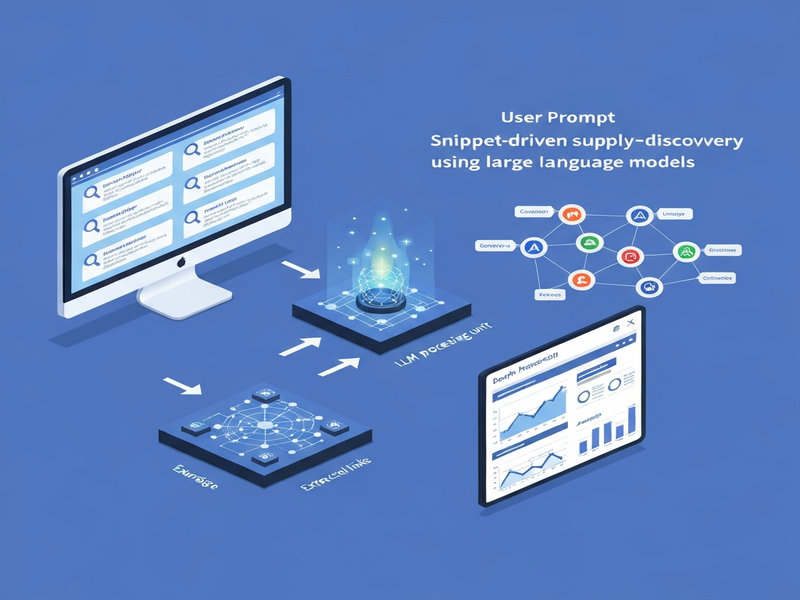
Evaluation & Results
The authors benchmarked the snippet‑driven pipeline against two baselines:
- Full‑text chunking: Exhaustively crawling and chunking every reachable web page for each seed.
- CSMAR disclosure database: The industry‑standard, disclosure‑based supply‑chain repository for Chinese listed firms.
Key findings:
- Extraction efficiency: Full‑text chunking uncovered 19.8× more unique relationships but required 251.2× more input tokens, leading to prohibitive cost and redundancy.
- Coverage boost: Compared with CSMAR, the snippet‑driven SCKG captured 7.2× more firms and 9.3× more relationships within the listed‑firm subset, revealing a heavy‑tailed degree distribution that mirrors real‑world supply‑chain hierarchies.
- Provenance quality: Each edge retained its originating snippet, allowing auditors to verify claims without re‑running the entire pipeline.
- Scalability: The entire pipeline processed the 130k seed list in under 48 hours on a modest cloud cluster, demonstrating feasibility for continuous, near‑real‑time updates.
These results demonstrate that snippet‑driven extraction delivers a “sweet spot” of breadth, depth, and cost‑effectiveness, making large‑scale supply‑chain mapping practical for both academia and industry.
Why This Matters for AI Systems and Agents
For AI practitioners building agents that need up‑to‑date corporate network knowledge, the SCKG offers a ready‑made, auditable substrate. Specific implications include:
- Enhanced risk‑assessment agents: Automated due‑diligence bots can query the graph to surface hidden dependencies, enabling faster credit scoring or sanctions screening.
- Dynamic simulation environments: Supply‑chain simulators can ingest the graph to model shock propagation (e.g., a factory shutdown) with realistic topology.
- Improved recommendation engines: Procurement AI can suggest alternative suppliers by traversing the graph’s similarity pathways.
- Agent orchestration: When combined with Workflow automation studio, agents can trigger alerts, generate reports, or launch remediation workflows the moment a new relationship appears in the SCKG.
- Enterprise integration: The graph can be fed into an Enterprise AI platform by UBOS, where downstream analytics, dashboards, and AI‑driven insights are built on top of a single source of truth.
- Marketing intelligence: AI marketing agents can leverage supplier‑customer links to identify cross‑selling opportunities or emerging market entrants.
What Comes Next
While the snippet‑driven method marks a significant step forward, several avenues remain open for refinement:
- Multilingual expansion: Extending the pipeline to handle English‑language sources and bilingual snippets would broaden coverage of multinational supply chains.
- Fine‑grained relationship taxonomy: Incorporating contract‑type, volume, and pricing attributes could transform the graph from a binary link map into a richer economic model.
- Active learning loops: Using human‑in‑the‑loop verification to iteratively improve LLM prompts and reduce false positives.
- Real‑time streaming: Integrating with a ChatGPT and Telegram integration could push new relationships to analysts as soon as they appear in search results.
- Domain‑specific LLMs: Training smaller, Chinese‑focused LLMs on supply‑chain jargon may further cut token costs while preserving extraction accuracy.
- Privacy‑preserving publishing: Techniques such as differential privacy could enable sharing of the SCKG with regulators without exposing proprietary firm data.
Organizations interested in prototyping these ideas can explore UBOS for startups or the UBOS solutions for SMBs, which provide plug‑and‑play connectors for search APIs, LLM inference, and graph storage.
Conclusion
The snippet‑driven supply‑chain discovery framework demonstrates that strategic use of search‑engine snippets can unlock massive, previously hidden inter‑firm relationships at a fraction of the cost of full‑text mining. By pairing this lightweight evidence layer with powerful LLMs, the authors built a supply‑chain knowledge graph that outperforms traditional disclosure‑based benchmarks in both breadth and depth while preserving provenance for auditability. For AI system designers, the resulting SCKG offers a high‑value, continuously refreshed data source that can power risk analytics, simulation, and autonomous decision‑making across finance, logistics, and enterprise intelligence.
For a deeper dive into the methodology and full experimental details, consult the original arXiv paper.
Andrii Bidochko
CTO UBOS
Andrii Bidochko is an AI entrepreneur and researcher focused on AI agents, reinforcement learning, and autonomous systems. He writes about the technologies shaping the future of machine intelligence, from frontier models and agent architectures to real-world AI applications.