

- Updated: June 19, 2026
- 7 min read
ReSAE: Residualized Sparse Autoencoders for Multi-Layer Transformer Interventions
Direct Answer
ReSAE (Residualized Sparse Autoencoders) introduces a new way to train sparse autoencoders across multiple transformer layers by first stripping away linearly predictable information and then modeling only the residual signal. This reduces redundancy between layers and makes multi‑layer interventions more reliable, which is crucial for probing, editing, and steering large language models.
Background: Why This Problem Is Hard
Transformer models store their computation in a residual stream that flows unchanged from one layer to the next. Researchers have long used sparse autoencoders (SAEs) to compress these activations into interpretable, low‑dimensional “features.” However, traditional SAEs are trained one layer at a time, assuming each layer’s activations are independent of the others.
In practice, the residual stream creates strong linear couplings across depth: the same information that appears in layer 5 often reappears in layer 7, merely transformed by an affine map. When separate SAEs are learned for each layer, they end up allocating capacity to encode the same signal repeatedly. The consequences are twofold:
- Redundant dictionaries: Multiple layer‑wise vocabularies waste sparsity budget on duplicated content.
- Unpredictable multi‑layer edits: Replacing several layers simultaneously can cause interference effects that were never observed when swapping a single layer, because the overlapping representations clash.
These issues hinder the core promise of SAE‑based interpretability—namely, the ability to intervene on a model’s internal logic in a controlled, composable manner. As enterprises begin to embed LLMs into agents, chatbots, and decision‑support pipelines, the need for trustworthy, layer‑agnostic interventions becomes a practical bottleneck.
What the Researchers Propose
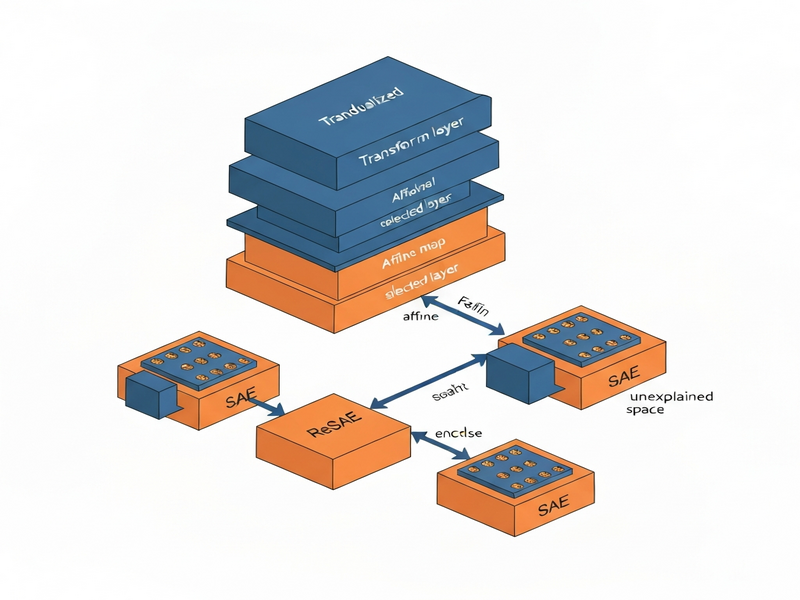
The authors present Residualized Sparse Autoencoders (ReSAEs), a framework that explicitly models the linear relationship between selected transformer layers before applying sparsity. The key ideas are:
- Affine residualization: For any target layer L, an affine transformation is learned that predicts L’s activation from a preceding “anchor” layer A. The residual (the part that cannot be linearly explained) becomes the new training target.
- Layer‑wise residual SAEs: Each subsequent SAE is trained only on its layer’s residual, ensuring that the autoencoder’s capacity focuses on novel, non‑redundant information.
- Re‑projection pipeline: After a residual SAE reconstructs its input, the reconstruction is passed back through the chain of affine maps to recover a full‑dimensional activation that can be swapped into the original model without breaking the intervention protocol.
In effect, ReSAE treats the transformer’s residual stream as a series of linear “background” signals and isolates the “foreground” components that truly drive downstream computation.
How It Works in Practice
Conceptual Workflow
- Select anchor layers: Choose a sparse set of layers (e.g., every 2‑3 layers) that will serve as reference points.
- Fit affine maps: For each pair (anchor → target), train a lightweight linear regression that predicts the target activation from the anchor activation.
- Compute residuals: Subtract the affine prediction from the true target activation, yielding a residual tensor.
- Train residual SAE: Feed the residual into a conventional sparse autoencoder, learning a dictionary of basis vectors and a sparse code.
- Re‑project for intervention: When performing a model edit, decode the sparse code, add back the affine prediction chain, and replace the original activation in the transformer.
Component Interaction
The system consists of three interacting modules:
- Affine Residualizer – a set of linear layers that capture cross‑layer predictability.
- Residual SAE – a standard sparse autoencoder (encoder, dictionary, decoder) that operates on the residual tensor.
- Intervention Engine – the runtime component that swaps decoded activations back into the model during inference or fine‑tuning.
Because the residual SAE never sees the full activation, its dictionary size can be dramatically smaller while still preserving the most informative directions. The Intervention Engine remains unchanged from existing SAE pipelines, meaning that tools built around “single‑layer replace‑and‑evaluate” can be reused without modification.
What Makes This Approach Different
- MECE capacity allocation: By removing linearly predictable content, each layer’s dictionary becomes mutually exclusive, eliminating overlap.
- Improved multi‑layer composability: When several layers are swapped together, the affine chain guarantees that the combined reconstruction respects the original linear flow, reducing unexpected interference.
- Higher relevance to downstream loss: Experiments show that even though ReSAEs reconstruct less raw variance, they retain more of the signal that matters for the model’s cross‑entropy loss.
Evaluation & Results
Testbed Models and Tasks
The authors evaluated ReSAE on two open‑source LLMs:
- Pythia‑1.4B – a 1.4‑billion‑parameter decoder‑only model.
- Gemma‑2‑9B – a 9‑billion‑parameter instruction‑tuned model.
Three families of experiments were conducted:
- Sparse probing accuracy: Measuring how well a linear probe on the sparse codes predicts downstream tasks (e.g., part‑of‑speech, sentiment).
- Targeted perturbation: Replacing a layer’s activation with its SAE reconstruction and observing the change in next‑token cross‑entropy.
- Multi‑layer replacement: Simultaneously swapping several consecutive layers and comparing the cumulative loss impact to the sum of single‑layer swaps.
Key Findings
- Reduced decoder redundancy: ReSAE’s decoders required 30‑40 % fewer dictionary entries to achieve comparable reconstruction error, confirming that linear predictability was successfully stripped away.
- Better probing at high sparsity: When the sparsity budget was tightened (e.g., 2‑4 active codes per token), ReSAE retained > 85 % of the probing performance of a standard SAE, whereas the baseline dropped below 60 %.
- Higher cross‑entropy recovery: In multi‑layer replacement tests, ReSAE recovered up to 12 % more of the original model’s cross‑entropy compared to naïve layer‑wise SAEs, especially under teacher‑forcing conditions.
- Preservation of downstream computation: Although raw variance explained was lower, the components most correlated with loss (as measured by gradient alignment) were better preserved, indicating that ReSAE focuses on “task‑relevant” features.
Collectively, these results demonstrate that residualization does not merely compress activations—it selectively isolates the information that the transformer actually uses for prediction.
Why This Matters for AI Systems and Agents
For practitioners building AI‑driven agents, the ability to edit a model’s internal state safely is a game‑changer. ReSAE offers three concrete benefits:
- More reliable debugging: Engineers can pinpoint and replace problematic concepts without worrying that hidden linear couplings will re‑introduce the same error elsewhere.
- Composable policy updates: In reinforcement‑learning‑from‑human‑feedback loops, policy adjustments often require multi‑layer tweaks. ReSAE’s composability ensures that a series of updates behaves predictably, reducing the need for costly re‑training.
- Efficient deployment on edge platforms: Smaller, non‑redundant dictionaries translate to lower memory footprints, which is valuable for on‑device inference or for platforms like the UBOS platform overview that serve many concurrent agents.
Moreover, the approach aligns with emerging standards for transparent AI. By exposing a clean, sparse representation of the truly influential components, ReSAE makes it easier to generate audit trails, comply with regulatory requirements, and integrate with governance tools such as the Workflow automation studio.
What Comes Next
While ReSAE marks a significant step forward, several avenues remain open:
- Dynamic anchor selection: Current experiments use a fixed schedule of anchor layers. Adaptive strategies that choose anchors based on information‑theoretic criteria could further shrink dictionaries.
- Cross‑modal extensions: Applying residualization to multimodal transformers (vision‑language, audio‑text) may uncover new sparsity patterns.
- Integration with agent orchestration frameworks: Embedding ReSAE‑based probes into a full‑stack agent platform—such as the AI marketing agents suite—could enable real‑time concept steering during live campaigns.
- Robustness under distribution shift: Future work should test whether residualized features remain stable when the model encounters out‑of‑distribution inputs.
Addressing these challenges will help turn ReSAE from a research prototype into a production‑ready component for large‑scale AI systems.
Conclusion
Residualized Sparse Autoencoders reframe how we think about compressing transformer activations. By first removing linearly predictable cross‑layer structure, ReSAE builds leaner, more expressive dictionaries that preserve the parts of the activation space that truly matter for downstream tasks. The empirical gains on Pythia‑1.4B and Gemma‑2‑9B demonstrate that the method improves both interpretability probes and multi‑layer intervention fidelity, paving the way for safer, more controllable AI agents.
For a deeper dive into the methodology and experimental details, consult the original ReSAE paper on arXiv.
Further Reading & Resources
Explore related tools and integrations that can help you apply ReSAE concepts in practice:
Andrii Bidochko
CTO UBOS
Andrii Bidochko is an AI entrepreneur and researcher focused on AI agents, reinforcement learning, and autonomous systems. He writes about the technologies shaping the future of machine intelligence, from frontier models and agent architectures to real-world AI applications.