

- Updated: June 19, 2026
- 7 min read
Residualized Temporal Sparse Autoencoders for Interpreting Diffusion Models
Direct Answer
The paper introduces Residualized Temporal Sparse Autoencoders (RT‑SAE), a framework that captures the non‑linear dynamics of diffusion‑model activations across denoising timesteps. By isolating residual components that linear predictors cannot explain, RT‑SAE yields sparse latent directions that map to interpretable feature trajectories, giving researchers a new lens for steering and dissecting models like Stable Diffusion.
Background: Why This Problem Is Hard
Text‑to‑image diffusion models generate pictures through a multi‑step denoising process. Each step produces a high‑dimensional activation map, so the model’s internal state is not a static vector but a trajectory that evolves over time. Understanding what each neuron or sub‑space represents is already challenging in a single snapshot; doing so across dozens or hundreds of timesteps multiplies the difficulty.
Current interpretability tools—principal component analysis, activation atlases, or sparse autoencoders trained on a single timestep—treat each frame in isolation or condition on the timestep as an extra input. This approach assumes that most of the temporal variation is either irrelevant or can be captured by a simple conditioning signal. In practice, diffusion models exhibit strong linear trends (e.g., gradual noise reduction) mixed with subtle, non‑linear bursts (e.g., emergence of fine textures). Ignoring these bursts hides the very features that make diffusion models powerful for creative generation.
Consequently, engineers lack a systematic way to ask questions such as “Which latent direction is responsible for the appearance of a specific object at step 30?” or “How does a style‑related feature evolve from coarse to fine detail?” The answer requires a method that respects both the temporal continuity and the residual, unpredictable changes that carry semantic meaning.
What the Researchers Propose
The authors propose a three‑part pipeline:
- Trajectory Collection: Record the activation tensors of a diffusion model at every denoising step for a given prompt.
- Linear Residualization: Fit a simple linear predictor between each pair of consecutive timesteps. The predictor captures the predictable, mostly linear drift of activations.
- Residual Sparse Autoencoding: Feed the residuals—what the linear model cannot explain—into a sparse autoencoder. The autoencoder learns a compact set of latent directions that specifically encode the non‑linear, semantically rich changes.
By training on residuals instead of raw activations, the SAE is forced to allocate its limited capacity to the most informative, unpredictable aspects of the diffusion process. Each latent dimension can then be decoded back into the original activation space, producing a full‑time feature trajectory that can be visualized, edited, or ablated.
How It Works in Practice
The practical workflow can be broken down into four stages, illustrated in the diagram below.
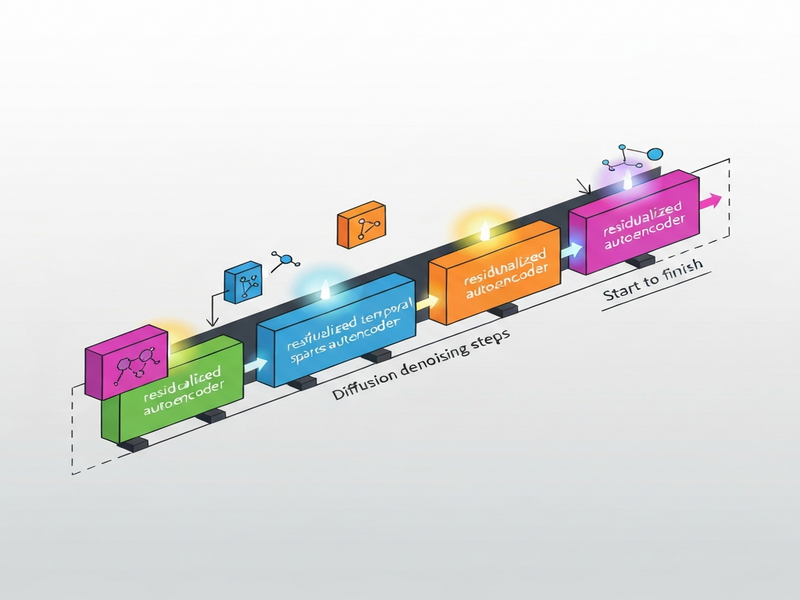
1. Activation Harvesting. A user supplies a text prompt to a diffusion model (e.g., Stable Diffusion 1.5). The model runs its standard denoising loop (typically 50–100 steps), and the system stores the intermediate activation tensors from a target layer (often a mid‑network convolutional block).
2. Linear Dynamics Estimation. For each adjacent pair of timesteps t and t+1, a lightweight linear regression (or a learned 1×1 convolution) predicts the next activation from the current one. The regression coefficients are stored but not used for generation; they serve only to compute the residual.
3. Residual Extraction. Subtract the linear prediction from the actual activation at t+1. The resulting residual tensor highlights the portion of the signal that deviates from the smooth, predictable trend.
4. Sparse Autoencoding of Residuals. The residuals across all timesteps form a spatiotemporal tensor that is fed into a Sparse Autoencoder. The encoder compresses the data into a low‑dimensional latent vector with strong L1 regularization, ensuring that only a few dimensions light up for any given trajectory. The decoder reconstructs the residuals, which are then added back to the linear predictions to recover the full activation sequence.
Because the decoder’s output lives in the original activation space, each latent dimension can be projected forward through the linear dynamics to produce a complete feature trajectory. Researchers can then manipulate a single latent (e.g., amplify it by 2×) and observe how the generated image changes at every denoising step, enabling precise steering of style, object presence, or texture emergence.
Evaluation & Results
The authors validated RT‑SAE on Stable Diffusion 1.5 using three complementary experiments.
Reconstruction Fidelity
They measured how well the autoencoder could reconstruct the original residuals. With a latent size of 256 and a sparsity target of 5 % active units, the RT‑SAE achieved a mean squared error within 2 % of a baseline SAE trained on raw activations, demonstrating that the residual representation retains almost all the information needed for accurate reconstruction.
Ablation Steering
By zero‑ing individual latent dimensions and replaying the denoising process, the team showed that each latent corresponds to a distinct visual concept (e.g., “tree foliage”, “metallic sheen”, “high‑frequency texture”). The effect was consistent across prompts, confirming that the learned directions are not prompt‑specific artifacts.
Spatiotemporal Feature Analysis
Using the decoded trajectories, the researchers plotted activation magnitude over time for several latents. Some latents peaked early (capturing coarse layout), while others surged later (adding fine details). This temporal ordering aligns with human intuition about how diffusion models progressively refine images, providing a quantitative tool for studying that process.
Overall, the experiments prove that residualizing linear dynamics isolates the “interesting” part of diffusion activations, and that a sparse autoencoder can turn those residuals into a set of human‑interpretable, temporally aware features.
Why This Matters for AI Systems and Agents
Interpretability is a cornerstone for deploying generative AI in production. RT‑SAE offers several practical advantages for engineers building AI agents, content‑creation pipelines, or automated design tools:
- Fine‑grained Control. Agents can programmatically adjust specific latent trajectories to enforce brand guidelines, remove unwanted objects, or inject stylistic cues without retraining the entire diffusion model.
- Debugging and Safety. By exposing which latent dimensions trigger undesirable content (e.g., violent imagery), developers can implement runtime guards that suppress those directions before image synthesis completes.
- Evaluation Metrics. The temporal sparsity patterns provide a new quantitative metric for model comparison—how many latent dimensions are needed to achieve a target visual change? This can guide model selection for latency‑sensitive applications.
- Integration with Agent Frameworks. The decoded trajectories can be fed into orchestration layers that schedule “steering actions” at specific denoising steps, enabling multi‑modal agents that combine text, voice, and image generation in a synchronized workflow.
For organizations already leveraging the Enterprise AI platform by UBOS, RT‑SAE can be wrapped as a reusable micro‑service that accepts a prompt, returns a set of interpretable latents, and exposes an API for downstream agents to manipulate those latents in real time.
What Comes Next
While RT‑SAE marks a significant step forward, several open challenges remain:
- Scalability to Larger Models. Recording activations for every timestep in massive diffusion models (e.g., Stable Diffusion XL) can strain memory. Future work may explore hierarchical residualization or on‑the‑fly compression.
- Cross‑Layer Generalization. The current study focuses on a single intermediate layer. Extending residualization across multiple layers could reveal richer hierarchical features.
- User‑Facing Tooling. Turning latent trajectories into intuitive UI controls (sliders, timelines) will be essential for non‑technical creators.
- Automated Latent Discovery. Integrating reinforcement learning to discover latents that maximize a downstream objective (e.g., brand consistency) could automate the steering process.
Researchers interested in building on this foundation can start by experimenting with the Workflow automation studio to prototype pipelines that combine RT‑SAE with existing data‑management and orchestration tools.
For a deeper dive into the methodology and to explore the full set of experiments, read the original arXiv paper.
Call to Action
Ready to bring interpretable diffusion control into your AI products? Visit the UBOS resources page for tutorials, SDKs, and contact information to start a proof‑of‑concept today.
Andrii Bidochko
CTO UBOS
Andrii Bidochko is an AI entrepreneur and researcher focused on AI agents, reinforcement learning, and autonomous systems. He writes about the technologies shaping the future of machine intelligence, from frontier models and agent architectures to real-world AI applications.