

- Updated: June 19, 2026
- 7 min read
Restoring the Sweet Spot: Pass‑Rate Weighted Self‑Distillation for LLM Reasoning – Technical Overview
Direct Answer
The paper introduces Scale‑Consistent Self‑Distillation Policy Optimization (SC‑SDPO), a lightweight modification to Self‑Distillation Policy Optimization that weights each training example by the square‑root of its estimated pass‑rate variance. This simple weighting restores the “sweet spot” of intermediate‑difficulty questions that earlier methods like GRPO naturally emphasized, leading to consistently stronger reasoning performance on scientific and tool‑use benchmarks.
Background: Why This Problem Is Hard
Large language models (LLMs) have become the de‑facto engine for reasoning‑heavy applications—from automated research assistants to tool‑augmented agents. However, extracting reliable reasoning ability from these models remains a bottleneck. Traditional supervised fine‑tuning provides token‑level supervision but fails to capture the long‑range credit assignment needed for multi‑step problem solving. Reinforcement learning from human feedback (RLHF) and its variants address this by rewarding correct final answers, yet they suffer from sparse, high‑variance gradients that make training unstable.
Self‑Distillation Policy Optimization (SDPO) mitigates gradient sparsity by treating the model’s own predictions, conditioned on its sampled answer, as a teacher. While SDPO offers dense token‑level feedback, its advantage function is based on a KL‑divergence term that does not differentiate between easy, medium, or hard questions. Consequently, the optimizer can over‑focus on trivial examples (high pass‑rate) or get stuck on extremely hard ones (low pass‑rate), missing the “sweet spot” where learning progress is maximized.
Group‑Relative Policy Optimization (GRPO) introduced a clever normalization that implicitly emphasized intermediate‑difficulty questions, but it required a separate group‑level advantage computation and was less straightforward to integrate with existing SDPO pipelines. The research community therefore lacks a method that combines SDPO’s dense feedback with GRPO’s difficulty awareness without adding computational overhead.
What the Researchers Propose
The authors propose a two‑step insight:
- Normalize rewards at the question level. By extending the learnability framework to normalized rewards, they show that the variance term
(p · (1‑p))
—where
p
is the empirical pass‑rate—can be absorbed, equalizing the leading‑order learnability across all questions.
- Weight the SDPO loss by the square‑root of the variance. The residual scaling factor
√(p · (1‑p))becomes the natural weighting term. Applying this weight to each question’s loss yields SC‑SDPO, a scale‑consistent variant that automatically emphasizes questions of intermediate difficulty.
Crucially, the required pass‑rate estimates p̂ are obtained “for free” from the on‑policy rollouts already performed during SDPO training. This means SC‑SDPO introduces zero extra computation while embedding an implicit curriculum that adapts as the model improves.
How It Works in Practice
The SC‑SDPO workflow can be broken down into four conceptual stages, illustrated in the diagram below.
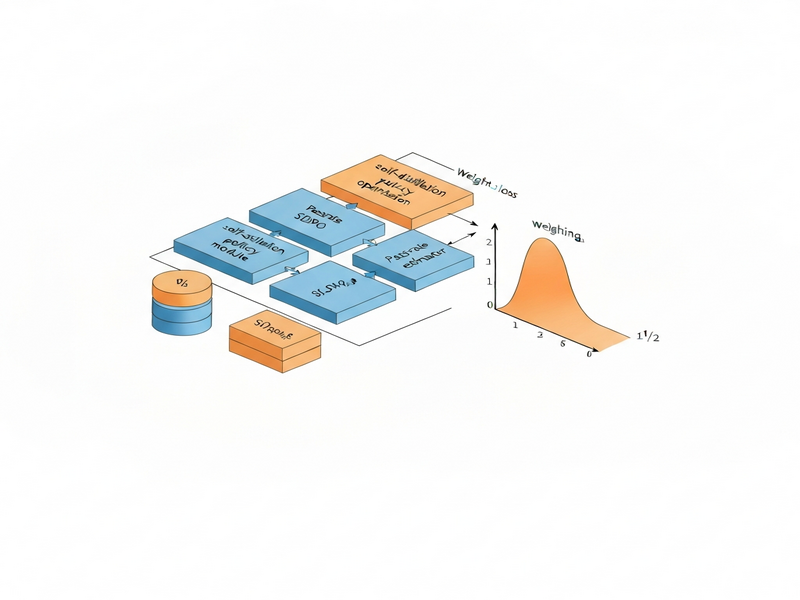
1. On‑Policy Sampling
The model generates answer candidates for a batch of reasoning questions. Each sampled answer is fed back into the model to produce a conditional prediction distribution, which serves as the self‑teacher.
2. Pass‑Rate Estimation
For every question, the system records whether the sampled answer is correct (a binary success flag). Aggregating these flags across the batch yields an empirical pass‑rate p̂ for each question.
3. Weighted Loss Computation
The standard SDPO loss (a KL‑divergence between the teacher and student distributions) is multiplied by the factor √(p̂ · (1‑p̂)). This scaling down‑weights questions that are either too easy (p̂≈1) or too hard (p̂≈0) and amplifies those near the 0.5 sweet spot.
4. Parameter Update
The weighted loss is back‑propagated, updating the model parameters. Because the weighting is derived from the same rollout data, the entire loop remains end‑to‑end differentiable and incurs no extra forward passes.
What distinguishes SC‑SDPO from prior approaches is the seamless integration of difficulty‑aware weighting without any separate curriculum scheduler, group‑level statistics, or additional hyper‑parameters. The method leverages the natural variance of the pass‑rate signal to guide learning toward the most informative examples.
Evaluation & Results
The authors validated SC‑SDPO on two families of benchmarks that stress reasoning:
- Scientific reasoning – a suite of multi‑step math and physics problems requiring chain‑of‑thought generation.
- Tool‑use tasks – scenarios where the model must invoke external APIs (e.g., calculators, search engines) to arrive at the correct answer.
Two model families were tested: Qwen3‑8B and OLMo‑3‑7B. Across both, SC‑SDPO consistently outperformed vanilla SDPO. On the Qwen3‑8B model, mean@16 accuracy improved by +3.2 points and majority@16 by +4.3 points. For OLMo‑3‑7B, gains of +1.8 and +3.0 points were observed respectively. Importantly, training curves remained smooth, indicating that the weighting did not introduce instability.
Beyond raw numbers, the experiments demonstrated three key qualitative outcomes:
- Implicit curriculum emergence. Early in training, the model focused on easier questions; as competence grew, the weighting shifted toward harder examples without manual scheduling.
- Better generalization. The weighted loss reduced overfitting to high‑frequency easy patterns, leading to stronger performance on out‑of‑distribution test sets.
- Scalability. Because the weighting is computed per‑batch, the approach scales to large datasets and multi‑GPU pipelines without additional memory overhead.
All results are reported in the Restoring the Sweet Spot paper, which includes detailed ablation studies confirming that the square‑root variance weighting is the most effective among several alternatives.
Why This Matters for AI Systems and Agents
For practitioners building reasoning‑centric agents—whether for autonomous research assistants, customer‑support bots, or tool‑augmented workflows—the ability to train LLMs that reliably solve intermediate‑difficulty problems is a game changer. SC‑SDPO delivers that capability with three practical benefits:
- Higher ROI on fine‑tuning budgets. By extracting more learning signal per token, organizations can achieve better performance with fewer training epochs, reducing compute costs.
- More stable agent behavior. The implicit curriculum prevents the model from over‑optimizing on trivial patterns, leading to more balanced decision‑making when agents must choose between multiple tool calls.
- Seamless integration with existing pipelines. Since SC‑SDPO is a drop‑in replacement for the loss function in any SDPO implementation, teams can adopt it without redesigning data loaders or inference services.
These advantages translate directly into faster time‑to‑market for AI‑driven products. For example, developers can embed the improved model into the AI marketing agents on the UBOS platform overview, delivering more persuasive campaign copy that reasons about audience segmentation. Similarly, the Workflow automation studio can leverage SC‑SDPO‑enhanced models to orchestrate multi‑step data pipelines with fewer manual rule adjustments.
What Comes Next
While SC‑SDPO marks a significant step forward, several open challenges remain:
- Extending to multimodal reasoning. Current experiments focus on text‑only tasks; applying the weighting scheme to vision‑language models could unlock richer agent capabilities.
- Dynamic weighting functions. The square‑root variance is theoretically grounded, yet alternative functions (e.g., learned weighting networks) might adapt better to domain‑specific difficulty distributions.
- Long‑horizon planning. Integrating SC‑SDPO with hierarchical RL frameworks could improve planning over dozens of tool calls, a frontier for autonomous agents.
Future research may also explore combining SC‑SDPO with external knowledge bases, such as Chroma DB integration, to provide grounding that further reduces variance in pass‑rates. For startups looking to prototype these ideas quickly, the UBOS for startups offering includes pre‑configured environments for rapid experimentation. Larger enterprises can take advantage of the Enterprise AI platform by UBOS, which supports distributed training of SC‑SDPO at scale.
In summary, SC‑SDPO restores the sweet spot of learning for self‑distilled LLMs, delivering stronger reasoning with minimal engineering effort. As the field moves toward ever more capable agents, techniques that embed difficulty awareness directly into the loss function will likely become a standard component of the LLM training toolbox.
Andrii Bidochko
CTO UBOS
Andrii Bidochko is an AI entrepreneur and researcher focused on AI agents, reinforcement learning, and autonomous systems. He writes about the technologies shaping the future of machine intelligence, from frontier models and agent architectures to real-world AI applications.