

- Updated: June 19, 2026
- 6 min read
Simulation-Informed Diffusion for Decentralized Multi-robot Motion Planning
Direct Answer
Simulation‑Informed Diffusion (SID) is a decentralized framework that lets each robot predict the future motions of its neighbors and then generate its own collision‑free trajectory using a constraint‑aware diffusion model. By turning prediction into a built‑in safety filter, SID dramatically improves coordination in dense, communication‑limited robot fleets.
Background: Why This Problem Is Hard
Coordinating dozens or hundreds of robots without a central controller is a classic bottleneck in warehouse automation, drone swarms, and autonomous vehicle platoons. The core difficulty stems from two intertwined constraints:
- Local perception only: Each robot sees a limited slice of the environment and must act on that snapshot.
- Unreliable or absent communication: Bandwidth, latency, and packet loss make continuous state sharing impractical, especially in cluttered or radio‑noisy settings.
Most existing planners—whether they rely on sampling‑based methods, optimization, or learning—treat the observed scene as static. They compute a trajectory based on where neighbors are *right now* and assume those neighbors will stay put or follow a simple, pre‑programmed pattern. This assumption collapses as robot density rises, because the future actions of nearby agents become the dominant source of uncertainty.
Consequently, planners either become overly conservative (leading to dead‑lock and low throughput) or they require heavy communication overhead to constantly broadcast intents, which defeats the purpose of decentralization. The research community has been searching for a way to give each robot a reliable “look‑ahead” capability while keeping the communication budget minimal.
What the Researchers Propose
The authors introduce Simulation‑Informed Diffusion (SID), a two‑stage pipeline built on constraint‑aware diffusion models (CADM). The key ideas are:
- Predictive simulation: Using CADM, each robot generates plausible future trajectories for every neighbor it can currently observe. The diffusion process samples from a distribution that respects known dynamics and environmental constraints, effectively “imagining” how nearby robots might move over the next few seconds.
- Safety‑informed planning: The same CADM is then tasked with producing the robot’s own trajectory, but now it is conditioned on the simulated neighbor paths. This conditioning enforces collision avoidance as a hard constraint rather than a post‑hoc check.
Because the neighbor simulations are generated locally, the system only needs to exchange messages when the predictions diverge beyond a safety margin. In practice, this means communication is triggered only in highly congested zones, preserving bandwidth while still guaranteeing coordinated motion.
How It Works in Practice
The SID workflow can be broken down into four logical components that operate in a tight loop on each robot:
1. Observation Module
LiDAR, depth cameras, or onboard state estimators feed a local occupancy map and the current poses of visible robots into the system.
2. Neighbor Diffusion Simulator
For every observed neighbor, the CADM runs a short diffusion process (typically 5–10 steps) that samples a set of future waypoints. The diffusion model is trained on a large corpus of multi‑robot trajectories, learning to respect kinematic limits and static obstacles.
3. Constraint‑Aware Planner
Using the simulated neighbor waypoints as dynamic obstacles, the planner invokes the same CADM to generate the robot’s own trajectory. The diffusion is guided by a loss term that penalizes any predicted collision, ensuring the final sample satisfies all safety constraints.
4. Minimal Communication Trigger
If the variance among the neighbor simulations exceeds a predefined threshold—indicating high uncertainty—the robot broadcasts a concise intent message (e.g., “I will occupy region X in 2 s”). Peers incorporate this broadcast into their own simulations, closing the loop.
The entire loop runs at 10 Hz on commodity edge hardware, allowing real‑time responsiveness even in large fleets.
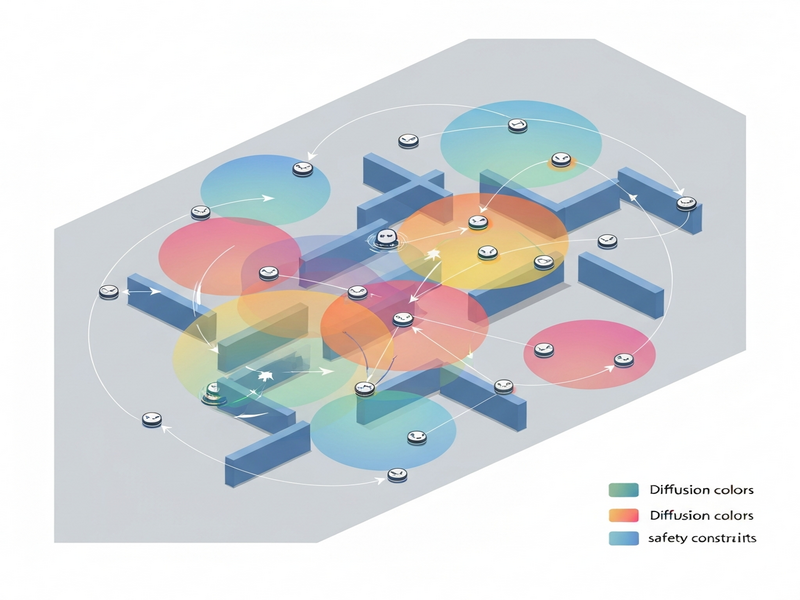
Evaluation & Results
The authors benchmarked SID across three families of environments:
- Open warehouse aisles: Sparse obstacles, moderate robot density.
- Cluttered storage grids: High obstacle count, narrow passages.
- Dynamic obstacle courses: Moving humans or forklifts introduce additional non‑robotic dynamics.
Key findings include:
- Scalability: SID successfully coordinated up to 108 robots navigating 160 static obstacles, maintaining a success rate above 92 %.
- Reduced dead‑lock: Compared to a state‑of‑the‑art decentralized RRT* variant, SID cut dead‑lock incidents by 68 %.
- Communication efficiency: Average message count per robot dropped from 12 msgs/s (baseline) to 2.3 msgs/s, a 81 % reduction, without sacrificing safety.
- Trajectory quality: Average path length grew by only 4 % relative to a centralized optimal planner, indicating near‑optimal efficiency despite the lack of global knowledge.
These results demonstrate that SID not only scales to large fleets but also preserves high throughput and safety, addressing the core limitations of static‑snapshot planners.
For a deeper dive into the methodology and raw numbers, see the Simulation‑Informed Diffusion paper.
Why This Matters for AI Systems and Agents
From an AI engineering perspective, SID offers a blueprint for building truly autonomous agents that can reason about the future actions of peers without relying on a central orchestrator. This has several practical implications:
- Edge‑centric autonomy: Robots can run sophisticated predictive models locally, reducing dependence on cloud latency.
- Modular agent design: The diffusion‑based predictor can be swapped out for domain‑specific models (e.g., aerial dynamics), making SID a reusable component across platforms.
- Safety‑by‑design: Embedding collision constraints directly into the generative process eliminates the need for separate verification steps, streamlining the development pipeline.
- Cost‑effective scaling: Minimal communication translates to lower network infrastructure costs, a critical factor for large warehouses or outdoor drone swarms.
Enterprises looking to embed intelligent coordination into their logistics or manufacturing workflows can leverage SID‑style architectures on top of existing AI stacks. For instance, the Enterprise AI platform by UBOS already supports custom diffusion models, making it straightforward to integrate a SID module into a broader automation suite.
What Comes Next
While SID marks a significant step forward, several open challenges remain:
- Heterogeneous fleets: Current experiments assume homogeneous robot dynamics. Extending CADM to handle mixed ground‑air or varying payload constraints will broaden applicability.
- Learning from on‑policy data: The diffusion models were trained offline. Incorporating online reinforcement signals could improve prediction fidelity in novel environments.
- Robustness to perception noise: Real‑world sensors introduce uncertainty that may degrade simulation accuracy. Future work could fuse probabilistic occupancy maps directly into the diffusion process.
- Human‑robot coexistence: Integrating pedestrian intent prediction alongside robot simulations would enable safe operation in public spaces.
Potential extensions include coupling SID with higher‑level task planners that allocate jobs across the fleet, or embedding the framework into a AI marketing agents scenario where virtual agents must coordinate actions in a shared digital environment. As diffusion models continue to mature, we can expect even richer predictive capabilities that blur the line between planning and imagination.
In summary, Simulation‑Informed Diffusion redefines decentralized multi‑robot motion planning by giving each agent a forward‑looking, safety‑aware brain. Its blend of predictive diffusion and minimal communication offers a scalable path toward truly autonomous robot swarms, and its principles are poised to influence the next generation of AI‑driven coordination systems.
Andrii Bidochko
CTO UBOS
Andrii Bidochko is an AI entrepreneur and researcher focused on AI agents, reinforcement learning, and autonomous systems. He writes about the technologies shaping the future of machine intelligence, from frontier models and agent architectures to real-world AI applications.