

- Updated: June 18, 2026
- 5 min read
Not All NVFP4 QAT Recipes Are Equal: How Architecture and Scale Shape Model Quality for Anomaly Segmentation
Direct Answer
The paper Not All NVFP4 QAT Recipes Are Equal shows that the choice of neural architecture dominates the robustness of 4‑bit quantization‑aware training (QAT) for real‑time anomaly segmentation, with Swin Transformers staying stable across all recipe variations and model scales. This matters because it gives practitioners a clear, hardware‑friendly path to deploy high‑recall medical‑imaging models on edge devices without sacrificing diagnostic quality.
Background: Why This Problem Is Hard
Anomaly segmentation—especially in high‑stakes domains like brain‑tumor detection—requires two seemingly contradictory properties:
- Recall‑critical inference: Missing a lesion can have severe clinical consequences, so models must flag even subtle abnormalities.
- Low‑precision, real‑time execution: Hospitals and remote clinics often rely on commodity GPUs or specialized ASICs that cannot afford 32‑bit floating‑point arithmetic.
Existing pipelines typically address one side of the equation. High‑precision CNNs achieve state‑of‑the‑art Dice scores but demand 16‑ or 32‑bit arithmetic, inflating latency and power consumption. Conversely, aggressive quantization (e.g., 4‑bit integer) slashes memory footprints but frequently collapses softmax distributions, leading to “attention‑collapse” or noisy gradients that erode recall.
Compounding the issue, most prior work evaluates quantization in isolation—using a single architecture, a single scale, and a single QAT recipe. This siloed approach hides the three‑way interaction between model design, size, and training tricks, leaving engineers guessing which combination will survive the harsh constraints of edge deployment.
What the Researchers Propose
Du and Rybakov introduce a systematic, three‑dimensional benchmarking framework that jointly varies:
- Architecture family: Convolutional Neural Networks (CNNs) versus attention‑based Vision Transformers (ViTs), specifically the Swin Transformer.
- Model scale: Small (≈1 M parameters), medium (≈5 M), and large (≈20 M) configurations.
- FP4 QAT recipe: Four distinct training pipelines ranging from naïve 4‑bit rounding to advanced gradient‑noise‑reduction techniques (e.g., stochastic rounding, learned clipping, and per‑layer calibration).
The core hypothesis is that architecture choice will dictate how sensitive a model is to quantization noise, and that sophisticated QAT recipes may only help when the underlying network can tolerate the noise.
How It Works in Practice
The experimental workflow can be visualized as a three‑axis grid:
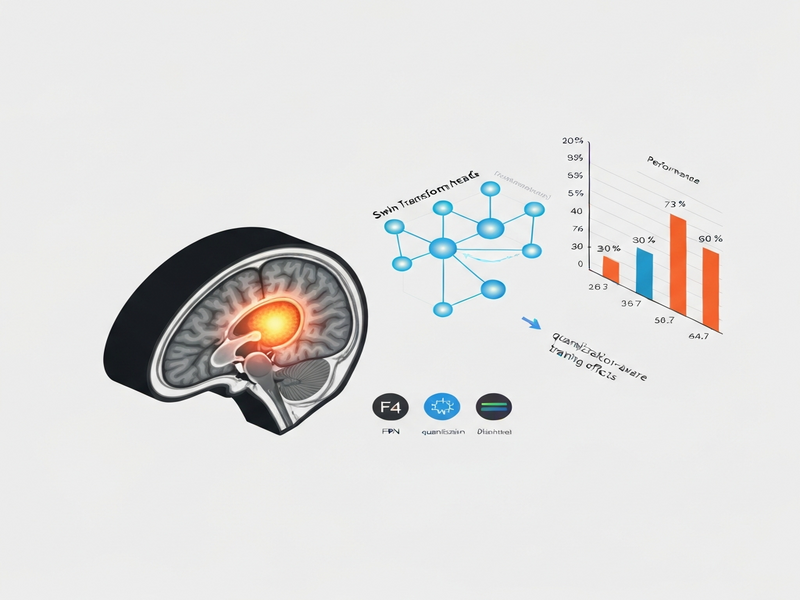
- Data preparation: A curated brain‑MRI dataset with pixel‑level tumor annotations is split into five patient‑wise folds to ensure cross‑validation robustness.
- Model instantiation: For each axis point, a network is built (e.g., a 5 M Swin‑Tiny or a 5 M ResNet‑34) and initialized with ImageNet weights.
- Quantization‑aware training: The selected QAT recipe injects 4‑bit quantizers into both forward activations and backward gradients. Advanced recipes add learnable scaling factors and noise‑shaping modules.
- Evaluation: After training, models are frozen, exported to a 4‑bit inference engine, and run on the held‑out test folds. Recall, precision, and inference latency are recorded.
What sets this approach apart is the uniform protocol: every combination is trained for the same number of epochs, uses identical data augmentations, and is evaluated under identical hardware constraints. This eliminates confounding variables and isolates the true impact of architecture, scale, and QAT recipe.
Evaluation & Results
The study reports three major findings:
- Architecture dominates quantization robustness: Swin Transformers maintain high recall (>92%) across all scales and QAT recipes, while CNNs suffer up to a 15% recall drop when paired with aggressive gradient‑quantizing recipes.
- Scale interacts with recipe complexity: At low capacity (≈1 M parameters), even the Swin model can experience “softmax discretization”—the attention scores collapse to a few discrete values—unless an advanced recipe (stochastic rounding + per‑layer clipping) is used.
- Advanced recipes rescue CNNs only at larger scales: When the CNN reaches ≈20 M parameters, sophisticated QAT tricks mitigate gradient noise enough to close the recall gap with Transformers, but the training overhead remains higher.
Five‑fold patient‑level cross‑validation confirms that these trends are not artifacts of a particular split. Moreover, latency measurements show that FP4‑quantized Swin models run 2–3× faster than their 16‑bit CNN counterparts on the same edge GPU, while preserving diagnostic quality.
Why This Matters for AI Systems and Agents
For AI practitioners building real‑time medical‑imaging pipelines, the paper delivers a decisive rule‑of‑thumb: choose an attention‑based architecture if you need 4‑bit quantization robustness. This insight translates into concrete system design choices:
- Edge deployment: Swin‑based anomaly detectors can be packaged into lightweight containers and run on portable ultrasound devices, enabling point‑of‑care diagnostics without cloud connectivity.
- Agent orchestration: In multi‑agent workflows where a segmentation model feeds downstream diagnosis agents, the predictable latency of FP4 Swin models simplifies scheduling and reduces overall pipeline jitter.
- Resource budgeting: Companies can allocate fewer GPU cores to inference, freeing compute for other agents (e.g., natural‑language report generation) and lowering operational costs.
These practical benefits align with broader enterprise AI strategies. For example, the UBOS platform overview highlights how modular AI components can be swapped without breaking orchestration, and a Swin‑based segmentation module fits neatly into that plug‑and‑play paradigm.
What Comes Next
While the findings are compelling, several open challenges remain:
- Generalization beyond brain MRI: The study focuses on a single modality; extending the benchmark to CT, X‑ray, or histopathology will test whether the architecture advantage holds universally.
- Mixed‑precision strategies: Combining FP4 for early layers with higher precision for attention heads could further shrink latency while preserving accuracy.
- Automated recipe selection: Meta‑learning or reinforcement‑learning agents could dynamically choose the optimal QAT recipe based on model size and target hardware.
Future research may also explore integrating these quantized models into end‑to‑end AI agents that generate radiology reports. The AI marketing agents page illustrates how UBOS enables rapid composition of such pipelines, and a similar approach could accelerate clinical‑AI deployments.
Finally, developers interested in building conversational assistants that query the segmentation service can leverage the OpenAI ChatGPT integration to turn raw anomaly maps into natural‑language explanations, closing the loop between perception and communication.
Andrii Bidochko
CTO UBOS
Andrii Bidochko is an AI entrepreneur and researcher focused on AI agents, reinforcement learning, and autonomous systems. He writes about the technologies shaping the future of machine intelligence, from frontier models and agent architectures to real-world AI applications.