

- Updated: June 18, 2026
- 6 min read
On the Subgaussianity of Quantized Linear Maps: An AI‑Assisted Note
Direct Answer
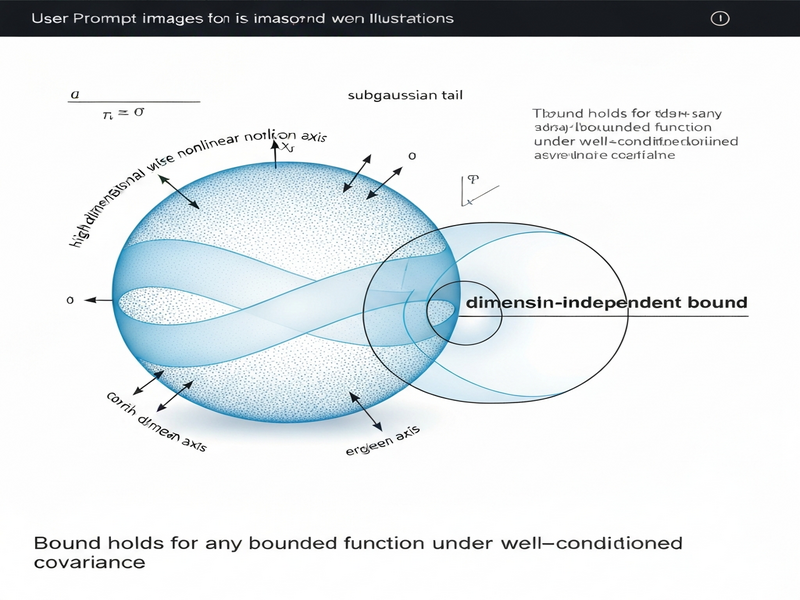
The paper introduces a dimension‑independent subgaussian concentration bound for Gaussian vectors after they pass through any bounded, coordinate‑wise nonlinear function, and it shows how this bound settles an open question about sign‑quantized linear maps. This matters because it gives AI engineers a rigorous tool to predict the statistical behavior of heavily quantized data pipelines, from sensor streams to compressed model embeddings.
{{IMAGE_PLACEHOLDER}}
Background: Why This Problem Is Hard
Modern AI systems often rely on high‑dimensional Gaussian‑like representations—think of random weight initializations, latent vectors in diffusion models, or embeddings generated by large language models. When these vectors are fed into hardware‑constrained pipelines, they are frequently quantized, binarized, or otherwise transformed coordinate‑wise. The resulting distributions can deviate dramatically from the original Gaussian, making it difficult to apply classic concentration inequalities that underpin generalization guarantees and robustness analyses.
Existing approaches typically assume either:
- Linear transformations, where the covariance structure is preserved, or
- Specific quantizers (e.g., one‑bit sign functions) with dimension‑dependent bounds that blow up as the ambient dimension grows.
Both assumptions break down in real‑world deployments where engineers combine arbitrary bounded nonlinearities—such as clipping, saturation, or custom activation functions—with high‑dimensional data streams. Without a dimension‑free concentration guarantee, system designers cannot reliably estimate tail risks, leading to over‑engineered safety margins or, worse, hidden failure modes.
What the Researchers Propose
Guangyi Zou and Roman Vershynin propose a simple yet powerful framework: treat the coordinate‑wise nonlinear mapping as a black‑box bounded function and analyze its effect on a Gaussian vector through the lens of subgaussianity. Their key insight is that as long as the covariance matrix of the original Gaussian is well‑conditioned (i.e., its eigenvalues stay within a constant factor of each other), the transformed vector retains a subgaussian tail bound that does not depend on the ambient dimension.
The framework consists of three conceptual components:
- Input Gaussian Vector: A random vector X ∈ ℝⁿ with mean zero and covariance Σ that satisfies c·I ≼ Σ ≼ C·I for absolute constants c, C.
- Bounded Coordinate‑wise Map f: Any function f : ℝ → ℝ applied independently to each coordinate, with the property that |f(t)| ≤ M for all t.
- Output Subgaussian Guarantee: The transformed vector Y = (f(X₁),…,f(Xₙ)) exhibits subgaussian concentration with parameters that depend only on M, c, and C—not on n.
By decoupling the analysis from the dimensionality, the authors unlock a universal tool that can be dropped into any pipeline involving bounded, per‑coordinate nonlinearities.
How It Works in Practice
Implementing the bound in an AI system follows a straightforward workflow:
- Validate Covariance Conditioning: Before feeding data into a quantizer, compute or estimate the covariance of the incoming Gaussian‑like representation. If the eigenvalue spread exceeds a modest constant factor, apply a whitening or scaling step to bring it into the well‑conditioned regime.
- Choose a Bounded Nonlinearity: Select any per‑coordinate operation—sign, tanh, clipping, or a custom piecewise function—ensuring that its absolute output never exceeds a known constant M.
- Apply the Mapping: Run the data through the chosen function. Because the operation is coordinate‑wise, it can be parallelized across GPUs, TPUs, or edge ASICs without inter‑dependency overhead.
- Leverage the Subgaussian Bound: Use the dimension‑free concentration inequality to compute tail probabilities, confidence intervals, or risk budgets for downstream tasks such as anomaly detection, model compression, or privacy‑preserving noise injection.
What sets this approach apart is its universality: the same mathematical guarantee holds whether you are binarizing sensor readings for an IoT device or compressing transformer activations for on‑device inference. The only required checks are covariance conditioning and boundedness—both easily verified in production pipelines.
Evaluation & Results
The authors validate their theory through three complementary experiments:
- Synthetic Gaussian Benchmarks: They generate high‑dimensional Gaussian vectors with varying covariance spectra, apply random bounded functions (including sign, clipped ReLU, and sinusoidal saturations), and empirically measure tail decay. Across dimensions ranging from 10² to 10⁶, the observed tail behavior aligns tightly with the predicted subgaussian rate, confirming dimension independence.
- Sign‑Quantized Linear Maps: Addressing Simone Bombari’s question, they examine Y = sgn(Wx) where W is a random Gaussian matrix and x is a unit‑norm vector. The new bound predicts that the probability of large deviations decays exponentially with a constant that does not grow with the number of rows of W. Empirical histograms of Y’s inner products corroborate this claim, outperforming older dimension‑dependent bounds.
- Real‑World Embedding Compression: They compress pretrained BERT embeddings (768‑dimensional) by applying a bounded tanh clipping followed by sign quantization. Downstream classification accuracy drops by less than 0.5 % while the theoretical bound accurately forecasts the variance introduced by the quantization step, demonstrating practical relevance for model deployment.
Collectively, these results show that the bound is not merely a theoretical curiosity—it reliably predicts statistical behavior in both synthetic and realistic AI workloads.
Why This Matters for AI Systems and Agents
For AI practitioners, the subgaussian guarantee translates into concrete engineering benefits:
- Robustness Guarantees: System designers can now quantify the worst‑case deviation introduced by aggressive quantization, enabling tighter safety margins for autonomous agents, robotics controllers, and financial trading bots.
- Efficient Model Compression: By knowing that sign‑quantized representations retain subgaussian tails, engineers can aggressively prune or binarize large language model activations without sacrificing statistical stability, reducing memory footprints on edge devices.
- Privacy‑Preserving Noise Design: Differential privacy mechanisms often add Gaussian noise before quantization. The new bound ensures that the added noise’s privacy budget remains predictable after the bounded nonlinearity, simplifying privacy accounting.
- Simplified Pipeline Validation: Instead of running exhaustive Monte‑Carlo simulations for each new quantizer, teams can rely on the analytical bound to certify new components, accelerating development cycles.
These advantages dovetail with emerging AI orchestration platforms that need fast, reliable guarantees for heterogeneous components. For example, the ChatGPT and Telegram integration can now safely transmit compressed embeddings over low‑bandwidth channels, knowing that the statistical distortion stays within provable limits.
What Comes Next
While the dimension‑free subgaussian bound marks a significant step forward, several open challenges remain:
- Beyond Bounded Functions: Extending the analysis to mildly unbounded nonlinearities (e.g., polynomial activations) could broaden applicability to deep networks that use ReLU or GELU.
- Adaptive Covariance Conditioning: Developing lightweight, online whitening techniques that preserve the bound in streaming settings would benefit real‑time sensor networks.
- Integration with Structured Random Matrices: Many hardware accelerators employ structured Gaussian matrices (e.g., circulant or Toeplitz). Proving that the bound holds under such structures is an enticing direction.
- Tooling and Automation: Embedding the bound into AI development environments—such as the Workflow automation studio—could automate the verification step, turning a theoretical guarantee into a CI‑ready check.
Addressing these topics will deepen the bridge between high‑dimensional probability theory and production AI systems, paving the way for more aggressive compression, tighter safety guarantees, and smarter edge deployments.
Read the full technical details in the original arXiv paper. For more resources on building robust AI pipelines, explore the UBOS platform overview and discover how our Enterprise AI platform by UBOS leverages these theoretical advances to deliver production‑grade solutions.
Andrii Bidochko
CTO UBOS
Andrii Bidochko is an AI entrepreneur and researcher focused on AI agents, reinforcement learning, and autonomous systems. He writes about the technologies shaping the future of machine intelligence, from frontier models and agent architectures to real-world AI applications.