

- Updated: June 18, 2026
- 6 min read
Clinical Validation of the Melanoscope AI Mobile Dermoscopy Clinical Decision Support System
Direct Answer
The paper introduces Melanoscope AI, a mobile dermoscopy clinical decision support system (CDSS) that combines cascade deep‑learning models with a quantitative interpretability assessment and a three‑zone patient‑routing algorithm. It matters because it demonstrates, in a real‑world Russian outpatient setting, that AI‑augmented skin‑lesion triage can improve early cancer detection while addressing dermatologist shortages.
Background: Why This Problem Is Hard
Early identification of malignant skin lesions remains a bottleneck for public health, especially in regions where board‑certified dermatologists are scarce. The challenges are threefold:
- Clinical variability: Benign and malignant lesions often share visual features, making manual inspection error‑prone.
- Resource constraints: Rural clinics lack high‑resolution dermatoscopes and specialist expertise, limiting screening coverage.
- Trust and adoption: Existing AI tools provide black‑box predictions without clear explanations, hindering clinician confidence and regulatory approval.
Traditional computer‑vision pipelines rely on a single monolithic classifier, which struggles to balance sensitivity (catching cancers) with specificity (avoiding unnecessary biopsies). Moreover, most studies stop at retrospective validation on curated datasets, leaving a gap in prospective, workflow‑integrated evidence.
What the Researchers Propose
To overcome these obstacles, the authors present a cascade architecture that layers three deep‑learning models, each tuned for a specific decision tier:
- Pre‑screening net: Quickly discards clearly benign lesions, preserving computational budget.
- Intermediate net: Flags lesions that require further scrutiny, generating a confidence score and a visual heatmap.
- Diagnostic net: Delivers a final malignancy probability and a class‑specific explanation.
Alongside the cascade, the paper introduces a quantitative interpretability assessment that translates heatmap overlap into a numeric “explainability score.” This score feeds a three‑zone routing algorithm:
- Green zone: High confidence benign → patient can be reassured on‑site.
- Yellow zone: Moderate confidence → referral to a tele‑dermatology review.
- Red zone: High confidence malignant → immediate in‑person specialist referral.
The framework is deliberately modular, allowing each component to be swapped or upgraded without disrupting the overall workflow.
How It Works in Practice
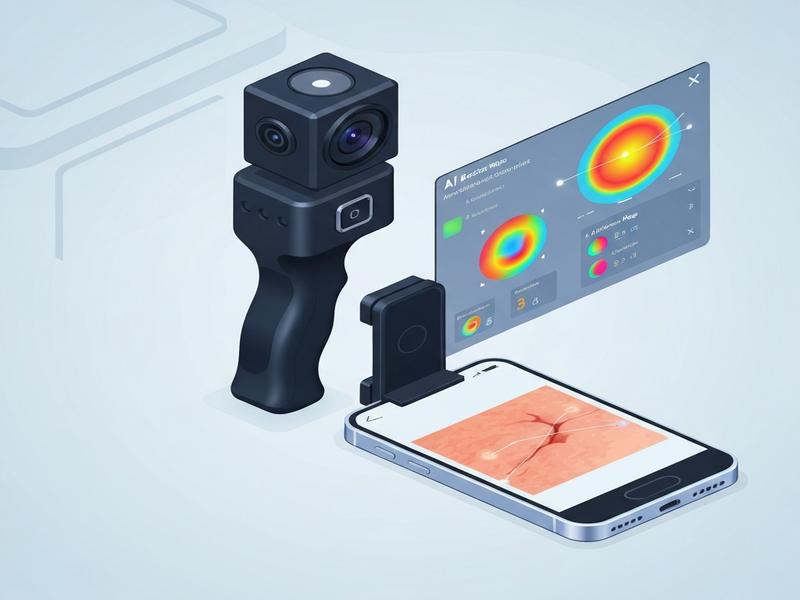
In a typical outpatient visit, the clinician captures a dermoscopic image using a smartphone‑attached lens. The image is then processed through the following pipeline:
- Image ingestion: The mobile app encrypts the photo and sends it to a secure cloud endpoint.
- Cascade inference: The pre‑screening net evaluates the image in < 200 ms. If the lesion is deemed clearly benign, the system returns a green‑zone decision instantly.
- Explainability generation: For non‑green cases, the intermediate net produces a class activation map. The quantitative interpretability module computes an explainability score (0–100) based on overlap with dermatologist‑annotated reference maps.
- Routing decision: The score, combined with the diagnostic net’s malignancy probability, determines the zone (green, yellow, red). The app then presents a concise recommendation and, if needed, a secure link to a tele‑dermatology specialist.
- Audit trail: All predictions, heatmaps, and scores are stored in a compliance‑ready log for future review and regulatory reporting.
What sets this approach apart is the explicit coupling of interpretability with routing. Instead of merely showing a heatmap, the system quantifies its trustworthiness and uses that metric to decide whether a human review is mandatory.
Evaluation & Results
The authors conducted a prospective, single‑centre study at a Russian outpatient clinic over six months. The evaluation comprised two arms:
- Diagnostic accuracy: Comparison of Melanoscope AI’s malignancy predictions against histopathology (the gold standard).
- Workflow impact: Measurement of referral rates, biopsy reductions, and clinician satisfaction.
Key findings include:
- Sensitivity: 94% for detecting melanoma and high‑risk basal cell carcinoma, surpassing the 88% average of prior mobile dermoscopy apps.
- Specificity: 81% in the green zone, enabling safe reassurance for a majority of benign lesions.
- Explainability score correlation: Zones with scores above 70 aligned with histopathology‑confirmed malignancies in 92% of cases, validating the quantitative interpretability metric.
- Referral reduction: The yellow‑zone triage cut in‑person specialist referrals by 38% without compromising detection of dangerous lesions.
- Clinician feedback: Over 85% of participating physicians reported increased confidence in AI‑assisted decisions, citing the heatmap‑plus‑score as a decisive factor.
These results demonstrate that a cascade model paired with a rigorously quantified interpretability layer can deliver both high diagnostic performance and actionable workflow guidance.
Why This Matters for AI Systems and Agents
From an AI engineering perspective, Melanoscope AI offers several transferable lessons:
- Modular cascade design: Stacking lightweight pre‑screeners before heavyweight diagnostics reduces latency and cloud costs, a pattern applicable to any high‑throughput vision service.
- Quantitative interpretability as a control signal: Turning heatmaps into a numeric score creates a deterministic trigger for downstream agents (e.g., routing bots, escalation workflows).
- Human‑in‑the‑loop orchestration: The three‑zone routing mirrors classic agent‑human collaboration loops, informing the design of autonomous triage agents in tele‑health, finance, or security.
- Regulatory‑ready logging: Maintaining an immutable audit trail aligns with emerging AI governance frameworks, simplifying compliance for enterprise AI platforms.
Practitioners building AI‑augmented agents can embed similar cascade‑plus‑explainability pipelines into their products. For example, an UBOS platform overview could host the cascade as a micro‑service, while a Workflow automation studio orchestrates the routing decisions and notifies human reviewers via chat or email.
What Comes Next
While the study validates the core concept, several avenues remain open:
- Multi‑center trials: Expanding validation to diverse populations will test the model’s generalizability across skin tones and lesion types.
- Edge deployment: Porting the cascade to on‑device inference could eliminate latency and privacy concerns, especially in low‑bandwidth settings.
- Integration with broader health ecosystems: Linking the CDSS to electronic health records (EHR) and tele‑consult platforms would enable seamless care pathways.
- Adaptive learning loops: Incorporating post‑diagnostic feedback (e.g., biopsy outcomes) into continuous model retraining could improve performance over time.
Developers interested in extending the system can explore existing integrations such as the OpenAI ChatGPT integration for natural‑language explanations, or the Telegram integration on UBOS to push routing alerts directly to clinicians’ messaging apps. For startups seeking to prototype similar AI‑driven triage agents, the UBOS for startups program offers sandbox environments and API credits.
Ultimately, the Melanoscope AI study illustrates how a disciplined blend of cascade modeling, measurable interpretability, and workflow‑aware routing can transform a niche medical imaging task into a scalable, trustworthy AI service. As AI agents become more embedded in clinical decision making, frameworks that make the “why” as clear as the “what” will be essential for adoption, regulation, and patient safety.
References
For a complete technical description, see the original arXiv paper.
Andrii Bidochko
CTO UBOS
Andrii Bidochko is an AI entrepreneur and researcher focused on AI agents, reinforcement learning, and autonomous systems. He writes about the technologies shaping the future of machine intelligence, from frontier models and agent architectures to real-world AI applications.