

- Updated: June 18, 2026
- 6 min read
Benchmarks are Not Enough: RAMP for Runtime Assessing of Agentic Models in Production Systems
Direct Answer
The paper introduces RAMP (Runtime Assessing of Agentic Models in Production), a dedicated infrastructure that evaluates large‑language‑model (LLM) agents under realistic, long‑horizon software‑engineering workloads. It matters because traditional static benchmarks miss critical failure modes that only appear when agents are orchestrated in real production pipelines, leading to a false sense of capability.
Background: Why This Problem Is Hard
LLM agents have moved beyond answering questions to performing multi‑step tasks such as code generation, dependency resolution, and continuous integration. In a production setting, these agents must:
- Interact with a chain of tools (compilers, package managers, test runners).
- Maintain state across dozens of API calls and file system mutations.
- Recover from partial failures without human intervention.
- Optimize resource usage (CPU, memory, API costs) while meeting deadlines.
Current evaluation practices focus on isolated prompts or short‑horizon benchmarks (e.g., “write a function that sorts a list”). Such tests ignore:
- Serial dependencies where the output of one step becomes the input of the next.
- Tool‑chain incompatibilities that surface only after several iterations.
- Feedback loops where an agent must adapt its strategy based on runtime diagnostics.
Because these dynamics are absent from static benchmarks, a model that scores 95 % on a benchmark can still fail catastrophically when deployed in a real CI/CD pipeline. The gap between benchmark performance and production reliability is the core bottleneck that RAMP aims to close.
What the Researchers Propose
RAMP is a modular, production‑grounded assessment platform built on top of the YatCC integrated platform. Its design follows a MECE (Mutually Exclusive, Collectively Exhaustive) decomposition of the evaluation problem:
- Standardized Orchestration Layer: Provides a uniform API for launching agentic workflows, regardless of the underlying LLM or toolset.
- Realistic Compiler‑Construction Workloads: Generates multi‑stage software‑building pipelines with explicit serial dependencies (e.g., source generation → compilation → linking → testing).
- Staged Recovery Mechanism: Injects controlled failures at each stage to observe how agents detect, diagnose, and recover from errors.
- Utility‑Oriented Multi‑Dimensional Metrics: Combines outcome quality (e.g., successful binary generation) with process efficiency (e.g., CPU time, API calls, monetary cost).
Each component plays a distinct role: the orchestration layer isolates the agent from infrastructure quirks; the workload generator supplies a reproducible, production‑like challenge; the recovery module forces agents to demonstrate resilience; and the metric suite translates raw logs into actionable performance signals.
How It Works in Practice
At a high level, a RAMP evaluation proceeds through the following workflow:
- Workflow Definition: Engineers describe a target software‑engineering pipeline using a declarative YAML schema (steps, required tools, input/output contracts).
- Agent Injection: The chosen LLM agent (e.g., GPT‑4o, Claude‑3.5) is wrapped by the orchestration API, which mediates all tool calls and logs every interaction.
- Execution Engine: RAMP spins up isolated containers for each tool (compiler, linker, test harness) and streams their stdout/stderr back to the orchestration layer.
- Failure Injection: At predetermined checkpoints, the engine deliberately corrupts an artifact (e.g., introduces a syntax error) to trigger the recovery path.
- Recovery Observation: The agent must detect the anomaly, propose a fix, and re‑invoke the appropriate tool. All attempts are timestamped and cost‑tracked.
- Metric Aggregation: After the pipeline terminates (successfully or not), RAMP computes a composite score that balances final artifact correctness, total compute time, and monetary expense.
The diagram below visualizes this end‑to‑end loop. Notice how the orchestration layer sits between the agent and the toolchain, acting as both a conduit and a watchdog.
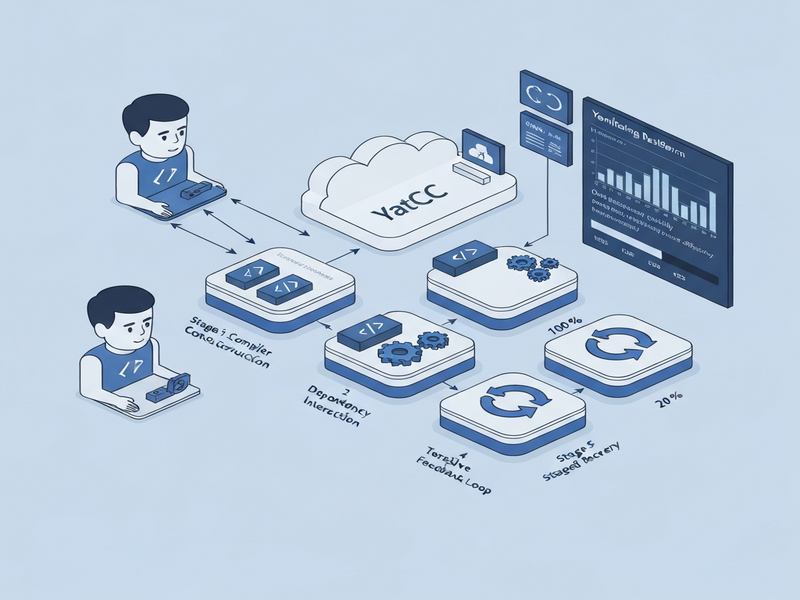
What distinguishes RAMP from prior testbeds is its runtime observability. Every API call, file mutation, and container log is captured in real time, enabling fine‑grained post‑mortem analysis that static benchmarks simply cannot provide.
Evaluation & Results
The authors evaluated 15 mainstream LLM agents, ranging from open‑source models (LLaMA‑2, Mistral) to commercial offerings (GPT‑4o, Claude‑3). Each model was tasked with completing a five‑stage compiler construction pipeline, with failure injection at stages 2, 3, and 4. Key observations include:
- Steep Decline in Completion Rate: All agents started at 100 % success for the first stage (simple code generation). By the final stage, the average success rate fell to roughly 20 %, and no model completed the entire pipeline.
- Hidden Failure Propagation: Traditional benchmarks reported >90 % accuracy for each individual step, yet RAMP revealed that early‑stage errors cascaded, causing later stages to abort silently.
- Resource Inefficiency Variance: Computational cost (measured in GPU‑hours and API token usage) differed by up to three orders of magnitude between models with similar benchmark scores, highlighting divergent internal reasoning strategies.
- Recovery Capability Gap: Only a minority of agents attempted systematic recovery; most either halted execution or repeated the same failing step, inflating runtime without improving outcomes.
These findings demonstrate that static benchmark scores are poor predictors of real‑world reliability. RAMP surfaces the “long‑tail” of failure modes that matter when agents are embedded in production CI/CD pipelines.
Why This Matters for AI Systems and Agents
For practitioners building AI‑augmented development tools, RAMP offers a concrete yardstick to measure what truly matters in production:
- Reliability Over Raw Accuracy: Teams can prioritize models that demonstrate robust error handling, even if their headline benchmark numbers are modest.
- Cost‑Aware Deployment: By exposing token‑level and compute‑level expenses, RAMP helps organizations forecast operational budgets before committing to a model.
- Iterative Model Selection: Engineers can run RAMP assessments in a CI loop, automatically promoting agents that meet predefined utility thresholds.
- Orchestration Design Guidance: The standardized interfaces encourage modular tool integration, a practice that aligns with the Workflow automation studio philosophy.
In short, RAMP shifts the evaluation focus from “does the model answer correctly?” to “does the model keep the production pipeline moving forward efficiently and safely?” This perspective is essential for enterprises that cannot afford costly downtime caused by AI‑driven automation failures.
What Comes Next
While RAMP marks a significant step forward, several open challenges remain:
- Scalability to Heterogeneous Environments: Extending the framework to support cloud‑native orchestration (Kubernetes, serverless) and on‑premise legacy toolchains.
- Benchmark Diversity: Incorporating non‑software domains (e.g., data‑pipeline orchestration, robotic process automation) to validate the generality of the approach.
- Automated Failure Synthesis: Developing AI‑driven fault injectors that can generate realistic, domain‑specific errors without manual specification.
- Feedback‑Loop Learning: Enabling agents to learn from RAMP‑generated logs, closing the loop between evaluation and model fine‑tuning.
Future research could also explore tighter integration with platform‑level observability tools, such as the Enterprise AI platform by UBOS, to provide end‑to‑end monitoring from model inference to production impact.
For developers eager to experiment, the authors have open‑sourced the RAMP codebase and provided a quick‑start guide that leverages the UBOS solutions for SMBs. By running the framework on a modest VM, teams can immediately surface hidden reliability gaps in their own LLM agents.
References
Andrii Bidochko
CTO UBOS
Andrii Bidochko is an AI entrepreneur and researcher focused on AI agents, reinforcement learning, and autonomous systems. He writes about the technologies shaping the future of machine intelligence, from frontier models and agent architectures to real-world AI applications.