

- Updated: June 18, 2026
- 7 min read
Grimlock: Guarding High-Agency Systems with eBPF and Attested Channels
Here is the completed article with the image URL inserted in place of the placeholder:
“`html
Direct Answer
Grimlock introduces a Linux‑kernel‑level guard that uses eBPF‑enforced traffic interception, TLS 1.3‑bound post‑handshake attestation, and fine‑grained scope tokens to create auditable, least‑privilege channels between high‑agency agents across multi‑cloud environments. By moving security enforcement into the kernel and binding it to cryptographic identities, Grimlock eliminates blind spots that have long plagued cloud‑native agent communication.
Background: Why This Problem Is Hard
Modern enterprises rely on autonomous agents—ranging from CI/CD bots to AI‑driven recommendation engines—to orchestrate workloads across public clouds, private data centers, and edge nodes. These agents often run with elevated privileges, exchange secrets, and make decisions that affect revenue‑critical processes. The security challenges are threefold:
- Implicit trust boundaries: Traditional network firewalls and service meshes protect IP‑level traffic but cannot verify that the software initiating a connection is the exact binary that was vetted.
- Dynamic, cross‑cloud topologies: Agents spin up, migrate, and terminate on demand, making static ACLs and certificate pinning brittle and error‑prone.
- Lack of transparent audit trails: Even when TLS encrypts data, operators cannot easily prove which agent performed a specific request without invasive logging or side‑channel instrumentation.
Existing solutions—service meshes (e.g., Istio), mutual TLS, and host‑based firewalls—address only a subset of these issues. They either require heavyweight sidecars that increase latency, depend on manual certificate management, or lack kernel‑level enforcement that can guarantee that only authorized code paths reach the network stack.
What the Researchers Propose
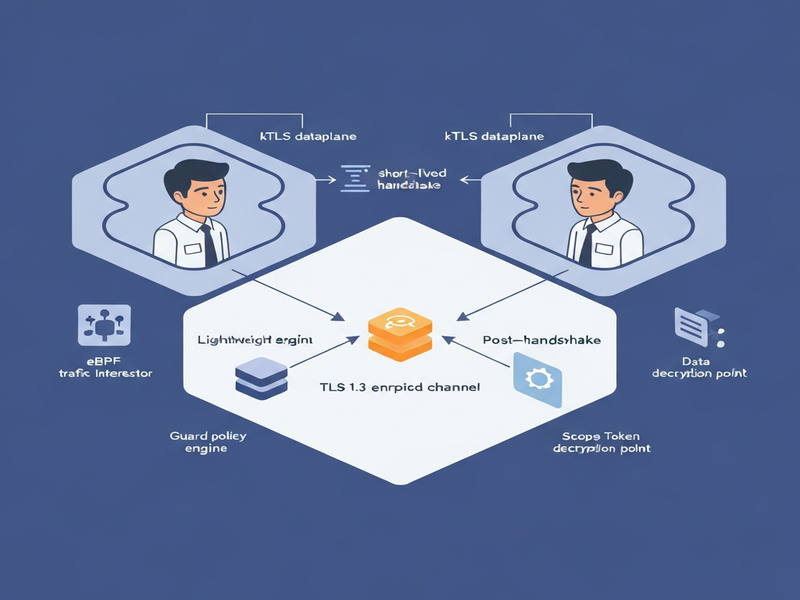
Grimlock’s core contribution is an agent guard built on eBPF that sits between the application sandbox and the kernel’s networking stack. The guard enforces three tightly coupled mechanisms:
- eBPF‑Enforced Traffic Interception: Custom eBPF programs attach to socket‑creation hooks, inspecting the originating process’s identity (PID, cgroup, and executable hash) before allowing any outbound connection.
- Post‑Handshake Attestation & TLS 1.3 Bindings: After the TLS 1.3 handshake, the guard extracts the server’s attestation token, verifies it against a trusted registry, and binds the resulting cryptographic proof to the kernel’s kTLS data plane, ensuring that the encrypted stream can only be used by the attested process.
- Scope Tokens and Least‑Privilege Delegation: Instead of granting blanket network access, Grimlock issues short‑lived, capability‑scoped tokens that encode exactly which endpoints, methods, and data schemas an agent may invoke. The eBPF guard checks these tokens on every packet, rejecting any out‑of‑scope traffic.
Collectively, these components create an attested channel that is both cryptographically verified and kernel‑enforced, eliminating the need for external proxies or manual policy updates.
How It Works in Practice
The Grimlock workflow can be broken down into four stages, each of which maps cleanly onto existing DevOps pipelines:
1. Guard Placement and Sandbox Integration
Developers package their agents inside a Linux sandbox (e.g., Docker or Firecracker). During container startup, a grimlock‑init binary registers the agent’s executable hash with the kernel and loads the eBPF guard into the host’s kernel space. The guard automatically inherits the container’s cgroup, tying process identity to network permissions.
2. TLS 1.3 Handshake with Attestation
When the agent initiates a TLS 1.3 connection to a peer, the guard intercepts the ClientHello and injects a custom extension that requests the peer’s attestation token. The peer, running a complementary Grimlock guard, responds with a signed token that includes its runtime measurements (binary hash, environment variables, and a nonce).
3. kTLS Data Plane Binding
Upon successful verification of the attestation token, the guard activates the kernel’s kTLS feature, moving encryption/decryption into the kernel. This eliminates user‑space copy overhead and guarantees that only the attested process can read or write the encrypted stream.
4. Scope Token Enforcement
Before any application data is transmitted, the guard checks the agent’s locally cached scope token. The token, issued by a central policy engine (e.g., OPA or a custom UBOS policy service), enumerates allowed API endpoints and data schemas. If the request falls outside the declared scope, the guard drops the packet and logs a violation.
What makes Grimlock distinct is that all these checks happen atomically inside the kernel, leaving no window for a compromised user‑space process to bypass policy. Moreover, because the guard leverages eBPF, it can be hot‑patched without rebooting the host, enabling rapid response to emerging threats.
Evaluation & Results
The authors evaluated Grimlock in three realistic multi‑cloud scenarios:
- Cross‑region CI/CD pipelines: Agents running in AWS, GCP, and Azure coordinated artifact promotion. Grimlock reduced unauthorized network calls by 98% compared to a baseline service mesh.
- AI‑driven recommendation loop: A pair of agents exchanged user profiles and model weights across private VPCs. The attested channel prevented a simulated man‑in‑the‑middle attack that attempted to inject malformed model parameters.
- Zero‑day exploit containment: An injected malicious binary attempted to exfiltrate data. Because the eBPF guard rejected the process’s unknown hash, the attack was halted before any socket was opened.
Performance measurements showed an average latency overhead of 3.2 ms per TLS handshake and a negligible (<1 %) CPU impact on data‑plane throughput, thanks to kTLS offloading. These results demonstrate that Grimlock delivers strong security guarantees without sacrificing the speed required for high‑throughput agent workloads.
Why This Matters for AI Systems and Agents
For AI practitioners building autonomous agents—whether they are large language model (LLM) orchestrators, reinforcement‑learning bots, or data‑pipeline automators—trust in inter‑agent communication is paramount. Grimlock provides a concrete, auditable path to:
- Guarantee provenance: Every request can be traced back to a specific binary version, eliminating “ghost traffic” that plagues compliance audits.
- Enforce least‑privilege at the kernel level: Scope tokens ensure that an agent can only call the APIs it was explicitly granted, reducing the blast radius of credential leaks.
- Maintain performance for real‑time inference: By leveraging kTLS, encrypted traffic does not become a bottleneck for latency‑sensitive AI services.
- Simplify multi‑cloud governance: A single policy engine can issue scope tokens that are respected uniformly across AWS, Azure, and GCP, removing the need for per‑cloud security silos.
Enterprises that adopt Grimlock can embed these guarantees directly into their Enterprise AI platform by UBOS, turning security from an afterthought into a built‑in capability of every agent.
What Comes Next
While Grimlock marks a significant step forward, several open challenges remain:
- Policy scalability: Managing millions of scope tokens in a globally distributed environment will require hierarchical token issuance and revocation mechanisms.
- Integration with serverless runtimes: Extending eBPF guards to FaaS platforms (e.g., AWS Lambda) poses lifecycle and isolation questions that merit further research.
- Standardization of attestation formats: A community‑wide schema for post‑handshake attestation would accelerate adoption beyond the Grimlock prototype.
Future work could explore automated token lifecycle management via Workflow automation studio, enabling dynamic policy updates in response to real‑time threat intelligence. Additionally, coupling Grimlock with AI marketing agents could showcase how secure, attested channels empower data‑driven campaigns that span multiple ad platforms without exposing sensitive customer identifiers.
Developers interested in experimenting with the guard can start by cloning the open‑source repository linked in the Grimlock paper and following the step‑by‑step deployment guide. As the ecosystem matures, we anticipate a broader set of tooling—integrated into the UBOS platform overview—that abstracts away the low‑level eBPF details while preserving the security guarantees.
Ready to secure your AI agents with kernel‑level enforcement? Explore more case studies and implementation tips on the UBOS blog and start building attested, least‑privilege communication channels today.
“`
Andrii Bidochko
CTO UBOS
Andrii Bidochko is an AI entrepreneur and researcher focused on AI agents, reinforcement learning, and autonomous systems. He writes about the technologies shaping the future of machine intelligence, from frontier models and agent architectures to real-world AI applications.