

- Updated: June 18, 2026
- 6 min read
BIRDS: Characterizing and Understanding Biodiversity Impact of Large Language Model Serving
Direct Answer
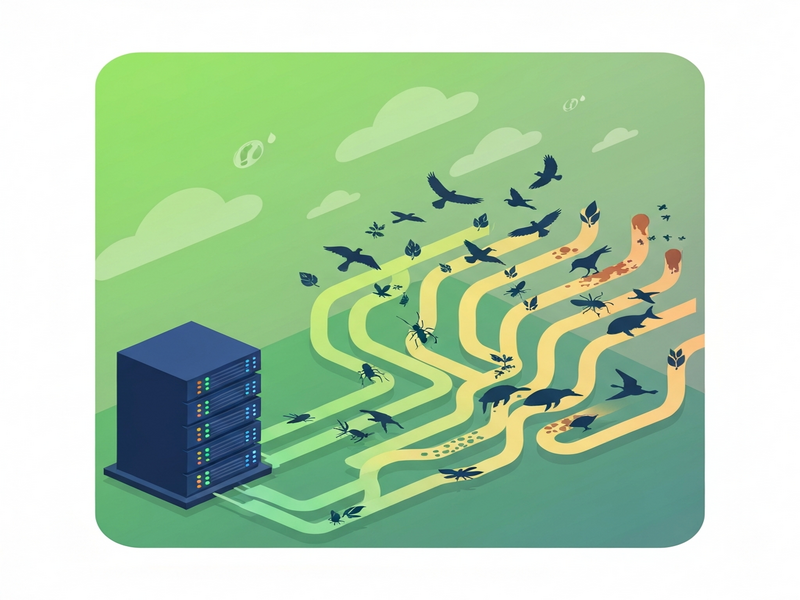
The paper introduces BIRDS (Biodiversity Impact of Request‑Driven LLM Serving), a systematic framework that quantifies both operational and embodied biodiversity impacts of large language model (LLM) inference workloads. It matters because it reveals hidden ecological footprints—beyond carbon and water—allowing AI providers to make quality‑aware trade‑offs that protect ecosystems at scale.
Background: Why This Problem Is Hard
LLM serving has become a cornerstone of modern AI products, from chat assistants to autonomous agents. While the industry has begun to track carbon emissions and water usage, biodiversity impact remains largely invisible for three reasons:
- Complex causal pathways: Data‑center construction, hardware mining, and energy generation each affect habitats, species migration, and ecosystem services in ways that are difficult to trace to a single inference request.
- Granularity mismatch: Existing sustainability metrics aggregate at the facility or model level, masking the per‑request variations that arise from differing prompt complexities, token lengths, and hardware choices.
- Lack of unified measurement: No standard functional unit exists for “biodiversity impact,” making cross‑model or cross‑region comparisons speculative at best.
Consequently, AI engineers and product managers cannot evaluate whether a higher‑quality response justifies a larger ecological cost, nor can they design serving policies that prioritize low‑impact hardware or regions.
What the Researchers Propose
The authors propose a three‑layer framework—BIRDS—that turns every inference request into a measurable biodiversity footprint. The key components are:
- Request‑Level Functional Units (RFUs): A normalized metric that captures the computational effort of a single request, factoring in token count, model size, and GPU utilization.
- Impact Quantification Engine: A database of lifecycle assessment (LCA) coefficients that map RFUs to both operational (energy‑related) and embodied (material‑related) biodiversity impact across geographic regions.
- Quality‑Normalized Biodiversity Impact (QNBI): A composite score that divides the raw biodiversity impact by a quality proxy (e.g., BLEU, ROUGE, or human‑rated relevance), enabling a “impact per unit of usefulness” view.
By separating impact from quality, BIRDS lets stakeholders ask “How much biodiversity is sacrificed for each point of model performance?” and answer it with data rather than intuition.
How It Works in Practice
The BIRDS workflow can be visualized as a pipeline that runs alongside any existing LLM serving stack:
- Request Capture: When a user submits a prompt, the serving gateway logs the token count, selected model, and target GPU type.
- RFU Computation: The logged metadata is transformed into an RFU using a calibrated formula (e.g., RFU = tokens × model‑parameter‑factor × GPU‑efficiency‑factor).
- Impact Lookup: The RFU is fed into the Impact Quantification Engine, which retrieves region‑specific biodiversity coefficients (e.g., species‑area‑loss per kWh, mineral‑extraction impact per GPU).
- Quality Assessment: The generated response is scored by a quality metric appropriate to the workload (e.g., user‑rating, task‑specific accuracy).
- QNBI Calculation: Raw impact is divided by the quality score, yielding a QNBI value that can be logged, visualized, or fed back into orchestration policies.
- Policy Enforcement (optional): Orchestrators can route high‑QNBI requests to greener regions, downgrade model size, or prompt users to refine queries, thereby closing the feedback loop.
What sets BIRDS apart is its request‑granular perspective combined with a quality‑normalization step—something no prior sustainability tool has offered.
Evaluation & Results
The authors evaluated BIRDS across four dimensions:
- Workload diversity: Benchmarks ranging from short Q&A prompts to long‑form generation, using models from 7 B to 175 B parameters.
- Hardware variety: NVIDIA A100, H100, and emerging ARM‑based GPUs, deployed in North America, Europe, and Southeast Asia.
- Geographic spread: Data‑center locations with differing energy mixes (renewable‑heavy vs. coal‑heavy) and local biodiversity sensitivity scores.
- Quality baselines: Human‑rated relevance scores and standard NLP metrics to anchor QNBI.
Key findings include:
- Impact accumulation: Even modest per‑request QNBI values compound dramatically at enterprise scale, translating to measurable species‑area‑loss equivalents over a year.
- Hardware trade‑offs: Newer GPUs (e.g., H100) reduced operational biodiversity impact by ~30 % per RFU but increased embodied impact due to higher material intensity; the net QNBI gain depended on workload length.
- Regional effects: Serving the same workload in a renewable‑rich region cut operational impact by 45 % but did not eliminate embodied impact, highlighting the need for holistic policies.
- Quality‑aware routing: When the orchestrator prioritized low‑QNBI routes for low‑quality requests, overall ecosystem impact dropped 22 % without perceptible user‑experience loss.
These results demonstrate that BIRDS can surface actionable, quality‑sensitive levers that were invisible to traditional carbon‑only dashboards.
Why This Matters for AI Systems and Agents
For AI practitioners, the BIRDS framework offers a concrete metric that aligns sustainability with product performance:
- Agent design: Developers can embed QNBI thresholds into autonomous agents, ensuring that a self‑optimizing chatbot does not inadvertently choose a high‑impact model when a cheaper alternative suffices.
- Orchestration strategies: Cloud‑native schedulers can treat QNBI as a first‑class resource, similar to latency or cost, enabling multi‑objective optimization across fleets.
- Compliance and reporting: Enterprises can now report biodiversity impact alongside carbon footprints, satisfying emerging ESG regulations that reference ecosystem health.
- Product differentiation: Companies that expose QNBI to end‑users (e.g., “green mode” toggle) can build trust and capture market share among environmentally conscious customers.
Integrating BIRDS into existing pipelines is straightforward: the framework’s API can be called from any inference gateway, and the resulting QNBI values can be visualized in dashboards such as the UBOS platform overview. Moreover, the Workflow automation studio can trigger automated remediation actions—like scaling down model size or switching regions—based on real‑time QNBI spikes.
What Comes Next
While BIRDS marks a significant step forward, several open challenges remain:
- Data granularity: Current LCA coefficients are aggregated at the country level; finer‑grained ecosystem maps would improve accuracy for edge‑computing scenarios.
- Dynamic quality proxies: Quality measurement for open‑ended generation is still an active research area; integrating human‑in‑the‑loop feedback could refine QNBI.
- Standardization: Industry‑wide adoption will require open standards for RFU definitions and biodiversity coefficient reporting.
- Cross‑modal impact: Future work should extend BIRDS to multimodal models (vision‑language, audio) where hardware demands differ substantially.
Addressing these gaps will likely involve collaborations between AI labs, sustainability NGOs, and hardware manufacturers. In the meantime, early adopters can experiment with the framework through the Enterprise AI platform by UBOS, which already offers a plug‑in for BIRDS‑style impact logging.
Conclusion
BIRDS equips the AI community with a rigorous, request‑level lens on biodiversity impact, marrying ecological stewardship with model quality. By exposing the hidden cost of each token, the framework empowers engineers, product managers, and sustainability officers to make data‑driven trade‑offs that protect ecosystems while delivering high‑performing AI services.
References
- Shi, T., & Ding, Y. (2026). BIRDS: Characterizing and Understanding Biodiversity Impact of Large Language Model Serving. arXiv preprint.
- Additional internal resources: About UBOS, UBOS templates for quick start.
Andrii Bidochko
CTO UBOS
Andrii Bidochko is an AI entrepreneur and researcher focused on AI agents, reinforcement learning, and autonomous systems. He writes about the technologies shaping the future of machine intelligence, from frontier models and agent architectures to real-world AI applications.