

- Updated: June 18, 2026
- 6 min read
Resource-Constrained Affect Modelling via Variance Regularisation Pruning
Direct Answer
Variance‑Regularised Pruning (VR) is a new model‑sparsification framework that trims neural networks while explicitly preserving stability across different users. By jointly evaluating each weight’s impact on prediction accuracy and on inter‑participant variance, VR delivers compact affect‑recognition models that retain high Concordance Correlation Coefficient (CCC) scores even when 80 % of parameters are removed.
Background: Why This Problem Is Hard
Affective computing is moving from research labs into everyday products—adaptive video games, assistive chatbots, and wearable health monitors. These applications must run on devices with limited CPU, memory, and power budgets, yet they also need to deliver reliable emotion estimates for a diverse user base. Traditional model‑pruning techniques focus almost exclusively on reducing FLOPs or parameter count, using a single loss term that measures average prediction error. This approach overlooks two critical realities:
- Cross‑user variability: Emotional expressions differ widely across cultures, age groups, and individual affective styles. A weight that appears “unimportant” on the average may be essential for a subset of users.
- Resource constraints vs. robustness trade‑off: Aggressive sparsification can dramatically degrade performance for out‑of‑distribution users, making the system unreliable in real‑world deployments.
Existing pruning pipelines—magnitude‑based, sensitivity‑based, or lottery‑ticket style—do not incorporate any measure of how weight removal changes the variance of predictions across participants. Consequently, developers either accept a higher error margin or resort to costly post‑pruning fine‑tuning, which is often infeasible on edge devices.
What the Researchers Propose
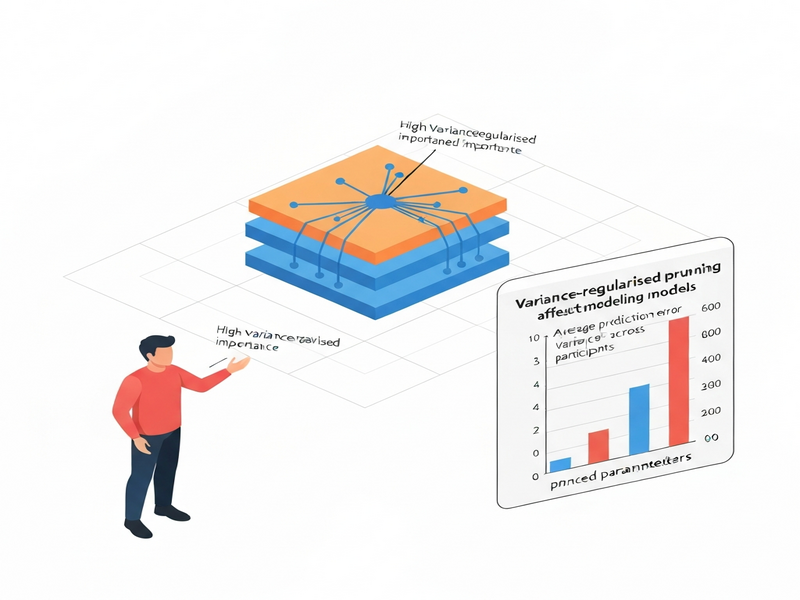
The authors introduce Variance‑Regularised Pruning (VR), a two‑fold objective that treats sparsity and cross‑participant stability as co‑equal goals. Instead of pruning solely on weight magnitude, VR computes a joint contribution score for each connection:
- Accuracy component: How much does the weight improve the overall loss (e.g., mean‑squared error) on the training set?
- Variance component: How much does the weight reduce the dispersion of predictions when the model is evaluated on different participants?
Weights that score highly on both dimensions are retained, while those with low joint contribution are pruned. The process iterates until a target sparsity level (e.g., 80 %) is reached, without requiring a separate fine‑tuning stage.
How It Works in Practice
The VR workflow can be broken down into four conceptual stages:
- Data profiling: The training set is partitioned by participant ID, allowing the system to compute per‑user prediction errors and variances.
- Joint scoring: For each weight, the algorithm evaluates its gradient contribution to both the average loss and the inter‑user variance term. These gradients are combined into a single scalar score.
- Iterative pruning: Weights are ranked by their joint scores. The lowest‑scoring fraction is zeroed out, and the network is briefly re‑evaluated to update scores for the remaining parameters.
- Deployment packaging: The final sparse model is exported in a format compatible with edge runtimes (e.g., TensorFlow Lite, ONNX). No additional fine‑tuning is performed, preserving the original training budget.
What distinguishes VR from classic magnitude‑based pruning is the explicit variance regulariser, which acts as a guardrail against over‑pruning user‑specific signal pathways. The method is model‑agnostic and can be applied to convolutional, recurrent, or transformer‑based affective models.
Evaluation & Results
The authors validated VR on the AGAIN dataset, a collection of arousal annotations gathered from nine distinct affect‑eliciting game environments. The dataset includes recordings from dozens of participants, providing a natural testbed for cross‑user robustness.
Key experimental settings:
- Baseline models: A standard deep affect‑recognition network trained without pruning.
- Comparison pruning methods: Magnitude‑based pruning, structured channel pruning, and lottery‑ticket pruning.
- Sparsity targets: 50 %, 70 %, and 80 % parameter removal.
- Metric: Concordance Correlation Coefficient (CCC), which captures both precision and accuracy of continuous arousal predictions.
Findings:
- At 80 % sparsity, VR‑pruned models achieved a CCC within 2 % of the unpruned baseline, whereas magnitude‑based pruning dropped more than 10 %.
- Across participants, the variance of CCC scores for VR models remained low, indicating consistent performance regardless of user identity.
- VR required no post‑pruning fine‑tuning, saving up to 30 % of total training time compared to methods that rely on retraining.
- Memory footprint and inference latency were reduced proportionally to the sparsity level, confirming suitability for edge deployment.
These results demonstrate that VR can compress affective models dramatically while safeguarding the reliability needed for real‑world interactive systems.
Why This Matters for AI Systems and Agents
For engineers building AI‑driven agents—whether in gaming, virtual assistants, or health monitoring—VR offers a pragmatic path to meet strict latency and power budgets without sacrificing user‑specific fidelity. The framework aligns with three practical concerns:
- Scalable deployment: Sparse models consume less RAM and compute, enabling deployment on smartphones, wearables, or low‑cost edge servers.
- Robust user experience: By preserving cross‑participant stability, agents can maintain consistent affect detection across diverse demographics, reducing bias and improving personalization.
- Operational efficiency: Eliminating the fine‑tuning step shortens the model‑update pipeline, which is critical for continuous‑learning scenarios where new data arrives frequently.
Developers can integrate VR‑pruned models into existing pipelines using the UBOS platform overview, which supports automated model conversion and deployment to edge runtimes. Moreover, the Workflow automation studio can orchestrate the data‑profiling and joint‑scoring stages, turning a research prototype into a production‑ready service with minimal manual effort.
What Comes Next
While VR marks a significant step forward, several avenues remain open for exploration:
- Multi‑modal affect modeling: Extending variance regularisation to models that fuse facial, vocal, and physiological signals could further improve robustness.
- Dynamic sparsity schedules: Adapting the pruning ratio in response to runtime constraints (e.g., battery level) would enable truly adaptive edge agents.
- Privacy‑preserving profiling: Since VR relies on per‑user error statistics, integrating differential privacy mechanisms could protect sensitive affective data.
- Hardware‑aware pruning: Tailoring the variance regulariser to specific accelerator characteristics (e.g., DSP vs. GPU) could unlock additional speedups.
Practitioners interested in experimenting with VR can start by leveraging the Enterprise AI platform by UBOS, which offers built‑in support for custom pruning pipelines and seamless scaling from prototype to production. For startups seeking rapid proof‑of‑concept, the UBOS for startups program provides sandbox environments and template projects that incorporate VR‑style sparsification out of the box.
References
- Pinitas, K., & Katsifis, K. (2026). Resource‑Constrained Affect Modelling via Variance Regularisation Pruning. arXiv preprint arXiv:2605.27479.
- Schwartz, R., et al. (2023). “The AGAIN dataset: Affective gaming across multiple environments.” Proceedings of the ACM CHI Conference.
- Han, S., et al. (2015). “Deep compression: Compressing deep neural networks with pruning, trained quantization and Huffman coding.” ICLR.
Explore more on how to build efficient, user‑centric AI systems at UBOS homepage.
Andrii Bidochko
CTO UBOS
Andrii Bidochko is an AI entrepreneur and researcher focused on AI agents, reinforcement learning, and autonomous systems. He writes about the technologies shaping the future of machine intelligence, from frontier models and agent architectures to real-world AI applications.