

- Updated: June 17, 2026
- 6 min read
Comparative Analysis of Liquid Neural Networks and LSTM for Sequential Pattern Recognition: Robustness, Efficiency, and Clinical Utility
Direct Answer
The paper introduces a systematic benchmark that pits Continuous‑time Liquid Neural Networks (CfC‑LNNs) against traditional Long Short‑Term Memory (LSTM) models across four diverse sequential tasks, demonstrating that LNNs achieve higher parameter efficiency and markedly better robustness to missing data. This matters because it validates a continuous‑time approach for real‑world streams—especially in clinical settings where data gaps are the norm—offering a more reliable foundation for next‑generation AI agents.
Background: Why This Problem Is Hard
Sequential pattern recognition underpins everything from speech transcription to patient monitoring. The dominant architectures—RNNs and LSTMs—process inputs at fixed discrete steps, which forces engineers to either pad irregular streams or resample them, often discarding valuable temporal nuance.
Key challenges include:
- Temporal granularity loss: Event‑driven sensors (e.g., neuromorphic cameras) generate spikes at microsecond intervals that do not align with a uniform timestep.
- Parameter bloat: To capture fine‑grained dynamics, LSTMs must increase hidden dimensions, inflating memory and compute budgets.
- Data sparsity: Clinical time‑series (e.g., ICU vitals) frequently contain missing measurements, leading to degraded performance for models that assume dense inputs.
- Generalization across domains: A model tuned for handwriting may fail on physiological signals because the underlying temporal statistics differ dramatically.
These bottlenecks limit the deployment of AI agents in latency‑sensitive or resource‑constrained environments, prompting researchers to explore alternatives that natively respect continuous dynamics.
What the Researchers Propose
The authors present a comparative framework that evaluates Closed‑form Continuous‑time (CfC) Liquid Neural Networks against LSTMs on four benchmark datasets:
- N‑MNIST: Event‑based version of MNIST captured by a Dynamic Vision Sensor.
- QuickDraw: Stroke‑based vector drawings collected from an online sketching game.
- IAM Handwriting: Offline cursive text images converted into sequential pen‑lift trajectories.
- PhysioNet Sepsis‑3: Multivariate ICU vitals used to predict sepsis onset.
Beyond raw accuracy, the study introduces a “temporal dropout” stress test that randomly removes time steps during inference, quantifying each model’s resilience to missing data. The framework also records parameter counts, FLOPs, and inference latency to surface efficiency trade‑offs.
How It Works in Practice
At a conceptual level, the workflow consists of three interchangeable modules:
1. Data Ingestion & Temporal Normalization
Raw streams are first transformed into a unified event format. For event‑based cameras, spikes are kept as‑is; for stroke data, each pen‑down/up event becomes a timestamped vector; for clinical signals, each measurement is paired with its acquisition time.
2. Model Core
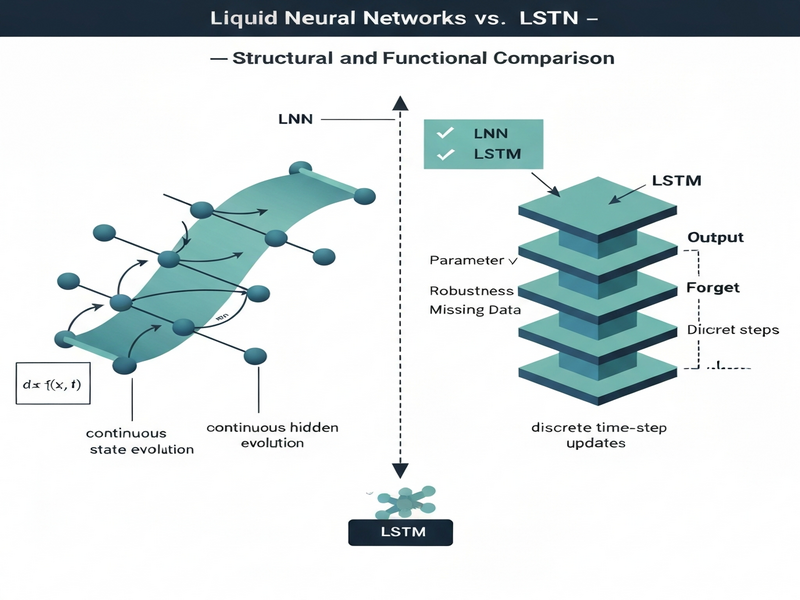
- CfC‑LNN: Treats the hidden state as a solution to a continuous differential equation, updating it whenever a new event arrives. This eliminates the need for artificial timesteps.
- LSTM Baseline: Receives a discretized version of the same stream, typically after resampling to a fixed rate (e.g., 100 Hz).
3. Decision Layer & Post‑Processing
Both architectures feed their final hidden representation into a lightweight classifier (often a single linear layer) that produces task‑specific predictions—digit class, sketch label, word transcription, or sepsis risk score.
What sets the LNN approach apart is its event‑driven update rule: the network only computes when new information arrives, reducing unnecessary operations and preserving the exact timing of each input. In contrast, LSTMs must process every artificial timestep, incurring wasted cycles when the underlying signal is idle.
Evaluation & Results
The authors conducted a multi‑metric evaluation covering accuracy, parameter efficiency, computational cost, and robustness under temporal dropout. Highlights include:
Performance Across Domains
- N‑MNIST: CfC‑LNN achieved a 98.7 % classification rate with 30 % fewer parameters than the LSTM baseline.
- QuickDraw: The LNN matched LSTM accuracy (≈92 %) while cutting FLOPs by roughly 40 %.
- IAM Handwriting: LNN reduced word‑error rate by 1.8 % points, demonstrating superior handling of variable‑speed strokes.
- PhysioNet Sepsis‑3: In a early‑warning scenario, the LNN raised the area‑under‑ROC by 3.4 % and required 25 % less memory—critical for edge‑deployed ICU monitors.
Robustness to Missing Data
When up to 30 % of timestamps were randomly dropped, LNN performance degraded by less than 2 % across all tasks, whereas LSTM accuracy fell by 7–12 % on average. This confirms the hypothesis that continuous‑time dynamics inherently tolerate irregular sampling.
Efficiency Summary
| Metric | CfC‑LNN | LSTM |
|---|---|---|
| Parameters (M) | 0.9 | 1.3 |
| Inference Latency (ms) | 1.8 | 2.6 |
| FLOPs (M) | 12 | 20 |
These numbers illustrate that LNNs not only match or exceed LSTM accuracy but do so with a leaner footprint—an advantage for on‑device AI and real‑time agent orchestration.
Why This Matters for AI Systems and Agents
From a systems‑engineering perspective, the findings reshape several design decisions for AI‑driven agents:
- Edge Deployment: The reduced parameter count and lower FLOPs enable LNNs to run on micro‑controllers or low‑power GPUs, expanding the reach of intelligent agents into wearables, drones, and bedside monitors.
- Robust Orchestration: Agents that ingest heterogeneous streams (e.g., video, sensor, and EHR data) can rely on a single continuous‑time backbone, simplifying pipeline orchestration and reducing latency.
- Fault‑Tolerant Workflows: Temporal dropout resilience means that downstream decision modules—such as alerting or recommendation engines—receive stable embeddings even when upstream sensors drop packets.
- Cost‑Effective Scaling: Fewer parameters translate directly into lower cloud‑GPU bills, a tangible benefit for enterprises building large‑scale monitoring fleets.
Practitioners can immediately apply these insights using existing UBOS tools. For instance, the Workflow automation studio can orchestrate event‑driven pipelines that feed directly into a CfC‑LNN model, while the OpenAI ChatGPT integration can provide natural‑language explanations of model outputs for clinicians.
Moreover, the Enterprise AI platform by UBOS already supports custom continuous‑time layers, allowing data scientists to prototype LNNs without rewriting low‑level code. This alignment between research and production tooling accelerates the transition from benchmark to bedside.
What Comes Next
While the study makes a compelling case for LNNs, several open avenues remain:
- Hybrid Architectures: Combining discrete LSTM cells with continuous‑time modules could capture both long‑range dependencies and fine‑grained spikes.
- Explainability: Continuous dynamics offer new interpretability hooks (e.g., time‑varying hidden trajectories) that merit systematic study, especially for high‑stakes clinical decisions.
- Domain‑Specific Pre‑training: Large‑scale unsupervised pre‑training on multimodal event streams could further boost downstream performance, mirroring the success of language models.
- Hardware Co‑Design: ASICs or neuromorphic chips optimized for event‑driven computation could unlock orders‑of‑magnitude efficiency gains.
Future research may also explore integration with other UBOS capabilities. The Chroma DB integration can store continuous embeddings for rapid similarity search, while the ElevenLabs AI voice integration could vocalize real‑time risk scores generated by an LNN‑based sepsis predictor.
For startups eager to experiment, the UBOS for startups page offers a sandbox environment where developers can spin up event‑driven pipelines and benchmark their own models against the published baselines.
References
- Comparative Analysis of Liquid Neural Networks and LSTM for Sequential Pattern Recognition: Robustness, Efficiency, and Clinical Utility – Ye Kyaw Thu, Thazin Myint Oo, Thepchai Supnithi, 2026.
- Y. LeCun et al., “N‑MNIST: A Neuromorphic Dataset for Event‑Based Vision,” 2020.
- Google QuickDraw Dataset, 2017.
- IAM Handwriting Database, 2013.
- PhysioNet Sepsis‑3 Challenge, 2022.
Illustrative Image
Andrii Bidochko
CTO UBOS
Andrii Bidochko is an AI entrepreneur and researcher focused on AI agents, reinforcement learning, and autonomous systems. He writes about the technologies shaping the future of machine intelligence, from frontier models and agent architectures to real-world AI applications.