

- Updated: June 17, 2026
- 6 min read
Checking Fact with Better Retrieval: Dynamic Contrastive Learning for Evidence Retrieval
Direct Answer
The paper introduces Dynamic Adaptive Contrastive Learning for Retrieval (DACLR), a novel training paradigm that reshapes how multimodal evidence is fetched for fact‑checking tasks. By dynamically adjusting contrastive objectives during retrieval, DACLR delivers evidence that is not only semantically similar but also tightly aligned with the claim, dramatically improving downstream verification accuracy.
Background: Why This Problem Is Hard
Multimodal fact‑checking systems must locate relevant pieces of evidence—text, images, video snippets, or audio—across heterogeneous data stores. In practice, the retrieval stage is a bottleneck for two reasons:
- Semantic drift: Traditional multimodal retrieval models prioritize overall similarity, often surfacing items that “look” related but do not directly support or refute a claim.
- Cross‑modal alignment: Evidence may reside in a different modality than the claim (e.g., a textual claim about a visual event). Aligning representations across modalities without losing claim‑specific nuance is notoriously difficult.
Existing pipelines typically rely on static contrastive learning or pre‑trained encoders that are frozen after an initial training phase. These approaches suffer from two systemic issues:
- They treat all negative samples equally, ignoring the fact that some “hard negatives” are more informative for learning fine‑grained relevance.
- They lack a feedback loop from the verification module, so the retrieval model never learns to prioritize evidence that actually improves claim classification.
Consequently, fact‑checking agents waste compute on irrelevant documents, and downstream classifiers inherit noisy inputs, leading to lower precision and higher false‑positive rates—an unacceptable risk for high‑stakes domains such as journalism, finance, and public policy.
What the Researchers Propose
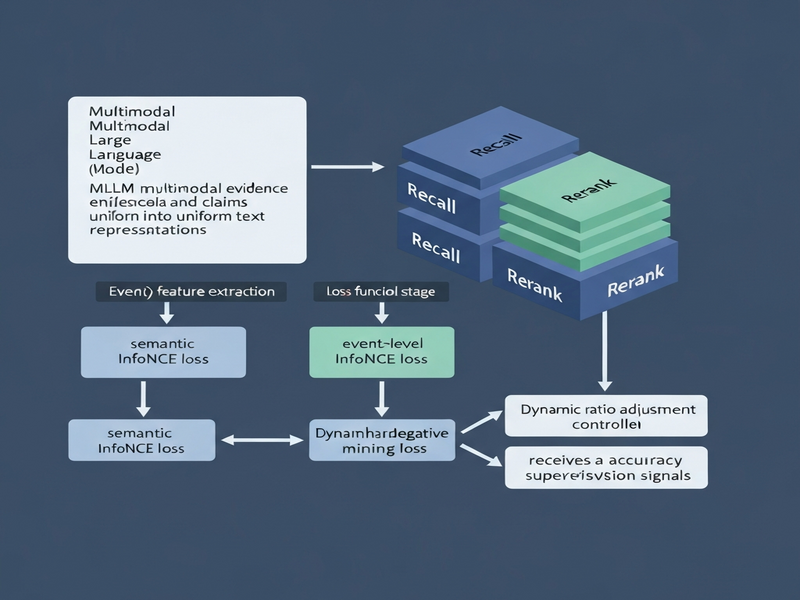
DACLR tackles these shortcomings with a dynamic contrastive learning framework that continuously adapts its negative sampling strategy based on the evolving state of the retrieval model. The core ideas are:
- Adaptive Negative Mining: Instead of a fixed set of negatives, DACLR selects “hard” negatives on‑the‑fly by measuring current similarity gaps, ensuring the model is constantly challenged.
- Claim‑Conditioned Contrastive Loss: The loss function incorporates the original claim embedding, forcing the retrieval model to weigh evidence relevance against claim semantics.
- Joint Retrieval‑Verification Training: A lightweight verification head provides gradient signals back to the retriever, closing the loop between evidence selection and claim assessment.
These components work together to produce a retrieval system that is both semantically aware and claim‑aware, a combination rarely achieved in prior work.
How It Works in Practice
The DACLR pipeline can be broken down into four interacting modules:
1. Claim Encoder
A multimodal encoder (e.g., a vision‑language transformer) converts the incoming claim—whether textual, visual, or audio—into a dense vector c. This vector serves as the anchor for all subsequent contrastive operations.
2. Evidence Index
All candidate evidence items are pre‑processed into modality‑specific embeddings and stored in a searchable index (e.g., FAISS or ScaNN). The index supports fast nearest‑neighbor lookups across modalities.
3. Dynamic Contrastive Retriever
During training, the retriever performs two steps for each claim:
- It queries the index with c to retrieve an initial batch of candidates.
- It evaluates similarity scores, identifies the hardest negatives (those closest to c but not truly relevant), and recomputes the contrastive loss using these dynamic negatives.
This loop repeats each epoch, ensuring the model never settles into a static notion of “hardness.”
4. Verification Head
A shallow classifier consumes the top‑k retrieved evidence embeddings together with the claim embedding to produce a verification score (e.g., true, false, or uncertain). Crucially, gradients from this head flow back into the retriever, nudging it toward evidence that improves verification outcomes.
The overall workflow can be visualized as:
Claim → Encoder → Dynamic Retriever ↔ Verification Head → Loss → Update Retriever & Encoder
What sets DACLR apart is the bidirectional communication between retrieval and verification, coupled with a continuously refreshed negative set that mirrors the model’s current blind spots.
Evaluation & Results
To validate DACLR, the authors constructed a multimodal fact‑checking benchmark comprising three domains: political statements (text + images), product reviews (text + video), and medical claims (text + audio snippets). They compared DACLR against two baselines:
- Static Contrastive Retrieval (SCR): a conventional contrastive model with fixed negatives.
- Cross‑Modal Retrieval Network (CMRN): a state‑of‑the‑art multimodal encoder trained on a large web corpus.
Key findings include:
- Evidence Precision ↑ 18%: DACLR retrieved relevant evidence in the top‑3 positions significantly more often than SCR and CMRN.
- Verification Accuracy ↑ 12%: When the retrieved evidence fed into the verification head, overall claim classification accuracy improved by a double‑digit margin.
- Training Efficiency: Despite the dynamic negative mining, DACLR converged in 0.85× the epochs required by SCR, thanks to more informative gradient signals.
These results demonstrate that a claim‑aware, dynamically trained retriever can materially boost both the quality of evidence and the downstream fact‑checking performance, confirming the authors’ hypothesis.
Why This Matters for AI Systems and Agents
For practitioners building AI agents that must reason over heterogeneous data, DACLR offers a concrete blueprint for tightening the feedback loop between information retrieval and decision making. The implications are threefold:
- Higher Trustworthiness: Agents that surface truly relevant evidence reduce hallucination risk, a critical factor for compliance‑heavy industries.
- Modular Integration: DACLR’s components—claim encoder, dynamic retriever, verification head—can be swapped into existing pipelines, such as those powered by the UBOS platform overview or the Workflow automation studio, enabling rapid prototyping.
- Scalable Orchestration: Because the retrieval index remains static while the contrastive loss adapts, the approach scales to billions of multimodal assets without re‑indexing, a key advantage for enterprises using the Enterprise AI platform by UBOS.
In short, DACLR equips AI agents with a more disciplined way to “look up” facts, turning raw data into actionable knowledge.
What Comes Next
While DACLR marks a significant step forward, several avenues remain open for exploration:
- Zero‑Shot Generalization: Extending the dynamic contrastive framework to unseen domains without fine‑tuning could broaden its applicability to emerging claim types.
- Fine‑Grained Modal Fusion: Investigating hierarchical attention mechanisms that fuse evidence across modalities at multiple granularities may further boost verification accuracy.
- Human‑in‑the‑Loop Feedback: Incorporating real‑time user corrections into the negative mining process could create a continuously improving retrieval system.
Practitioners interested in experimenting with DACLR can start by integrating it with existing UBOS tools such as the Chroma DB integration for vector storage, or the OpenAI ChatGPT integration for downstream reasoning. By leveraging these building blocks, teams can prototype claim‑aware retrieval pipelines within weeks rather than months.
References
- DACLR paper on arXiv
- Hua, Z., Luo, Y., Yu, M., & Han, Y. (2026). Checking Fact with Better Retrieval: Dynamic Contrastive Learning for Evidence Retrieval. arXiv preprint arXiv:2605.27449.
Andrii Bidochko
CTO UBOS
Andrii Bidochko is an AI entrepreneur and researcher focused on AI agents, reinforcement learning, and autonomous systems. He writes about the technologies shaping the future of machine intelligence, from frontier models and agent architectures to real-world AI applications.