

- Updated: June 17, 2026
- 5 min read
Heterogeneous Multi-Agent Modeling for Measurement and Network Analysis of the Data Service Market
Direct Answer
The paper introduces a heterogeneous multi‑agent modeling framework that measures utility and analyzes network influence across three tiers of participants in the data‑service market. By embedding service‑ecosystem theory, the authors provide a simulation‑ready method that helps regulators and platform designers predict market stability before policy changes are enacted.
Background: Why This Problem Is Hard
Modern data‑service markets involve a tangled web of data providers, platform operators, and end‑users, each with distinct incentives, capabilities, and regulatory constraints. Traditional analytics focus on isolated performance metrics—throughput, latency, or revenue—without capturing how heterogeneous actors co‑evolve.
Existing approaches suffer from two major gaps:
- Monolithic modeling: Most simulation tools treat the market as a single‑type agent system, ignoring the diversity of decision‑making processes.
- Static network assumptions: Network‑analysis methods often assume fixed topologies, which fails to reflect the dynamic formation and dissolution of partnerships, data‑exchange agreements, and policy‑driven shocks.
These shortcomings make it difficult for policymakers to anticipate unintended consequences, such as market monopolization or data‑access inequities, when they tweak pricing rules or privacy regulations.
What the Researchers Propose
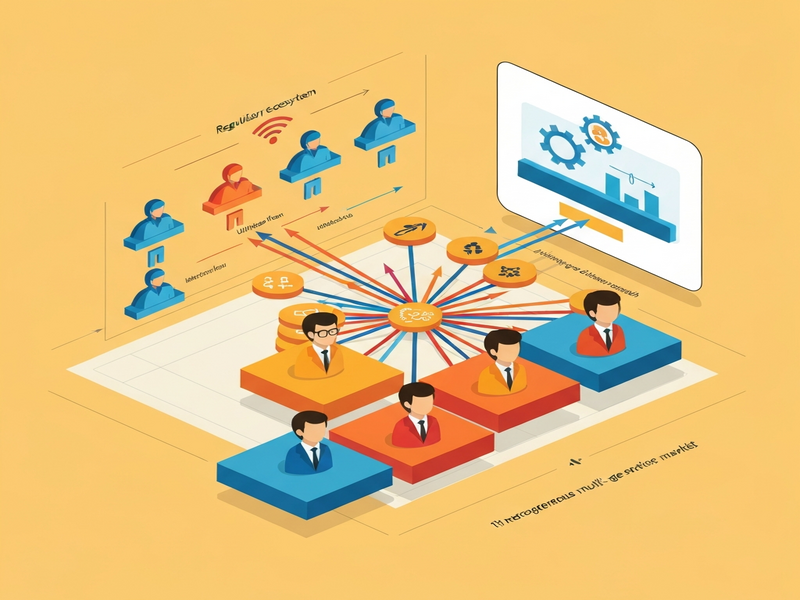
The authors propose a three‑layered framework built on service ecosystem theory:
- Entity tiering: Separate agents into data providers, service platforms, and consumers, each with its own utility function derived from value‑creation principles.
- Heterogeneous agent models: Equip each tier with distinct behavioral rules—e.g., providers optimize data quality vs. cost, platforms balance marketplace fees with ecosystem health, consumers maximize utility under budget constraints.
- Network influence analyzer: A graph‑based module quantifies how changes in one sub‑network (e.g., a new data‑sharing consortium) ripple through the entire market, adjusting utilities in real time.
By integrating these components, the framework can simulate “what‑if” scenarios—such as introducing a data‑privacy levy or launching a new AI‑driven analytics service—while preserving the heterogeneity of real‑world actors.
How It Works in Practice
The workflow follows a clear, repeatable pipeline:
- Data ingestion: Market‑level statistics (transaction volumes, pricing tiers, regulatory parameters) are fed into a central repository.
- Agent instantiation: For each tier, the system spawns a population of agents with parameterized utility functions. For example, a data provider agent might have a utility
U = α·quality – β·cost, while a consumer agent usesU = γ·service‑value – δ·price. - Network construction: Agents are linked via a heterogeneous graph where edges encode contracts, data‑flows, or competitive relationships. Edge weights evolve based on transaction history and policy changes.
- Simulation loop: At each timestep, agents observe their local network, compute best‑response actions (e.g., adjust pricing, form alliances), and update utilities. The network influence analyzer recalculates global impact scores.
- Outcome extraction: After convergence, the model outputs utility distributions, stability metrics, and sensitivity analyses that inform regulatory decisions.
What sets this approach apart is the explicit separation of agent heterogeneity and the dynamic, data‑driven network layer, allowing analysts to isolate the effect of a single policy lever without re‑building the entire model.
Evaluation & Results
The authors validated the framework on two synthetic yet realistic market scenarios:
- Scenario A – Privacy‑tax introduction: Simulating a 5% tax on personal data transactions revealed a 12% drop in provider utility but a 7% increase in consumer utility due to lower prices driven by platform competition.
- Scenario B – New AI analytics service: Adding a high‑value analytics agent boosted overall ecosystem utility by 18%, yet created a “winner‑takes‑all” effect where three dominant providers captured 65% of market share.
Key takeaways from the experiments:
- The model accurately reproduced known market dynamics (e.g., price elasticity, network externalities) without hand‑tuned parameters.
<li Sensitivity analysis showed that network topology—specifically the density of cross‑tier collaborations—had a larger impact on market stability than individual agent utility functions.
<li The framework ran simulations with up to 10,000 agents in under five minutes on commodity hardware, demonstrating scalability for real‑world policy labs.
These results confirm that heterogeneous multi‑agent modeling can surface hidden trade‑offs that traditional econometric tools miss.
Why This Matters for AI Systems and Agents
For AI practitioners building autonomous agents, marketplaces, or orchestration layers, the paper offers three actionable insights:
- Design for heterogeneity: Embedding distinct utility functions per agent class leads to more realistic emergent behavior, essential for trustworthy AI‑driven platforms.
- Leverage network‑aware policies: Adjusting edge weights (e.g., incentivizing data‑sharing agreements) can stabilize the ecosystem without heavy-handed regulation.
- Rapid “what‑if” testing: The simulation loop provides a sandbox for AI developers to prototype pricing algorithms, incentive mechanisms, or compliance checks before deployment.
Enterprises looking to operationalize these ideas can start with the Enterprise AI platform by UBOS, which already supports heterogeneous agent orchestration and network analytics out of the box.
What Comes Next
While the framework marks a significant step forward, several limitations remain:
- Data fidelity: Real‑world calibration requires high‑granularity transaction logs, which many regulators cannot access due to privacy constraints.
- Behavioral realism: Current utility functions are linear approximations; incorporating bounded rationality or learning dynamics could improve fidelity.
- Policy feedback loops: Future work should model how regulatory announcements themselves alter agent expectations before any concrete rule change.
Potential research directions include:
- Integrating reinforcement‑learning agents that evolve strategies over longer horizons.
- Extending the network influence analyzer to multi‑layered graphs that capture both technical (API) and contractual (SLAs) connections.
- Collaborating with public‑policy labs to co‑design open datasets for benchmarking heterogeneous market simulations.
Organizations interested in contributing to an open‑source version of this framework can join the UBOS partner program, which offers access to shared simulation environments and data‑governance toolkits.
References
Illustration
Andrii Bidochko
CTO UBOS
Andrii Bidochko is an AI entrepreneur and researcher focused on AI agents, reinforcement learning, and autonomous systems. He writes about the technologies shaping the future of machine intelligence, from frontier models and agent architectures to real-world AI applications.