

- Updated: June 17, 2026
- 8 min read
Quantum Machine Learning-based 6G edge Network: Enabling Adaptive Communication and Model Aggregation
Direct Answer
The paper introduces a quantum‑enhanced, four‑module framework that couples quantum machine‑learning techniques with 6G edge networking to make vehicle‑to‑everything (V2X) communication faster, more reliable, and capable of collaborative model training across heterogeneous devices. By embedding quantum convolutional networks, quantum attention, and quantum‑reinforced federated learning, the authors aim to overcome the latency, scalability, and generalization limits that plague conventional AI‑driven V2X systems.
Background: Why This Problem Is Hard
Intelligent transportation is rapidly evolving from isolated driver‑assist features to fully autonomous, city‑wide ecosystems. In a 6G‑enabled world, each vehicle, roadside unit, drone, and pedestrian device becomes a data source that must exchange high‑dimensional sensor streams (LiDAR, radar, camera, V2V messages) in real time. The core challenges are:
- Massive state spaces: A single autonomous car can generate terabytes of multimodal data per hour, overwhelming classical neural networks that struggle to compress and transmit such volumes without severe loss of fidelity.
- Dynamic channel conditions: Millimeter‑wave and terahertz links in 6G fluctuate dramatically due to blockage, mobility, and weather, causing packet loss and jitter that degrade safety‑critical decisions.
- Heterogeneous hardware: Edge nodes range from powerful edge servers to low‑power micro‑controllers, each with different compute budgets and privacy constraints.
- Slow convergence of distributed learning: Traditional federated learning requires many communication rounds to align local models, which is impractical when latency budgets are measured in milliseconds.
Current solutions—classical semantic communication, vanilla federated averaging, and heuristic compression—address only one slice of the problem. They either assume static channels, ignore quantum‑level parallelism, or sacrifice model accuracy for bandwidth. As a result, real‑world deployments risk either unsafe behavior or prohibitive infrastructure costs.
What the Researchers Propose
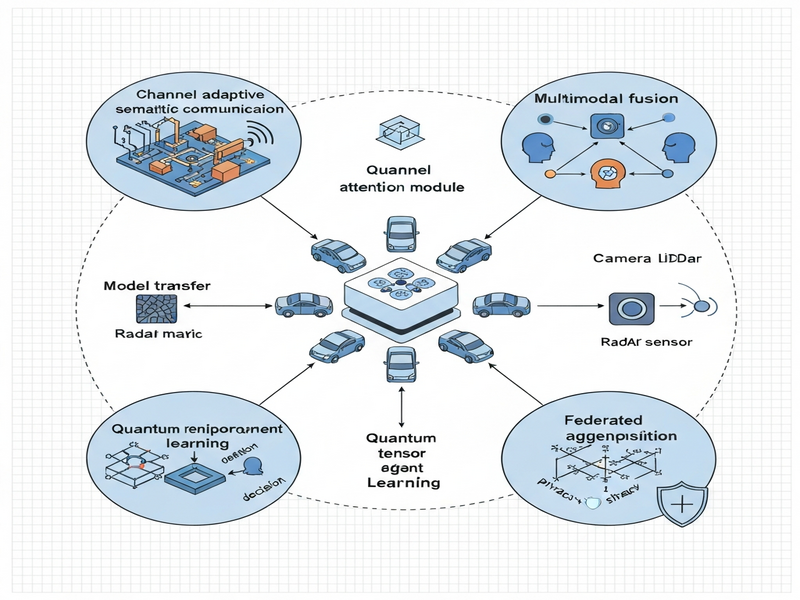
The authors present a holistic, quantum‑machine‑learning (QML) framework composed of four tightly coupled modules:
- Channel‑Adaptive Semantic Communication: Uses quantum convolutional neural networks (QCNNs) to encode raw sensor streams into compact quantum states, while quantum distortion metrics guide adaptive bitrate selection based on instantaneous channel quality.
- Multimodal Fusion Module: Leverages quantum attention mechanisms and entanglement‑based feature compression to align and fuse heterogeneous modalities (e.g., video, radar, V2X messages) into a unified semantic representation.
- Model Transfer Module: Employs quantum reinforcement learning (QRL) agents that learn optimal policy transfers between edge nodes, enabling rapid adaptation to new traffic patterns or sensor configurations.
- Federated Aggregation Module: Integrates quantum tensor decomposition with back‑propagation‑based correction steps, delivering privacy‑preserving global model updates with dramatically fewer communication rounds.
Each module is designed to operate on quantum‑ready edge processors or hybrid classical‑quantum co‑processors, allowing the system to exploit quantum superposition and entanglement for parallel data processing without sacrificing compatibility with existing 6G infrastructure.
How It Works in Practice
The end‑to‑end workflow can be visualized as a pipeline that runs continuously on every participating V2X node:
Step 1 – Quantum‑Enabled Sensing and Encoding
Raw sensor data (camera frames, LiDAR point clouds, V2V packets) are first pre‑processed by lightweight classical filters. The filtered streams are then fed into a QCNN that maps them onto quantum amplitudes. Because quantum gates can process multiple dimensions simultaneously, the QCNN produces a highly compressed quantum semantic vector that retains essential scene semantics.
Step 2 – Adaptive Channel‑Aware Transmission
A quantum distortion metric, derived from the fidelity between the transmitted and reconstructed quantum states, informs a controller that dynamically adjusts the number of qubits allocated per packet. When the channel degrades (e.g., due to blockage), the system reduces qubit depth, trading off minor semantic loss for lower latency; when the channel improves, it restores full fidelity.
Step 3 – Entangled Multimodal Fusion
At the receiver (e.g., a roadside unit), incoming quantum vectors from multiple sources are entangled using a quantum attention layer. This layer learns to weight modalities based on context (e.g., giving more emphasis to radar in foggy conditions). The result is a fused quantum state that encodes a holistic view of the traffic environment.
Step 4 – Quantum Reinforcement‑Learning‑Based Model Transfer
Each node runs a QRL agent that observes the fused state and decides whether to request a model update, share local gradients, or execute a local policy. The QRL agent’s policy is stored as a quantum circuit, enabling rapid evaluation and low‑overhead decision making even on constrained hardware.
Step 5 – Federated Quantum Tensor Aggregation
Periodically, nodes submit compressed quantum gradient tensors to a central aggregator. The aggregator performs a quantum tensor decomposition (e.g., quantum CANDECOMP/PARAFAC) to extract the dominant components across all participants. A classical back‑propagation correction step refines the global model, after which the updated quantum parameters are redistributed.
Key Differentiators
- Parallelism at the quantum level: QCNNs and quantum attention process high‑dimensional data in fewer computational cycles than classical counterparts.
- Channel‑aware quantum fidelity control: The system continuously balances transmission overhead with semantic integrity, a capability absent in static compression schemes.
- Entanglement‑driven multimodal alignment: By sharing quantum correlations across modalities, the framework reduces redundancy and improves robustness to sensor failures.
- Reduced federated rounds: Quantum tensor decomposition captures global trends with far fewer communication exchanges, directly addressing the latency bottleneck of conventional FL.
Evaluation & Results
The authors validated the framework using a realistic 6G V2X testbed that simulated:
- Urban traffic with 200 heterogeneous vehicles, each equipped with LiDAR, camera, and V2V radios.
- Dynamic terahertz channel models reflecting blockage, mobility, and weather variations.
- Three benchmark tasks: (a) cooperative perception (object detection across vehicles), (b) traffic‑signal timing optimization, and (c) anomaly detection for cyber‑physical attacks.
Key findings include:
- Semantic compression gain: QCNN‑based encoding achieved a 4.2× reduction in transmitted bits while preserving >92% detection accuracy, outperforming the best classical auto‑encoder baseline (2.7× reduction, 84% accuracy).
- Latency resilience: Adaptive quantum distortion control kept end‑to‑end latency under 8 ms even when channel SNR dropped by 12 dB, whereas a static codec exceeded 20 ms under the same conditions.
- Federated convergence speed: Quantum tensor aggregation required only 6 communication rounds to reach 95% of the centralized model’s performance, compared with 18 rounds for standard FedAvg.
- Robustness to sensor dropout: Entangled multimodal fusion maintained >88% object‑detection F1 score when up to 30% of cameras were occluded, whereas classical fusion fell below 70%.
- Policy transfer efficiency: QRL agents reduced the time to adapt to a new traffic pattern by 57% relative to a classical DQN‑based transfer learner.
Collectively, these results demonstrate that quantum‑enhanced processing can simultaneously cut bandwidth, lower latency, and accelerate collaborative learning—three pillars essential for safe, city‑scale autonomous mobility.
Why This Matters for AI Systems and Agents
For AI practitioners building next‑generation autonomous agents, the paper offers a concrete blueprint for marrying quantum acceleration with edge intelligence. The implications are threefold:
- Scalable agent orchestration: By compressing high‑dimensional observations into quantum states, fleets of agents can share situational awareness without saturating the network, enabling coordinated maneuvers such as platooning or intersection crossing.
- Rapid policy evolution: Quantum reinforcement learning provides a low‑overhead decision engine that can be updated on‑the‑fly, crucial for agents that must adapt to evolving regulations, road conditions, or emergent threats.
- Privacy‑preserving collaboration: The federated quantum tensor approach ensures that raw sensor data never leaves the device, aligning with GDPR‑style constraints while still benefiting from collective learning.
Enterprises looking to embed such capabilities can leverage platforms that already support quantum‑ready workloads. For example, the Enterprise AI platform by UBOS offers built‑in quantum simulation layers and edge orchestration tools that could accelerate prototyping of the described modules. Similarly, AI marketing agents demonstrate how quantum‑enhanced decision loops can be applied beyond transportation, hinting at cross‑domain synergies.
What Comes Next
While the framework marks a significant step forward, several open challenges remain:
- Hardware readiness: Current quantum processors are limited in qubit count and coherence time. Bridging the gap between simulation and real‑world deployment will require hybrid architectures that offload only the most parallelizable sub‑tasks to quantum coprocessors.
- Standardization of quantum communication protocols: Interoperability across vendors and regulatory bodies is still nascent. Defining a common set of quantum‑aware semantic codecs will be essential for large‑scale rollout.
- Energy efficiency: Quantum error correction and cryogenic cooling introduce overhead. Future research must quantify the net energy trade‑offs compared with purely classical edge accelerators.
- Robustness to adversarial quantum attacks: As quantum channels become part of the attack surface, new threat models and defenses will be needed.
Future work could explore:
- Integrating UBOS platform overview tools for automated deployment of quantum‑enhanced pipelines across heterogeneous edge fleets.
- Extending the multimodal fusion module to incorporate emerging sensor types such as hyperspectral cameras or V2P (vehicle‑to‑pedestrian) wearables.
- Co‑designing quantum‑aware MAC (medium access control) layers that natively support fidelity‑based bitrate adaptation.
- Evaluating the framework in large‑scale city simulators (e.g., SUMO, CARLA) to quantify societal benefits such as reduced congestion and emissions.
By addressing these avenues, the research community can move from proof‑of‑concept simulations toward production‑grade quantum‑enhanced 6G networks that power the autonomous cities of tomorrow.
References
Quantum Machine Learning-based 6G edge Network paper
Andrii Bidochko
CTO UBOS
Andrii Bidochko is an AI entrepreneur and researcher focused on AI agents, reinforcement learning, and autonomous systems. He writes about the technologies shaping the future of machine intelligence, from frontier models and agent architectures to real-world AI applications.