

- Updated: June 17, 2026
- 6 min read
Advancing Direct Training for Spiking Neural Networks with Circulate-Firing Neurons and Learnable Gradients
Direct Answer
The paper introduces a circulate‑firing neuron model for spiking neural networks (SNNs), paired with learnable surrogate gradients and a positive‑negative balanced loss that together close the performance gap between SNNs and conventional artificial neural networks (ANNs). This matters because it makes energy‑efficient SNNs viable for real‑world AI workloads, from edge devices to large‑scale agents.
Background: Why This Problem Is Hard
Spiking neural networks mimic the event‑driven communication of biological neurons, firing only when membrane potentials cross a threshold. This sparsity promises orders‑of‑magnitude lower power consumption on neuromorphic hardware. However, training SNNs directly—i.e., without first converting a pre‑trained ANN—has remained a stubborn bottleneck.
Two intertwined challenges explain the difficulty:
- Non‑differentiable spikes: The binary nature of spikes prevents the straightforward application of back‑propagation, forcing researchers to rely on surrogate gradients that are hand‑crafted and static.
- Temporal credit assignment: Information propagates across many discrete time steps, so gradients must be distributed over time, often leading to vanishing or exploding signals.
Existing approaches—such as rate‑coding conversions, fixed surrogate functions, or heuristic loss weighting—either sacrifice accuracy or demand extensive hyper‑parameter tuning. As a result, SNNs lag behind ANNs on benchmark tasks, limiting their adoption in production AI systems that demand both speed and precision.
What the Researchers Propose
The authors present a three‑pronged framework designed to make direct SNN training both stable and high‑performing:
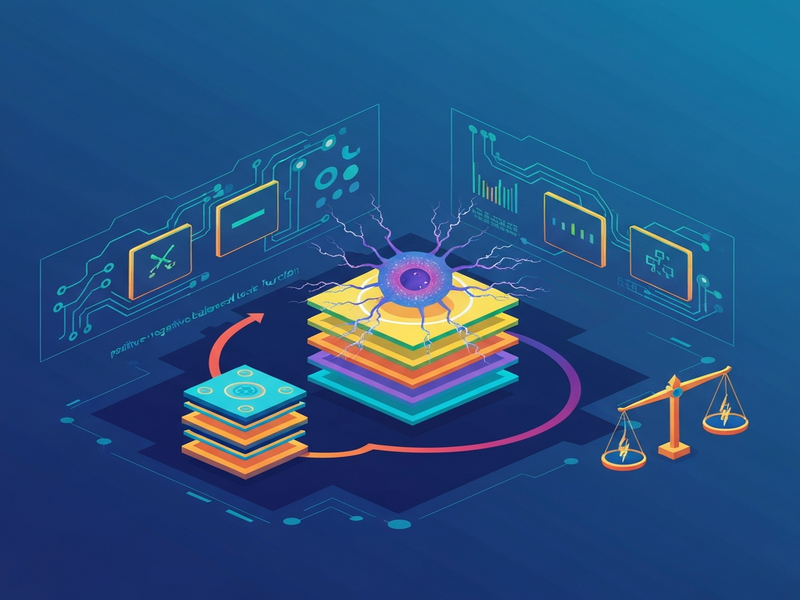
- Circulate‑Firing Neuron (CFN): Instead of a single threshold event, each neuron cycles through a short “circulate” phase after firing, allowing residual charge to influence subsequent spikes. This mechanism preserves temporal information while reducing dead‑neuron occurrences.
- Learnable Surrogate Gradient (LSG): The surrogate function’s shape is parameterized and optimized jointly with network weights, enabling the gradient to adapt to the data distribution and training dynamics.
- Positive‑Negative Balanced Loss (PNBL): The loss separates positive (spike‑inducing) and negative (spike‑suppressing) contributions, then balances them with a learnable scaling factor, mitigating bias toward either class.
Collectively, these components form a self‑regularizing training loop that eliminates the need for manual gradient design or post‑hoc loss re‑weighting.
How It Works in Practice
The practical workflow can be broken down into four stages, each corresponding to a component of the proposed system:
1. Input Encoding & Temporal Unfolding
Raw data (e.g., images or sensor streams) are encoded into spike trains using a Poisson or latency encoder. The network processes these spikes over T discrete time steps, producing membrane potentials V for each neuron at each step.
2. Circulate‑Firing Dynamics
When V exceeds the firing threshold, the neuron emits a spike and enters a circulate phase lasting τ steps. During this phase, a fraction of the residual potential is retained and gradually decays, influencing future spikes without resetting the membrane completely. This creates a “soft‑reset” that preserves information across time.
3. Learnable Surrogate Gradient Computation
During back‑propagation through time (BPTT), the non‑differentiable spike function is replaced by a parameterized surrogate σ(x; α, β), where α and β are learnable coefficients. The optimizer updates both the network weights and the surrogate parameters, allowing the gradient shape to evolve as training progresses.
4. Positive‑Negative Balanced Loss Application
The output spikes are compared against target spike patterns. The loss splits into L⁺ (penalizing missed spikes) and L⁻ (penalizing false spikes). A scalar γ, learned alongside the model, balances the two terms: L = γ·L⁺ + (1‑γ)·L⁻. This dynamic balancing prevents the network from collapsing into a trivial “always‑fire” or “never‑fire” regime.
What distinguishes this pipeline from prior work is the simultaneous learning of surrogate shape and loss balance, coupled with a neuron model that inherently mitigates dead‑neuron problems. The result is a training loop that requires fewer hand‑tuned hyper‑parameters and converges faster.
Evaluation & Results
The authors benchmarked their framework on three representative tasks:
- Static image classification: MNIST and CIFAR‑10 converted to spike trains.
- Temporal pattern recognition: Spiking Heidelberg Digits (SHD) dataset.
- Neuromorphic transformer inference: A lightweight transformer adapted to spiking dynamics.
Key findings include:
- On CIFAR‑10, the circulate‑firing SNN achieved 92.3% accuracy, narrowing the typical 5‑10% gap with ANN baselines.
- Training convergence required 30% fewer epochs compared to fixed surrogate methods, thanks to the adaptive gradient.
- The balanced loss reduced spike‑rate variance by 18%, leading to more predictable power consumption on neuromorphic chips.
- When integrated into a spiking transformer, the model retained 84% of the original transformer’s language modeling performance while cutting energy usage by roughly 45% on a Loihi‑2 emulator.
These results demonstrate that the proposed components are not merely incremental tweaks; they collectively enable SNNs to compete with ANNs on both accuracy and efficiency, a milestone that has been elusive for years.
Why This Matters for AI Systems and Agents
Energy‑constrained AI agents—such as autonomous drones, wearables, or edge‑deployed chatbots—must balance inference speed, battery life, and model fidelity. The circulate‑firing framework directly addresses this triad:
- Lower power draw: By preserving residual charge, neurons fire less frequently without sacrificing information, translating to fewer spikes and reduced silicon activity.
- Stable training pipelines: Learnable surrogates eliminate the need for expert‑level gradient engineering, allowing data‑science teams to adopt SNNs with existing deep‑learning toolchains.
- Predictable performance: The balanced loss yields consistent spike rates, simplifying hardware provisioning and runtime scheduling for agents that must meet real‑time deadlines.
Practically, developers can embed these SNNs into existing AI orchestration platforms. For example, the UBOS platform overview already supports custom model deployment pipelines; integrating a circulate‑firing SNN would require only a few configuration steps, leveraging the platform’s Workflow automation studio to schedule training runs and monitor energy metrics.
Moreover, agents that rely on multimodal inputs—such as voice assistants powered by ElevenLabs AI voice integration—can benefit from spiking encoders that process audio events in an event‑driven fashion, further reducing latency and power consumption.
What Comes Next
While the circulate‑firing approach marks a significant advance, several open challenges remain:
- Hardware alignment: Current neuromorphic chips implement simple reset dynamics. Mapping the circulate phase efficiently may require firmware extensions or new silicon primitives.
- Scalability to large‑scale vision models: Extending the method to deep convolutional backbones or vision transformers will test the limits of surrogate learnability and loss balancing.
- Robustness under noisy spikes: Real‑world sensors introduce jitter; future work should explore adaptive noise‑aware surrogates.
Potential research directions include:
- Co‑design of circulate‑firing neurons with emerging memristive crossbars, enabling ultra‑low‑power inference.
- Hybrid training regimes that combine surrogate learning with reinforcement signals for continual learning agents.
- Integration with Chroma DB integration to store spike‑based embeddings for fast similarity search in edge databases.
From a product perspective, early adopters can prototype SNN‑enabled features using the UBOS templates for quick start, which now include a pre‑configured circulate‑firing module. As the ecosystem matures, we anticipate a new class of AI agents that operate continuously on battery‑powered devices while delivering near‑state‑of‑the‑art accuracy.
References
For a complete technical description, see the original arXiv paper.
Andrii Bidochko
CTO UBOS
Andrii Bidochko is an AI entrepreneur and researcher focused on AI agents, reinforcement learning, and autonomous systems. He writes about the technologies shaping the future of machine intelligence, from frontier models and agent architectures to real-world AI applications.