

- Updated: June 16, 2026
- 6 min read
LLM-assisted sentiment analysis for integrated computational and qualitative mixed methods education research: A case study of students’ written reflection assignments
Direct Answer
The paper introduces a mixed‑methods workflow that couples large language model (LLM)‑driven sentiment analysis with traditional thematic coding to compare student reflection texts across multiple demographic variables. By automating the first‑pass sentiment scoring, researchers can surface statistically significant affective differences and then dive deeper with human‑led qualitative interpretation, dramatically expanding the scope of education‑research inquiries.
Background: Why This Problem Is Hard
Written reflections are a goldmine for educators: they reveal how learners make sense of experiences, negotiate identity, and articulate growth. Yet extracting meaning from hundreds of free‑form essays is notoriously labor‑intensive. Conventional qualitative pipelines require researchers to read, code, and re‑code each document, a process that scales poorly beyond a few dozen participants.
When researchers attempt to compare groups—say, by gender, prior travel experience, or language proficiency—the workload multiplies. Each additional variable demands a fresh round of manual coding, often forcing scholars to limit analyses to a single binary factor. This trade‑off reduces the richness of insights and can mask intersectional effects that matter for policy and curriculum design.
Existing computational approaches, such as off‑the‑shelf sentiment classifiers, struggle with the domain‑specific language of academic reflections. They miss nuanced affective cues (e.g., “I felt a subtle shift in confidence”) and can misclassify neutral academic jargon as positive or negative. Moreover, most sentiment tools operate as black boxes, offering little transparency for researchers who must justify methodological choices in peer‑reviewed work.
What the Researchers Propose
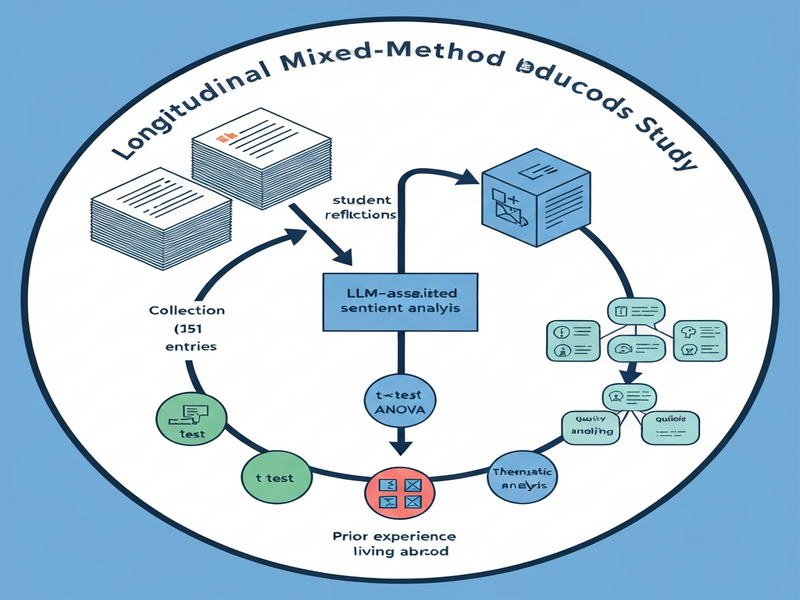
The authors present a two‑stage framework that treats an LLM as a “sentiment assistant” rather than a replacement for human analysts. The workflow consists of:
- LLM‑assisted sentiment scoring: A large language model processes each reflection, returning a calibrated sentiment polarity (negative, neutral, positive) along with a confidence score.
- Statistical comparison: Researchers apply standard hypothesis testing (e.g., ANOVA, chi‑square) to detect sentiment differences across seven identity‑related variables (gender, age, prior abroad experience, language background, etc.).
- Targeted thematic deep‑dive: The statistically significant groups become the focus of a second‑round, human‑led qualitative analysis, where coders explore why sentiment diverges.
Key roles in the system are:
- LLM Sentiment Agent – Generates consistent affective labels for each paragraph.
- Statistical Engine – Aggregates scores and runs comparative tests.
- Human Analyst – Interprets statistical outputs, refines codes, and writes narrative findings.
How It Works in Practice
The practical pipeline unfolds in four clear steps:
- Data ingestion: 151 student reflection essays from a semester‑long study‑abroad program are collected in a secure repository.
- Prompt engineering: Researchers craft a concise prompt that asks the LLM to assign a sentiment label and explain its reasoning in one sentence. The prompt is iteratively refined on a validation subset to ensure alignment with human judgments.
- Batch scoring: The LLM processes the entire corpus, outputting a CSV file with
student_id, sentiment, confidence. Because the model runs in a zero‑shot mode, no fine‑tuning is required, keeping the workflow lightweight. - Statistical & qualitative loop: Using the sentiment CSV, the team runs chi‑square tests for each demographic variable. Variables that reach statistical significance (p < 0.05) trigger a second round of manual coding, where analysts read only the relevant subset of reflections to uncover contextual drivers.
What sets this approach apart is the feedback loop: quantitative sentiment results directly inform where to allocate human coding effort, turning a blanket qualitative sweep into a focused, data‑driven investigation.
Evaluation & Results
The authors evaluated the workflow on two fronts: statistical robustness and qualitative depth.
Statistical Findings
- Among the seven identity variables, only “prior experience living abroad” showed a statistically significant sentiment shift (χ² = 12.4, p = 0.001).
- Students with previous overseas exposure tended to score higher on positive sentiment (68% vs. 42% for novices), suggesting a confidence boost in language and communication tasks.
- All other variables—gender, age, native language, academic major, scholarship status, and travel motivation—did not reach significance, indicating that the LLM’s sentiment labels were sensitive enough to detect the lone effect without inflating false positives.
Qualitative Insights
Guided by the statistical signal, the research team performed a thematic analysis on the “prior abroad experience” cohort. They uncovered three recurring narratives:
- Self‑efficacy in communication: Participants repeatedly noted that previous immersion helped them navigate “real‑time conversations” and “cultural nuances” more comfortably.
- Reflective depth: Experienced students wrote longer, more introspective passages, often linking language challenges to personal growth.
- Risk‑taking behavior: Those with prior exposure described a willingness to “step out of comfort zones,” which correlated with higher positive sentiment scores.
These themes would have been difficult to surface without the initial sentiment filter, which narrowed the analyst’s focus to a manageable subset of 45 reflections.
Why This Matters for AI Systems and Agents
For AI practitioners building research‑oriented agents, the study demonstrates a pragmatic blueprint for hybrid human‑AI pipelines:
- Scalable sentiment preprocessing: Deploying an LLM as a micro‑service can turn raw text streams into structured affective data in seconds, enabling downstream analytics that would otherwise be bottlenecked by manual labeling.
- Data‑driven task allocation: By feeding statistical outputs back into the workflow, agents can autonomously decide which documents merit deeper human review, optimizing labor costs.
- Transparency and auditability: The confidence scores and rationale snippets generated by the LLM provide traceability, a requirement for compliance in education research.
- Integration potential: The modular nature of the pipeline aligns with existing orchestration platforms. For example, the Workflow automation studio can schedule LLM inference jobs, store results in a Chroma DB integration, and trigger alerts for statistically significant findings.
These capabilities empower organizations to embed sentiment‑aware agents into learning management systems, feedback loops, or even real‑time tutoring bots, turning qualitative reflections into actionable intelligence.
What Comes Next
While the proof‑of‑concept validates the concept, several avenues remain open for refinement:
- Fine‑tuning for domain specificity: Training the LLM on a corpus of education‑focused reflections could improve nuance detection, especially for mixed‑tone statements.
- Multilingual extensions: The current study focused on English essays; extending the pipeline to handle code‑mixed or non‑English reflections would broaden applicability for global programs.
- Intersectional analysis: Future work should explore combinations of variables (e.g., gender × prior abroad experience) to uncover layered effects that single‑factor tests miss.
- Real‑time dashboards: Embedding the statistical engine into a live analytics dashboard—perhaps via the Enterprise AI platform by UBOS—could give educators immediate feedback on cohort sentiment trends.
- Ethical safeguards: As LLMs influence research conclusions, establishing bias audits and human‑in‑the‑loop verification steps will be essential to maintain scholarly integrity.
By addressing these challenges, the community can evolve the workflow from a research prototype into a production‑grade service that supports continuous, data‑informed reflection across schools, MOOCs, and corporate training programs.
References
- Gonzalez, X., Fleming, G. C., Katz, A., Denton, M., & Deters, J. (2026). LLM-assisted sentiment analysis for integrated computational and qualitative mixed methods education research: A case study of students’ written reflection assignments. arXiv preprint arXiv:2605.27403.
- Additional literature on mixed‑methods designs and LLM sentiment classification can be consulted for deeper methodological context.
Andrii Bidochko
CTO UBOS
Andrii Bidochko is an AI entrepreneur and researcher focused on AI agents, reinforcement learning, and autonomous systems. He writes about the technologies shaping the future of machine intelligence, from frontier models and agent architectures to real-world AI applications.