

- Updated: June 16, 2026
- 6 min read
Memory-Based vs. Context-Only Conditioning Produces Distinct Behavioral Patterns in Stateful Personalization
Direct Answer
The paper introduces a systematic comparison between two conditioning strategies—memory‑based personalization and context‑only (question‑level) conditioning—in a teacher‑facing educational recommender system. It shows that the two approaches generate fundamentally different behavioral patterns, with memory‑based models producing learner‑specific, history‑driven recommendations while context‑only models react more sharply to the immediate question.
Background: Why This Problem Is Hard
Personalized learning promises to adapt instructional content to each student’s needs, but delivering that promise at scale remains a technical bottleneck. Traditional recommender systems in education rely heavily on either:
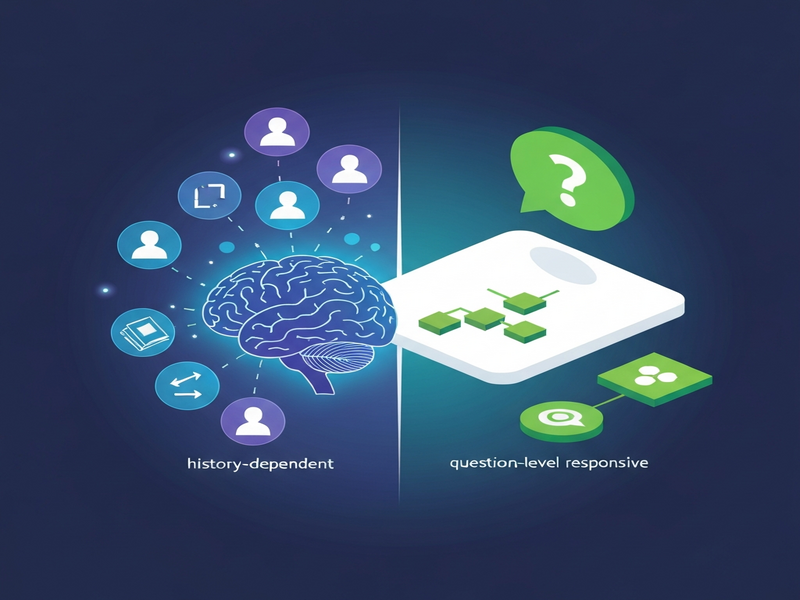
- Context‑only conditioning: The model receives only the current student query (e.g., “What is photosynthesis?”) and generates a recommendation based on that snapshot.
- Memory‑based conditioning: The model incorporates a persistent learner profile—historical performance, prior misconceptions, and engagement signals—into every inference step.
Both strategies have clear limitations. Context‑only models excel at immediate relevance but ignore the learner’s trajectory, leading to repetitive or contradictory suggestions. Memory‑based models retain longitudinal insight but can become “sticky,” over‑emphasizing past behavior and failing to adapt to new, unexpected questions. Moreover, the educational domain adds constraints that are rarely present in e‑commerce or media recommendation: pedagogical alignment, curriculum standards, and teacher oversight.
Existing research often treats personalization as a monolithic problem, reporting aggregate accuracy or click‑through rates without dissecting how conditioning choices affect the *behavior* of the system. This gap makes it difficult for product teams to decide which conditioning paradigm best serves their instructional goals.
What the Researchers Propose
Park et al. propose a diagnostic framework that isolates the behavioral impact of conditioning choices. Rather than introducing a new algorithm, they repurpose an existing teacher‑facing recommender and run two parallel versions:
- Context‑Only Variant: Each recommendation is generated solely from the embedding of the current student question, using a similarity search over a content pool.
- Memory‑Based Variant: The model augments the question embedding with a learner‑specific memory vector that aggregates past interactions (e.g., prior questions, correctness, time‑on‑task).
The key contribution is a set of *behavioral metrics*—deviation correlation, paired statistical tests, and teacher‑facing interpretability signals—that quantify how each conditioning method reacts to identical inputs across different learners.
How It Works in Practice
The experimental system consists of four logical components:
- Question Encoder: Transforms the student’s free‑text question into a dense vector using a pre‑trained language model.
- Memory Store: A lightweight key‑value database that maintains a rolling summary of each learner’s interaction history. The summary is updated after every recommendation.
- Similarity Engine: Retrieves candidate learning resources by measuring cosine similarity between the query vector (with or without memory augmentation) and a pre‑indexed corpus of instructional content.
- Teacher Dashboard: Presents the ranked recommendations along with interpretability cues (e.g., “Why this resource? – matches prior misconception”).
In the context‑only flow, the pipeline is linear: Question → Encoder → Similarity Engine → Dashboard. In the memory‑based flow, the Memory Store injects a learner vector into the encoder output before similarity search, creating a *stateful* inference path. The distinction is subtle in code but profound in outcome: the same question from two different learners can trigger divergent resource rankings when memory is present.
What sets this approach apart is the *paired* experimental design. Every teacher‑student interaction is logged twice—once under each conditioning regime—allowing a direct, apples‑to‑apples comparison of behavioral signatures.
Evaluation & Results
The authors evaluated the system on a real‑world dataset collected from a K‑12 math tutoring platform over a six‑month period. Evaluation focused on three axes:
1. Question‑Level Responsiveness
Using deviation correlation, they measured how tightly recommendation scores tracked changes in the question text. Context‑only conditioning displayed a higher correlation (≈0.78) than memory‑based conditioning (≈0.52), confirming that the former is more sensitive to immediate query nuances.
2. History‑Dependent Differentiation
Paired t‑tests revealed that memory‑based recommendations diverged significantly across learners even when the question was identical (p < 0.01). This effect manifested as “learner‑specific tailoring” – for example, a student who repeatedly struggled with fractions received more scaffolded resources, while a peer with a strong fraction background was offered advanced challenges.
3. Teacher Interpretability
Teachers rated the memory‑based dashboard as more actionable (4.3/5) compared to the context‑only view (3.6/5). The added “why” explanations—derived from the memory vector—helped educators understand the pedagogical rationale behind each suggestion.
Collectively, these findings demonstrate that conditioning choice is not a mere implementation detail; it fundamentally reshapes the system’s behavioral landscape.
Why This Matters for AI Systems and Agents
For AI practitioners building agents that interact with humans—whether in education, customer support, or health coaching—the study offers a clear design trade‑off:
- Responsiveness vs. Consistency: Context‑only agents excel at reacting to fresh inputs, making them suitable for open‑ended queries or crisis response where immediacy is paramount.
- Personalization Depth vs. Flexibility: Memory‑based agents embed a user’s longitudinal profile, enabling nuanced, goal‑oriented guidance but risking over‑fitting to past behavior.
Understanding these dynamics helps teams decide when to invest in persistent state management versus lightweight stateless inference. Moreover, the diagnostic metrics introduced—deviation correlation and paired significance testing—provide a reusable toolkit for evaluating any stateful AI system.
Organizations looking to embed AI into learning workflows can leverage these insights to balance teacher control with algorithmic autonomy. For instance, an Enterprise AI platform by UBOS could expose toggles that let administrators switch between conditioning modes based on curriculum phases (e.g., diagnostic assessments vs. mastery reviews).
What Comes Next
While the paper establishes a solid behavioral baseline, several open challenges remain:
- Scalability of Memory Stores: As learner populations grow, maintaining up‑to‑date memory vectors without incurring latency becomes non‑trivial.
- Hybrid Conditioning: Future work could explore dynamic blending—using context‑only inference for novel topics and memory‑based inference for familiar domains.
- Cross‑Domain Transfer: Extending the diagnostic framework to other verticals (e.g., corporate training, language learning) would test its generality.
- Ethical Guardrails: Persistent profiling raises privacy concerns; mechanisms for learner consent and data expiration must be baked into system design.
Addressing these gaps will likely involve tighter integration with orchestration tools that can route requests to the appropriate conditioning pipeline on the fly. The Workflow automation studio offers a low‑code environment for building such conditional routing logic, enabling rapid experimentation without deep engineering effort.
Illustration: Memory‑Based vs. Context‑Only Conditioning
Conclusion
The comparative study by Park and colleagues shines a spotlight on a hidden dimension of personalization: the conditioning strategy itself. By rigorously quantifying how memory‑based and context‑only models behave under identical inputs, the authors provide actionable evidence for educators, product managers, and AI engineers alike. As AI agents become more embedded in learning ecosystems, the choice between stateful and stateless conditioning will shape not only recommendation relevance but also teacher trust, learner agency, and system scalability.
For readers interested in diving deeper, the full original arXiv paper offers detailed methodology, statistical tables, and supplemental analyses.
Andrii Bidochko
CTO UBOS
Andrii Bidochko is an AI entrepreneur and researcher focused on AI agents, reinforcement learning, and autonomous systems. He writes about the technologies shaping the future of machine intelligence, from frontier models and agent architectures to real-world AI applications.