

- Updated: June 16, 2026
- 7 min read
BioELX: Cross-lingual Biomedical Entity Linking – A Technical Overview
Direct Answer
BioELX introduces a two‑stage, annotation‑free framework for cross‑lingual biomedical entity linking that first expands the retrieval vocabulary with multilingual aliases and then uses a large language model (LLM) to rank candidates in a context‑aware manner. This matters because it dramatically lifts linking accuracy for low‑resource languages without requiring costly, language‑specific training data.
Background: Why This Problem Is Hard
Biomedical entity linking (BEL) is the process of mapping textual mentions of diseases, drugs, genes, or procedures to canonical identifiers in a curated knowledge base such as UMLS or Wikidata. In a multilingual setting, the challenge multiplies:
- Scarcity of annotated data: High‑quality, expert‑curated BEL corpora exist mainly for English. Building comparable resources for Turkish, Korean, Thai, or other low‑resource languages demands extensive domain expertise and translation effort.
- Alias diversity: A single biomedical concept can be referenced by dozens of synonyms, abbreviations, and local spellings. Existing retrievers, typically built on SapBERT embeddings, are trained on English‑centric alias lists, causing them to miss non‑English surface forms.
- Contextual ambiguity: Many mentions are short (e.g., “ACE”) and can refer to multiple concepts depending on surrounding text. Without a context‑sensitive disambiguation step, retrieval‑only pipelines produce noisy candidate sets.
- Domain shift across corpora: Clinical notes, patents, and scientific articles each exhibit distinct linguistic styles and terminology, further limiting the generalizability of monolingual models.
These bottlenecks hinder the deployment of robust biomedical NLP systems in global health settings, where accurate entity linking underpins tasks such as adverse‑event detection, literature mining, and multilingual clinical decision support.
What the Researchers Propose
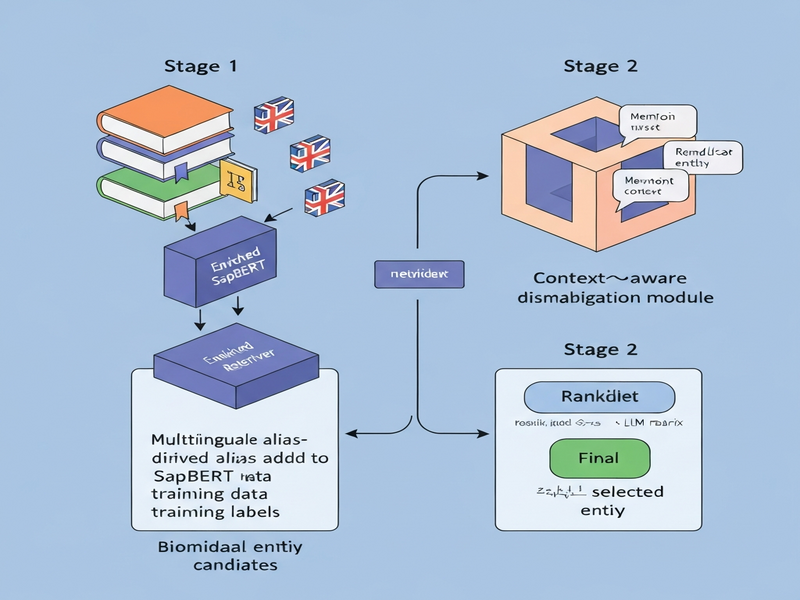
BioELX tackles the data‑scarcity and alias‑coverage problems with a modular, two‑stage pipeline that requires no task‑specific supervision:
Stage 1 – Alias‑Based Retrieval
The first stage enriches the SapBERT retriever by injecting multilingual alias pairs harvested from Wikidata. By aligning each concept’s English label with its translations, the model learns a shared embedding space that can retrieve relevant candidates for mentions in any language.
Stage 2 – LLM Ranking
The second stage replaces handcrafted scoring functions with a pre‑trained large language model that jointly ingests the mention context and each retrieved candidate. The LLM produces a relevance score, effectively performing context‑aware disambiguation without any fine‑tuning on BEL data.
Crucially, both stages operate independently of annotated BEL corpora, making the approach immediately applicable to new languages and domains.
How It Works in Practice
The BioELX workflow can be visualized as a linear pipeline with clear hand‑offs between components:
- Alias Extraction: A script queries Wikidata for all biomedical entities present in the target knowledge base, pulling every available label and alias across supported languages.
- Retriever Training: The multilingual alias pairs are fed into a contrastive learning objective that fine‑tunes SapBERT. Positive pairs consist of an English label and its foreign alias; negatives are sampled from unrelated concepts.
- Candidate Retrieval: At inference time, a mention (e.g., a Korean phrase) is encoded with the fine‑tuned SapBERT model, and the top‑k nearest KB concepts are fetched based on cosine similarity.
- Context Construction: The surrounding sentence or paragraph is concatenated with each candidate’s canonical name and definition, forming a prompt for the LLM.
- LLM Scoring: A pre‑trained LLM (e.g., GPT‑4‑style) processes each prompt and returns a probability that the candidate matches the mention. The scores are normalized and the highest‑ranked entity is selected as the final link.
What sets BioELX apart is the decoupling of retrieval and ranking, allowing each module to be swapped or upgraded independently. For example, a newer multilingual encoder could replace SapBERT, or a domain‑specific LLM could be used for ranking without retraining the retriever.
Evaluation & Results
To validate the framework, the authors benchmarked BioELX on five diverse datasets that span clinical notes, patents, and Wikipedia articles in multiple languages:
- XL‑BEL: A multilingual BEL benchmark covering English, Turkish, Korean, and Thai.
- EMEA: European Medicines Agency documents in several European languages.
- Patent: Biomedical patent abstracts with cross‑lingual mentions.
- WikiMed‑DE: German‑language medical Wikipedia entries.
- MedMentions: A large English‑only corpus used as a control.
Across these scenarios, BioELX consistently outperformed prior state‑of‑the‑art systems. Notable highlights include:
- A +19.2% absolute gain in Recall@1 on the XL‑BEL benchmark, driven largely by improvements in low‑resource languages (e.g., +21.6% for Turkish, +22.1% for Korean, +30.8% for Thai).
- Steady lifts on domain‑specific corpora: +6.2% on EMEA, +5.4% on Patent, and +12.8% on WikiMed‑DE.
- Comparable or superior performance on the English‑only MedMentions set, demonstrating that the multilingual augmentation does not sacrifice English accuracy.
These results prove that a retrieval‑first, LLM‑second strategy can close the performance gap for languages that previously suffered from sparse alias coverage and limited training data.
Why This Matters for AI Systems and Agents
For developers building biomedical AI agents—whether they power clinical decision support, literature summarization, or drug‑discovery pipelines—accurate entity linking is a foundational capability. BioELX delivers several practical benefits:
- Zero‑shot multilingual support: Agents can ingest patient notes or research abstracts in any supported language without bespoke annotation projects.
- Context‑aware disambiguation: The LLM ranking step reduces false positives that arise from ambiguous abbreviations, improving downstream reasoning and recommendation quality.
- Modular integration: Because retrieval and ranking are separate services, they can be orchestrated within existing AI orchestration platforms, such as the Workflow automation studio for building end‑to‑end pipelines.
- Scalable to new domains: Adding a new biomedical sub‑ontology (e.g., rare disease registries) only requires updating the alias database, not retraining a full BEL model.
In short, BioELX lowers the barrier for enterprises to embed multilingual biomedical intelligence into their agents, accelerating time‑to‑value in global health initiatives.
What Comes Next
While BioELX sets a new performance baseline, several avenues remain open for further research and productization:
- Dynamic alias discovery: Leveraging community‑generated resources or mining synonyms from large biomedical corpora could keep the multilingual alias list fresh and domain‑specific.
- Fine‑tuning the LLM on BEL contexts: Although the current approach works zero‑shot, a lightweight adapter trained on a small set of annotated mentions might boost ranking precision for highly specialized vocabularies.
- Integration with vector databases: Storing the SapBERT embeddings in a scalable vector store such as Chroma DB integration would enable real‑time retrieval at enterprise scale.
- Privacy‑preserving deployment: For clinical settings, exploring on‑premise or federated versions of the pipeline can address patient data confidentiality concerns.
- Extending to multimodal inputs: Future work could incorporate imaging reports or structured lab results, enriching the context that the LLM uses for ranking.
Addressing these challenges will further solidify BioELX as a core component of next‑generation biomedical AI ecosystems.
References
For a complete technical description, see the original BioELX paper on arXiv.
Illustration
Conclusion
BioELX demonstrates that cross‑lingual biomedical entity linking can achieve state‑of‑the‑art accuracy without any language‑specific supervision. By enriching SapBERT with multilingual aliases and delegating disambiguation to a powerful LLM, the framework bridges the gap for low‑resource languages and opens the door to truly global biomedical AI applications. Organizations looking to embed multilingual knowledge extraction into their agents should consider BioELX’s modular design as a blueprint for scalable, privacy‑aware, and future‑proof deployments.
Andrii Bidochko
CTO UBOS
Andrii Bidochko is an AI entrepreneur and researcher focused on AI agents, reinforcement learning, and autonomous systems. He writes about the technologies shaping the future of machine intelligence, from frontier models and agent architectures to real-world AI applications.