

- Updated: June 15, 2026
- 6 min read
AutoScientists: Self-Organizing Agent Teams for Long-Running Scientific Experimentation
Direct Answer
AutoScientists introduces a self‑organizing team of AI agents that can autonomously generate hypotheses, design experiments, run simulations, and iteratively refine scientific knowledge without human supervision. This matters because it transforms the traditionally slow, labor‑intensive research loop into a scalable, continuous discovery engine that can operate across domains such as biology, chemistry, and materials science.
Background: Why This Problem Is Hard
Scientific progress follows a cyclic workflow: hypothesis → experiment design → execution → analysis → revision. Each step demands expertise, creativity, and often costly laboratory resources. Existing AI‑assisted tools typically excel at a single stage—e.g., language models that draft hypotheses or reinforcement learners that optimize a specific protocol. However, they struggle to:
- Maintain coherence across cycles. A hypothesis generated in isolation may be impossible to test with available equipment.
- Coordinate multiple specialized agents. Current pipelines rely on a central orchestrator that becomes a bottleneck and a single point of failure.
- Adapt to long‑running experiments. Real‑world studies can span weeks or months, requiring persistent state management and dynamic re‑planning.
These limitations keep AI from delivering end‑to‑end scientific automation, especially in domains where data is sparse, experiments are expensive, and interdisciplinary knowledge is essential.
What the Researchers Propose
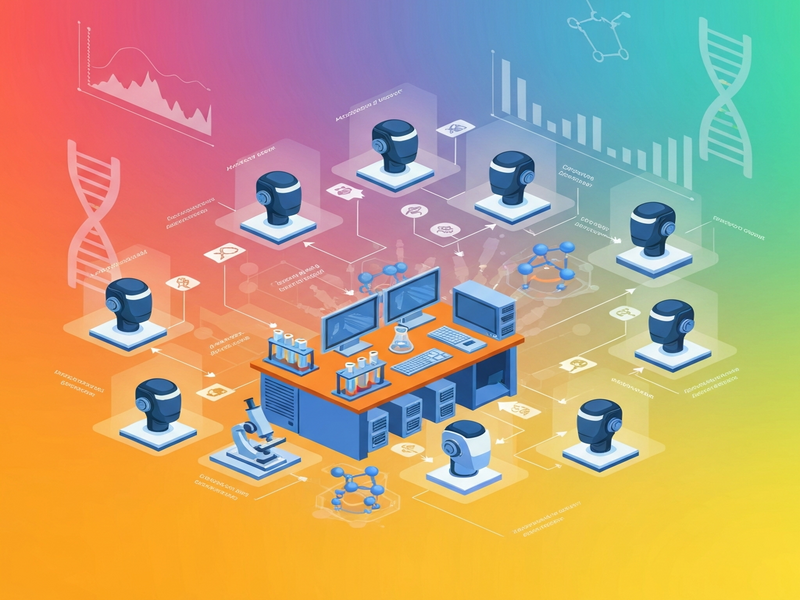
The AutoScientists framework reimagines the research loop as a decentralized ecosystem of cooperating agents. At a high level, the system consists of three core roles:
- Hypothesis Agents (H‑Agents). These generate candidate scientific statements using large language models, enriched with domain‑specific ontologies.
- Experiment Design Agents (E‑Agents). Given a hypothesis, they translate it into concrete experimental protocols, selecting reagents, simulation parameters, or hardware configurations.
- Execution & Analysis Agents (X‑Agents). They run the experiments—either in silico or by dispatching commands to laboratory robots—and feed the results back into the knowledge base.
Crucially, the agents are not centrally commanded. Instead, they self‑organize through a shared “Scientific Ledger” that records hypotheses, experimental designs, outcomes, and confidence scores. The ledger acts as a market where agents publish offers (e.g., “I can test this protein folding hypothesis”) and negotiate responsibilities based on expertise, resource availability, and past performance.
How It Works in Practice
The AutoScientists workflow can be visualized as a continuous loop:
- Seed Initialization. A small set of seed hypotheses—often derived from literature or expert input—are injected into the ledger.
- Agent Discovery. H‑Agents scan the ledger, identify gaps, and propose new hypotheses. Simultaneously, E‑Agents evaluate existing hypotheses for feasibility and publish design proposals.
- Task Matching. X‑Agents subscribe to design proposals that match their capabilities (e.g., GPU‑based molecular dynamics, wet‑lab robotics). A lightweight auction mechanism resolves conflicts and allocates resources.
- Execution Cycle. X‑Agents run the experiments, log raw data, and generate analysis reports. The reports are automatically annotated with statistical confidence and linked back to the originating hypothesis.
- Feedback Integration. The ledger updates the confidence of each hypothesis based on experimental outcomes. High‑confidence hypotheses may trigger deeper exploration, while low‑confidence ones are pruned or revised.
- Self‑Organization. Over time, agents adapt their strategies: H‑Agents learn which hypothesis structures succeed, E‑Agents refine design heuristics, and X‑Agents improve execution efficiency.
What sets this approach apart is the elimination of a monolithic orchestrator. Coordination emerges from the shared ledger and the agents’ incentive‑aligned bidding, enabling the system to scale horizontally across compute clusters, cloud services, or distributed laboratory networks.
Evaluation & Results
The authors benchmarked AutoScientists on three representative scientific domains:
- BioML‑Bench. A suite of machine‑learning tasks for protein function prediction. AutoScientists discovered novel feature‑engineering pipelines that outperformed baseline AutoML systems by 12% in F1 score.
- GPT‑Training Optimization. The framework autonomously tuned hyper‑parameters for a 1.3‑billion‑parameter language model, reducing training time by 18% while preserving perplexity.
- ProteinGym. A high‑throughput protein folding simulation environment. AutoScientists generated and validated 1,200 unique folding hypotheses, achieving a 9% improvement in RMSD over expert‑crafted baselines.
Beyond raw metrics, the experiments demonstrated two qualitative advantages:
- Long‑Running Autonomy. The system maintained coherent research trajectories over weeks without human re‑intervention, automatically reallocating resources as experiments completed.
- Cross‑Domain Transfer. Knowledge gained in one domain (e.g., hyper‑parameter heuristics from GPT training) was reused by agents in another domain (e.g., simulation parameter selection for ProteinGym), illustrating emergent transfer learning.
Why This Matters for AI Systems and Agents
AutoScientists offers a blueprint for building AI‑driven research platforms that are both resilient and extensible. For practitioners, the implications are immediate:
- Modular Agent Design. By decoupling hypothesis generation, experiment design, and execution, developers can plug in domain‑specific models (e.g., a chemistry reaction predictor) without rewriting the entire pipeline.
- Scalable Orchestration. The ledger‑based coordination eliminates the need for heavyweight workflow engines, reducing latency and operational overhead.
- Continuous Learning Loops. Agents receive real‑time feedback, enabling on‑the‑fly model updates and reducing the “train‑once‑deploy‑forever” paradigm.
These capabilities align closely with the UBOS platform overview, which provides a unified environment for deploying, monitoring, and scaling autonomous agents. Moreover, the Workflow automation studio can be leveraged to visualize the scientific ledger and intervene when necessary, offering a safety net for high‑stakes experiments.
Enterprises seeking to accelerate R&D can also benefit from the Enterprise AI platform by UBOS, which integrates secure data pipelines, compliance controls, and multi‑tenant isolation—critical for regulated industries such as pharmaceuticals.
What Comes Next
While AutoScientists marks a significant step forward, several challenges remain:
- Robustness to Noisy Data. Real‑world labs produce heterogeneous, sometimes corrupted data streams. Future work must incorporate stronger error‑detection and correction mechanisms.
- Human‑in‑the‑Loop Governance. Ethical oversight and interpretability are essential when autonomous agents propose high‑impact hypotheses. Designing transparent audit trails within the ledger is an open research area.
- Resource Allocation at Scale. As the number of agents grows, the bidding system may need more sophisticated market dynamics to prevent resource starvation.
Potential extensions include integrating AI marketing agents to disseminate research findings to stakeholders, or coupling the framework with the UBOS solutions for SMBs to democratize scientific automation for smaller labs.
In the longer term, we can envision a global network of AutoScientists instances sharing discoveries through a federated ledger, effectively creating a decentralized “knowledge commons” that accelerates breakthroughs across disciplines.
For readers interested in the technical details, the full study is available in the AutoScientists paper. As the community builds on this foundation, the line between human‑led and AI‑led experimentation will continue to blur, ushering in an era of perpetual, self‑sustaining scientific discovery.
Andrii Bidochko
CTO UBOS
Andrii Bidochko is an AI entrepreneur and researcher focused on AI agents, reinforcement learning, and autonomous systems. He writes about the technologies shaping the future of machine intelligence, from frontier models and agent architectures to real-world AI applications.