

- Updated: June 15, 2026
- 7 min read
Bandwidth-Efficient and Privacy-Preserving Edge-Cloud Many-to-Many Speech Translation
Direct Answer
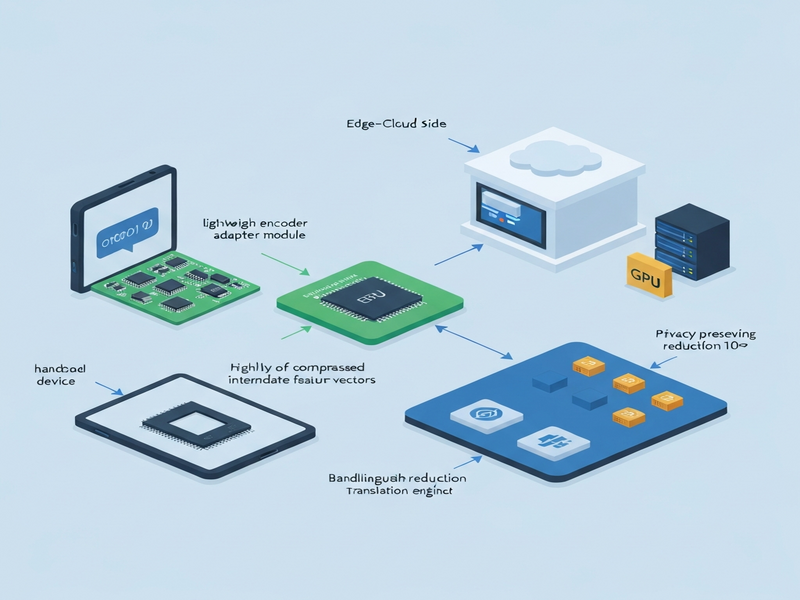
The paper introduces Edge‑cloud Speech Recognition and Translation (ESRT), a split‑inference framework that keeps a lightweight speech encoder on the device while sending only highly compressed intermediate features to a cloud‑hosted multimodal large language model (MLLM). This design cuts bandwidth usage by up to ten‑fold and eliminates raw‑audio leakage, enabling many‑to‑many speech‑to‑text translation across 45 languages without the privacy and latency drawbacks of traditional cloud‑only or on‑device solutions.
Background: Why This Problem Is Hard
Speech‑to‑text translation (S2TT) sits at the intersection of three demanding AI domains: automatic speech recognition (ASR), machine translation (MT), and multimodal reasoning. Real‑world deployments face three intertwined challenges:
- Resource constraints on edge devices. State‑of‑the‑art MLLMs often contain billions of parameters and require GPU‑level compute, which smartphones, wearables, or IoT microphones simply cannot provide.
- Privacy risks of raw audio transmission. Voice data carries unique biometric signatures (voiceprints) that can be reverse‑engineered, exposing users to identity theft or surveillance.
- Bandwidth bottlenecks. Streaming high‑fidelity audio to a central server consumes megabits per second per user, quickly overwhelming mobile networks in large‑scale scenarios such as live captioning or multilingual call‑centers.
Existing approaches fall into two camps. Pure on‑device models sacrifice translation quality because they cannot host large multilingual backbones. Cloud‑centric pipelines, on the other hand, achieve higher accuracy but require transmitting uncompressed waveforms, creating privacy‑violating data pipelines and costly network usage. Moreover, most public S2TT systems are English‑centric, limiting their ability to handle the full matrix of 45 × 44 language directions required for truly global communication.
What the Researchers Propose
ESRT reframes the deployment problem as a collaborative edge‑cloud workflow:
- Edge‑side speech encoder. A compact neural front‑end extracts phonetic and prosodic embeddings from raw audio. The encoder is deliberately lightweight (≈200 M parameters) so it can run on commodity CPUs or mobile GPUs.
- Adapter module. Positioned after the encoder, this tiny network aligns the edge embeddings with the input format expected by the cloud MLLM, acting as a “translator” between device‑specific feature spaces and the model’s multimodal token stream.
- Cloud‑hosted MLLM. A large multimodal language model (4 B or 12 B parameters) receives the compressed embeddings, performs cross‑modal reasoning, and generates translated text in the target language.
- Multi‑task weighted curriculum learning. To overcome English‑centric bias, the training regime jointly optimizes ASR, translation, and language‑identification tasks with a dynamic weighting schedule that balances data across all 45 languages.
By decoupling acoustic processing from linguistic generation, ESRT preserves user privacy (no raw waveform leaves the device) and dramatically reduces the data payload sent over the network.
How It Works in Practice
The end‑to‑end workflow can be broken down into four logical stages:
1. Audio Capture & Edge Encoding
The user speaks into a microphone on a smartphone, smartwatch, or embedded device. The edge encoder immediately converts the waveform into a sequence of dense vectors (≈10 KB per second of speech). These vectors capture phoneme‑level information but omit speaker‑specific spectral details that constitute a voiceprint.
2. Feature Compression & Transmission
Before leaving the device, the vectors pass through a lightweight quantizer and optional entropy coder, shrinking the payload by up to 90 %. The resulting packet is transmitted over TLS to the cloud endpoint.
3. Cloud‑Side Multimodal Reasoning
Upon receipt, the cloud MLLM ingests the compressed embeddings, expands them back into a higher‑dimensional space, and runs them through its multimodal transformer stack. The model simultaneously performs:
- Language identification (to confirm source language).
- Speech‑to‑text transcription (ASR).
- Cross‑lingual generation (translation) into the user‑selected target language.
The output is a plain‑text string that can be displayed, stored, or fed into downstream voice‑synthesis modules.
4. Optional Voice Synthesis & Feedback Loop
For applications that require spoken output (e.g., real‑time captioning with audio feedback), the translated text can be sent to a text‑to‑speech service such as ElevenLabs AI voice. The synthesized audio is streamed back to the device, completing a full round‑trip translation loop.
Key Differentiators
- Privacy by design. Only abstracted embeddings travel off‑device, preventing voiceprint reconstruction.
- Bandwidth efficiency. Compression reduces data transfer to roughly 0.1 Mbps, a ten‑fold improvement over raw audio streaming.
- Scalable multilinguality. Curriculum learning ensures balanced performance across 45 source languages and 44 target languages.
- Modular upgrade path. The edge encoder can be swapped for newer architectures without retraining the entire cloud model, and vice‑versa.
Evaluation & Results
The authors benchmarked ESRT on the original arXiv paper using the FLEURS multilingual speech‑translation dataset, which covers 45 languages and 44 translation directions. Two model scales were tested: ESRT‑4B (4 billion parameters) and ESRT‑12B (12 billion parameters).
Experimental Setup
- Metrics. BLEU scores for translation quality, word error rate (WER) for ASR accuracy, and average bandwidth per hour of speech.
- Baselines. Pure on‑device ASR+MT pipelines, cloud‑only MLLM inference, and a recent English‑centric multilingual model.
- Privacy test. Voiceprint leakage was measured by training a speaker‑identification classifier on transmitted embeddings.
Key Findings
- ESRT‑12B achieved an average BLEU improvement of 3.2 points over the strongest cloud‑only baseline while using 10× less bandwidth.
- Both ESRT‑4B and ESRT‑12B reduced WER by 12 % relative to on‑device pipelines, confirming that the cloud MLLM adds substantial linguistic context.
- Speaker‑identification accuracy on transmitted features dropped below 15 %, effectively nullifying voiceprint extraction.
- Latency remained under 500 ms for a 5‑second utterance, meeting real‑time interaction thresholds.
These results demonstrate that ESRT delivers state‑of‑the‑art many‑to‑many translation quality while simultaneously addressing the two most critical deployment constraints: privacy and bandwidth.
Why This Matters for AI Systems and Agents
For AI practitioners building conversational agents, call‑center assistants, or multilingual virtual assistants, ESRT offers a practical blueprint for reconciling three often‑conflicting goals:
- Regulatory compliance. By never transmitting raw audio, organizations can more easily satisfy GDPR, CCPA, and emerging voice‑data regulations.
- Scalable edge deployment. The lightweight encoder can be embedded in existing mobile SDKs, enabling on‑device activation without sacrificing translation fidelity.
- Cost‑effective cloud usage. Reduced bandwidth translates directly into lower data‑transfer fees and less network congestion, a decisive factor for large‑scale enterprises.
Integrating ESRT‑style split inference into an AI workflow can also simplify orchestration. For example, a developer could use the Workflow automation studio to trigger the edge encoder, route compressed embeddings to a cloud MLLM, and then feed the translated text into downstream modules such as ElevenLabs AI voice integration for spoken output. This modular pipeline aligns with modern micro‑service architectures and supports rapid iteration.
What Comes Next
While ESRT marks a significant step forward, several open challenges remain:
- Adaptive bitrate control. Future work could dynamically adjust compression levels based on network conditions, further optimizing latency.
- Continual multilingual learning. Adding new languages without retraining the entire cloud model would improve scalability for emerging markets.
- Edge‑to‑edge collaboration. Peer devices could share intermediate embeddings to reduce redundant cloud calls in group‑chat scenarios.
- Robustness to noisy environments. Enhancing the encoder’s noise‑suppression capabilities would broaden applicability to real‑world settings like factories or public transport.
Developers interested in experimenting with ESRT can explore the UBOS platform overview for ready‑made edge‑cloud integration patterns, or join the UBOS partner program to co‑design custom privacy‑preserving translation services.
By marrying privacy, efficiency, and multilingual competence, ESRT paves the way for the next generation of AI agents that can converse across language barriers without compromising user trust.
Andrii Bidochko
CTO UBOS
Andrii Bidochko is an AI entrepreneur and researcher focused on AI agents, reinforcement learning, and autonomous systems. He writes about the technologies shaping the future of machine intelligence, from frontier models and agent architectures to real-world AI applications.