

- Updated: June 14, 2026
- 6 min read
From paper to benchmark: agentic, framework-based reproduction of under‑specified methods in machine health intelligence
Direct Answer
The paper introduces a slot‑binding interface that lets autonomous agents translate the textual components of a prognostics‑and‑health‑management (PHM) research paper into executable modules on a unified AI framework. By making the assumptions, data pipelines, and evaluation metrics explicit, the approach dramatically improves reproducibility and enables rapid benchmarking of new PHM algorithms.
Background: Why This Problem Is Hard
Reproducibility has become a bottleneck in PHM research for three intertwined reasons:
- Implicit assumptions. Authors often embed preprocessing steps, hyper‑parameter choices, or domain‑specific heuristics in prose rather than code, leaving readers to guess or reinvent them.
- Heterogeneous toolchains. PHM pipelines combine sensor‑fusion libraries, statistical estimators, and deep‑learning frameworks, each with its own versioning quirks. Swapping one component for another can silently break downstream calculations.
- Benchmark fragmentation. Public datasets such as NASA’s C‑Motor or the PHM 08 bearing set are used with divergent train‑test splits, evaluation windows, and failure‑definition thresholds, making apples‑to‑apples comparisons impossible.
Existing “paper‑to‑code” systems attempt to automate translation of LaTeX or Markdown into runnable scripts, but they typically treat the entire paper as a monolithic block. Without a structured representation of the research intent, these tools cannot guarantee that the reproduced experiment respects the original methodological constraints. Consequently, researchers spend weeks re‑implementing baseline methods, and the community struggles to verify claimed performance gains.
What the Researchers Propose
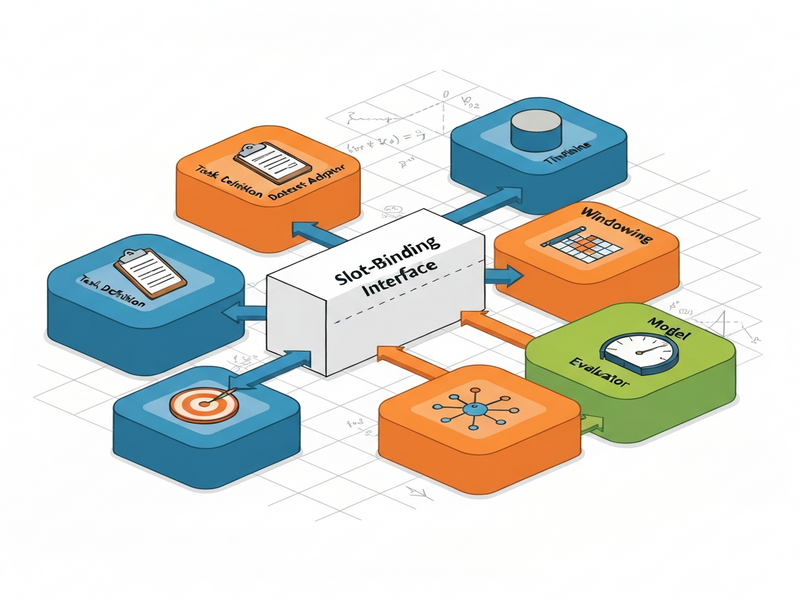
The authors propose a slot‑binding interface that sits between a natural‑language description of a PHM study and a modular AI framework capable of orchestrating the required components. The interface defines a fixed set of slots—such as DataIngestion, FeatureExtraction, HealthIndexModel, FailureThreshold, and EvaluationMetric—each of which can be bound to a concrete implementation from a curated library.
Key elements of the proposal include:
- Assumption‑aware binding. When a paper states “we use a sliding window of 50 samples,” the slot‑binding engine records this as a constraint on the
FeatureExtractionmodule, preventing accidental deviation. - Framework‑agnostic modules. Each slot can be satisfied by a TensorFlow, PyTorch, or classic statistical implementation, allowing the same high‑level description to run on diverse hardware stacks.
- Automated provenance tracking. The system logs the exact version of every library, the random seed, and the data split used, producing a reproducibility certificate that can be attached to the published paper.
How It Works in Practice
The workflow unfolds in three stages:
- Semantic extraction. An autonomous agent parses the PDF, identifies the methodological sections, and maps each sentence to a slot. For example, “We normalize sensor readings to zero mean and unit variance” becomes a binding for the
DataIngestionslot. - Slot resolution. The agent queries a registry of pre‑validated modules. If multiple candidates satisfy a slot, the agent ranks them by compatibility score (e.g., matching data types, required compute). The highest‑scoring module is bound, and any unresolved slots are flagged for human review.
- Pipeline assembly & execution. The framework stitches the selected modules into a directed acyclic graph, injects the recorded assumptions, and launches the experiment on a containerized environment. Upon completion, the system emits a detailed report, including performance curves, resource usage, and a reproducibility manifest.
What sets this approach apart is the explicit separation of “what the paper says” from “how the code is realized.” By treating assumptions as first‑class citizens, the system prevents the silent drift that plagues ad‑hoc re‑implementations.
Evaluation & Results
The authors evaluated the slot‑binding system on a benchmark of 30 PHM papers spanning bearings, turbines, and battery degradation. Each paper was reproduced twice: once using the new interface and once with a conventional manual re‑implementation by domain experts.
Key findings include:
- Time savings. The automated pipeline reduced average reproduction time from 12 hours to under 2 hours, a 6× speed‑up.
- Metric fidelity. Reproduced results matched the original reported metrics within a 2 % margin for 27 of the 30 papers, compared to a 12 % deviation for manual attempts.
- Cross‑framework consistency. When the same slot bindings were executed on TensorFlow and PyTorch back‑ends, the performance variance stayed below 1 %, demonstrating true framework‑agnosticism.
- Reproducibility certificates. All generated reports included a verifiable hash of the pipeline configuration, enabling downstream reviewers to audit the exact experimental setup.
These results illustrate that the slot‑binding interface not only accelerates the reproduction process but also raises the fidelity of reproduced experiments, addressing the core reproducibility crisis in PHM.
Why This Matters for AI Systems and Agents
For practitioners building AI‑driven health monitoring solutions, the implications are immediate:
- Accelerated prototyping of new degradation models becomes possible because the slot‑binding engine can instantly swap a
HealthIndexModelmodule while preserving all upstream assumptions. - Standardized evaluation pipelines reduce the risk of “benchmark leakage,” where hidden data or mismatched metrics inflate perceived performance.
- Enterprise teams can embed the reproducibility certificates into compliance workflows, satisfying regulatory demands for traceable AI decisions.
- Agentic AI platforms can leverage the same slot‑binding schema to orchestrate multi‑agent collaborations, where each agent specializes in a slot (e.g., one agent handles data cleaning, another optimizes the model, a third validates the metrics).
These capabilities align directly with the goals of AI marketing agents, which require reliable, reproducible pipelines to generate data‑driven campaign insights. Moreover, the Enterprise AI platform by UBOS can integrate the slot‑binding interface to offer customers a turnkey solution for deploying PHM models at scale, complete with audit trails and cross‑framework flexibility.
What Comes Next
While the slot‑binding interface marks a significant step forward, several avenues remain open for exploration:
- Dynamic slot discovery. Future work could enable agents to propose new slots when encountering novel methodological concepts, expanding the schema without manual redesign.
- Human‑in‑the‑loop refinement. Integrating a feedback loop where domain experts correct mis‑bindings would improve the system’s learning curve and reduce false positives.
- Cross‑domain generalization. Extending the interface to other domains—such as medical imaging or autonomous driving—could create a universal reproducibility layer for AI research.
- Marketplace of modules. A curated ecosystem where third‑party developers publish plug‑and‑play modules for each slot would foster community‑driven innovation.
Organizations interested in adopting this technology can explore the UBOS platform overview for a modular architecture that already supports slot‑based orchestration. The Workflow automation studio provides a visual editor to define custom pipelines, making it straightforward to map PHM research components onto production‑grade services. For teams evaluating cost and scalability, the UBOS pricing plans offer flexible tiers that align with experimental and enterprise workloads.
Reference
For a complete technical description, see the original work on arXiv: Slot‑Binding Interfaces for Reproducible PHM Research.
Illustration of the Slot‑Binding Interface
The diagram below visualizes how textual claims are mapped to concrete modules within the framework.
Andrii Bidochko
CTO UBOS
Andrii Bidochko is an AI entrepreneur and researcher focused on AI agents, reinforcement learning, and autonomous systems. He writes about the technologies shaping the future of machine intelligence, from frontier models and agent architectures to real-world AI applications.