

- Updated: June 13, 2026
- 7 min read
Do LLMs Build World Models From Text? A Multilingual Diagnostic of Spatial Reasoning
Direct Answer
The paper introduces MentalMap, a multilingual benchmark that rigorously tests whether large language models (LLMs) can construct internal spatial world models from pure‑text descriptions. It matters because the study uncovers a universal “L3 reasoning cliff” where models lose most of their atomic spatial knowledge when asked to reason about viewpoints, highlighting a fundamental limitation of text‑only LLMs for real‑world spatial tasks.
Background: Why This Problem Is Hard
Spatial reasoning is a cornerstone of embodied AI, robotics, and any system that must navigate or describe physical environments. Humans effortlessly combine language with a mental map of space, but LLMs are trained on sequences of tokens without explicit grounding. Existing evaluations—often limited to English, single‑step fact retrieval, or synthetic grids—fail to capture the layered complexity of real‑world spatial cognition:
- Multilingual diversity: Languages encode directionality, reference frames, and spatial prepositions differently, challenging models that have seen uneven data distributions.
- Hierarchical reasoning: From recognizing that “the cup is on the table” (atomic fact) to constructing a full graph of object relations across multiple viewpoints (world‑graph generation).
- Pure‑text constraints: Without visual input, models must retain and manipulate spatial information solely in working memory, a process that may exceed token‑level capacity.
Consequently, current benchmarks provide an incomplete picture, and developers lack a diagnostic tool that isolates where and why LLMs stumble on spatial tasks.
What the Researchers Propose
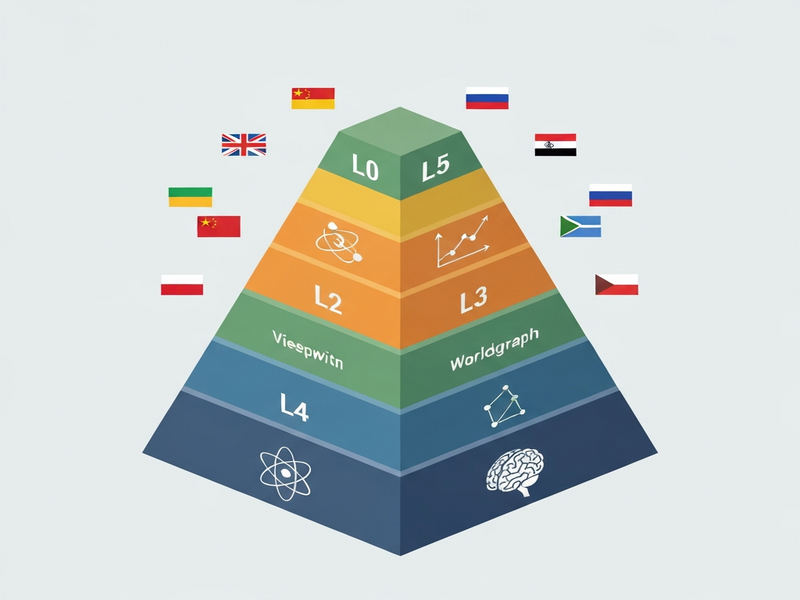
The authors present MentalMap, a six‑level capability hierarchy (L0–L5) that spans from simple spatial facts to the generation of complete world graphs. The benchmark is built on 100 ProcTHOR household scenes and covers eight typologically diverse languages plus a structured‑text control. Four diagnostic axes probe:
- Frame of reference (egocentric vs. allocentric).
- Reading‑direction bias (left‑to‑right vs. right‑to‑left scripts).
- Reasoning‑effort allocation (how many inference steps the model appears to use).
- Hallucination propensity (generation of non‑existent objects or relations).
By systematically varying these axes, MentalMap isolates whether a model truly builds a mental map or merely memorizes surface patterns.
How It Works in Practice
The benchmark follows a clear workflow:
- Scene Generation: ProcTHOR creates realistic kitchen, living‑room, and bedroom layouts, each annotated with precise 3D coordinates.
- Textual Description: For each scene, a set of language‑specific narratives describes object locations, relations, and possible viewpoint changes.
- Prompt Construction: Researchers feed the narrative to an LLM using zero‑shot, few‑shot, or chain‑of‑thought prompting, depending on the experiment.
- Response Parsing: The model’s output is parsed into structured slots (e.g., “object‑A is north of object‑B”). For higher levels (L4‑L5), the output must form a graph representation.
- Scoring Engine: Accuracy is measured per level, and diagnostic metrics (e.g., frame‑of‑reference consistency) are computed across languages.
What sets MentalMap apart is its multilingual, multi‑axis design. Instead of a single monolithic test, each axis can be toggled, allowing researchers to pinpoint whether a failure stems from language‑specific bias, memory overload, or a deeper lack of spatial grounding.
Evaluation & Results
The study evaluated thirteen LLMs, ranging from open‑source 7B models to proprietary 175B systems, across three prompting strategies (plain, few‑shot, and chain‑of‑thought). Key experimental scenarios included:
- Atomic fact retrieval (L0) – “Where is the lamp?”
- Relative positioning (L1‑L2) – “Is the chair left of the table?”
- Viewpoint transformation (L3) – “If you stand at the doorway, where is the sofa?”
- World‑graph construction (L4‑L5) – “Generate a full connectivity map of the room.”
Universal L3 Reasoning Cliff: Across all languages and model families, performance dropped sharply at level L3. Even the strongest models retained less than 50 % of their L0 accuracy once they had to reason about a new viewpoint. The cliff persisted regardless of model size, prompting style, or language, suggesting a systemic bottleneck.
Additional observations:
- Structured‑output failures (L4‑L5) varied widely; some models produced syntactically correct graphs but with incorrect edges, while others hallucinated objects entirely.
- Human participants, when given the same pure‑text protocol, exhibited a similar performance drop, indicating that the limitation may stem from working‑memory constraints inherent to text‑only reasoning.
- Reading‑direction bias affected languages with right‑to‑left scripts, slightly lowering L1‑L2 scores but not the L3 cliff.
These findings collectively demonstrate that current LLMs, even at massive scales, lack a robust internal spatial world model when constrained to text alone.
Why This Matters for AI Systems and Agents
For practitioners building AI agents that interact with physical environments—whether virtual assistants, warehouse robots, or autonomous drones—the MentalMap results raise several red flags:
- Agent Planning Reliability: Agents that rely solely on LLM‑generated spatial instructions risk catastrophic errors when viewpoint changes are required, a common scenario in navigation tasks.
- Multilingual Deployment: The benchmark confirms that language‑specific quirks do not rescue the core limitation; thus, deploying agents in non‑English markets will not automatically mitigate spatial reasoning gaps.
- Evaluation Standards: MentalMap offers a reproducible, multilingual test suite that can become part of continuous integration pipelines for AI agents, ensuring that spatial reasoning regressions are caught early.
- System Architecture Decisions: The findings motivate hybrid designs that combine LLMs with external spatial modules (e.g., graph databases, simulation engines). Integrating a Chroma DB integration for persistent world‑graph storage, for instance, can offload memory‑intensive reasoning from the language model.
In short, the L3 cliff signals that pure‑text LLMs are insufficient for any agent that must understand or manipulate a dynamic spatial context. Developers should consider augmenting language models with dedicated spatial reasoning components or multimodal inputs.
What Comes Next
While MentalMap shines a light on a critical weakness, it also outlines a roadmap for future research and product development:
- Multimodal Fusion: Incorporating visual or depth data alongside text could expand the effective working memory, allowing models to anchor spatial concepts in perceptual embeddings.
- Scratchpad‑Augmented Prompting: External “scratchpad” buffers that let the model write intermediate facts before answering may mitigate the memory bottleneck observed in humans.
- Curriculum Learning: Training regimes that gradually increase viewpoint complexity could help models internalize transformation rules more robustly.
- Benchmark Expansion: Extending MentalMap to outdoor scenes, dynamic objects, and longer narrative chains would further stress‑test world‑model capabilities.
- Product Integration: Teams building AI assistants can leverage the UBOS platform overview to prototype agents that combine LLMs with spatial back‑ends, or explore the Workflow automation studio for orchestrating multimodal pipelines.
- Business Use Cases: Startups aiming to differentiate their AI products may adopt AI marketing agents that are aware of spatial context (e.g., arranging virtual storefronts), while enterprises can evaluate the Enterprise AI platform by UBOS for large‑scale deployment.
Addressing the L3 cliff will likely require a paradigm shift from “text‑only” to “text‑plus‑world” architectures, where language models act as orchestrators rather than sole reasoners.
Conclusion
The MentalMap benchmark provides the first systematic, multilingual probe of LLMs’ ability to build spatial world models from text. Its discovery of a universal L3 reasoning cliff underscores a fundamental limitation of current pure‑text approaches, one that persists across languages, scales, and prompting styles. For AI researchers, product teams, and business leaders, the takeaway is clear: to achieve reliable spatial reasoning, future systems must blend language understanding with external spatial representations, multimodal perception, or scratchpad‑style reasoning aids. The benchmark itself will serve as a valuable yardstick as the community iterates toward truly world‑aware language agents.
Read the full study on arXiv for detailed methodology, data splits, and reproducible code.
Andrii Bidochko
CTO UBOS
Andrii Bidochko is an AI entrepreneur and researcher focused on AI agents, reinforcement learning, and autonomous systems. He writes about the technologies shaping the future of machine intelligence, from frontier models and agent architectures to real-world AI applications.