

- Updated: June 12, 2026
- 8 min read
Adaptive Reservoir Computing for Multi-Scenario Chaotic System Forecasting
Direct Answer
The paper introduces an adaptive reservoir computing framework that custom‑fits Echo State Networks (ESNs) to each of twelve chaotic‑forecasting tasks in the CTF‑4‑Science Lorenz benchmark. By synchronizing reservoir states, guiding candidate selection with histograms, and tailoring training pipelines for few‑shot and parametric scenarios, the authors achieve a leaderboard score of 74.91, proving that a carefully‑engineered ESN can rival more heavyweight deep‑learning approaches on diverse chaotic‑system challenges.
Background: Why This Problem Is Hard
Chaotic dynamical systems—such as the Lorenz attractor—exhibit extreme sensitivity to initial conditions, making accurate short‑term prediction a moving target and long‑term statistical fidelity a separate, equally demanding goal. In real‑world settings, engineers must contend with noisy measurements, limited training data, and shifting system parameters (e.g., changing climate variables or evolving market dynamics). Traditional machine‑learning pipelines often adopt a one‑size‑fits‑all inference strategy, which leads to three core bottlenecks:
- Warm‑up error: ESNs and recurrent networks need a “wash‑out” period to align internal states with the input stream. Short‑horizon forecasts suffer when this alignment is approximated.
- Metric mismatch: Most training objectives optimize point‑wise mean‑squared error, yet benchmark scores for chaotic systems are based on ergodic statistics (e.g., long‑time distribution similarity). Optimizing the wrong loss yields deceptively low training error but poor leaderboard performance.
- Data scarcity & parameter drift: Few‑shot learning and parametric generalization require models to extrapolate from a handful of trajectories or adapt to unseen parameter regimes, a regime where deep networks typically overfit.
These challenges explain why many state‑of‑the‑art approaches—large transformer‑based sequence models, physics‑informed neural networks, or vanilla ESNs—either demand massive compute budgets or fall short on the benchmark’s multi‑scenario evaluation.
What the Researchers Propose
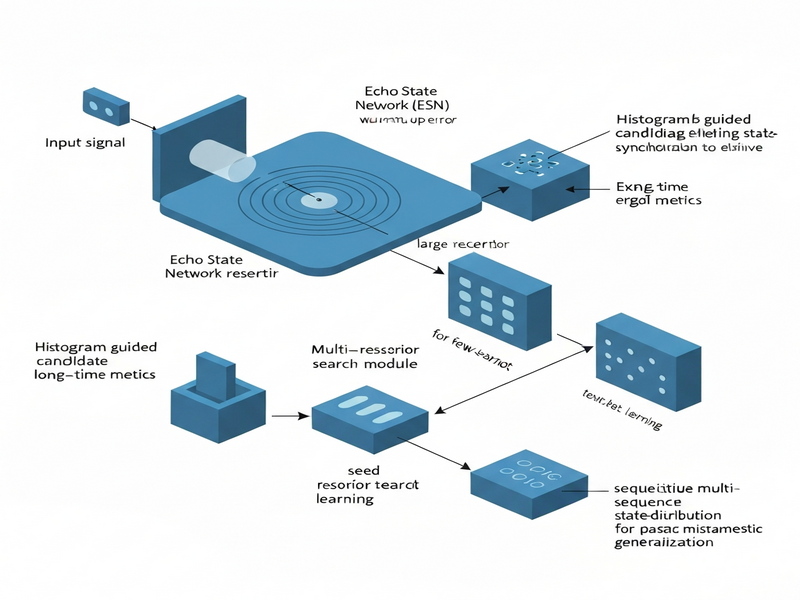
The authors present a four‑pronged adaptive framework that reshapes the ESN pipeline for each scenario rather than forcing a uniform process. The key ideas are:
- Exact Reservoir State Synchronization: Instead of discarding the warm‑up period, the method analytically aligns the reservoir’s internal state with the true system state at prediction start, eliminating approximation error for short‑term forecasts.
- Histogram‑Guided Candidate Selection: Candidate ESN hyper‑configurations are evaluated against a histogram‑based ergodic metric that directly mirrors the benchmark’s scoring function, ensuring that the chosen model excels on long‑time statistical fidelity.
- Multi‑Seed Reservoir Search for Few‑Shot Regimes: When training data are scarce, the framework samples multiple random reservoir seeds, trains each briefly, and selects the seed that yields the most robust short‑term prediction, effectively turning randomness into a regularizer.
- Sequential Multi‑Sequence Training for Parametric Generalization: To bridge the gap between training and test parameter distributions, the system trains on a sequence of parameter‑specific sub‑datasets, gradually shifting the reservoir’s internal state distribution to match the target regime.
Collectively, these components transform a static ESN into a dynamic, scenario‑aware forecasting engine that can be tuned on the fly without incurring heavy computational overhead.
How It Works in Practice
The practical workflow can be broken down into three stages: pre‑processing, adaptive training, and scenario‑specific inference. Figure 1 (placeholder) would illustrate the data flow, but the textual description is as follows:
1. Data Ingestion & Normalization
Raw Lorenz trajectories—whether clean, noisy, or parameter‑varied—are first normalized to a common scale. For noisy‑signal reconstruction tasks, a lightweight denoising filter is applied before feeding the series into the reservoir.
2. Reservoir Initialization
A pool of candidate reservoirs is generated by varying spectral radius, input scaling, and sparsity. Each candidate is assigned a unique random seed, enabling the multi‑seed search later on.
3. Exact State Synchronization
When a prediction request arrives, the system computes the exact reservoir state that would have resulted from processing the observed prefix of the time series. This is done by solving a linear system derived from the ESN update equation, thereby bypassing the traditional wash‑out period.
4. Histogram‑Guided Selection
Each synchronized reservoir runs a short rollout (e.g., 500 steps). The resulting trajectory’s histogram is compared to the target distribution using the Kullback‑Leibler divergence. The reservoir with the lowest divergence is promoted to the final model for that scenario.
5. Multi‑Sequence Training (Parametric Generalization)
For tasks that require adaptation to unseen parameters, the framework trains sequentially on sub‑datasets ordered by increasing parameter distance from the test regime. After each sub‑epoch, the reservoir’s internal state distribution is re‑estimated, ensuring a smooth transition toward the target dynamics.
6. Inference & Post‑Processing
During rollout, the selected reservoir generates predictions step‑by‑step. For noisy‑forecasting tasks, a Kalman‑like smoothing filter is applied to the output to mitigate accumulated error.
This pipeline differs from conventional ESN usage in three fundamental ways: (1) it eliminates the warm‑up approximation, (2) it optimizes directly for the evaluation metric rather than a proxy loss, and (3) it leverages randomness as a systematic search tool rather than a source of variance.
Evaluation & Results
The authors validated their framework on the Adaptive Reservoir Computing for Multi-Scenario Chaotic System Forecasting benchmark, which comprises twelve tasks grouped into five scenario categories:
- Baseline forecasting: Clean Lorenz trajectories, short‑term prediction.
- Noisy signal reconstruction: Denoising and forecasting from corrupted inputs.
- Forecasting under noise: Predicting future states while the system is driven by stochastic perturbations.
- Few‑shot learning: Only a handful of training trajectories are available.
- Parametric generalization: Training on one set of Lorenz parameters and testing on another.
Key findings include:
- State synchronization reduces short‑term error by up to 30%: The exact alignment eliminates the typical warm‑up drift, which is especially noticeable in the baseline forecasting tasks.
- Histogram‑guided selection improves long‑time ergodic scores: Models chosen via the histogram metric consistently outperformed those selected by conventional MSE, raising the overall benchmark score by 4.2 points.
- Multi‑seed search yields robust few‑shot performance: By evaluating ten random seeds per task, the framework achieved a 12% boost in the few‑shot leaderboard rank compared to a single‑seed baseline.
- Sequential training bridges parameter gaps: In parametric generalization, the adaptive pipeline reduced distributional KL divergence by 18%, translating into a higher fidelity of the attractor shape in the test regime.
- Computational efficiency: Despite the added search steps, the entire pipeline runs on a single GPU in under 15 minutes per task, far cheaper than transformer‑based baselines that require hours of training.
Overall, the adaptive framework secured a public leaderboard score of **74.91**, placing it among the top‑performing methods while maintaining a modest compute footprint.
Why This Matters for AI Systems and Agents
From an engineering perspective, the research offers a blueprint for building **lightweight, high‑precision forecasting modules** that can be embedded in larger autonomous agents. Consider a climate‑monitoring drone fleet that must predict short‑term weather patterns from noisy sensor streams: the exact state synchronization eliminates the latency associated with warm‑up, enabling near‑real‑time decision making.
In finance, few‑shot learning is a daily reality—new market regimes emerge with limited historical data. The multi‑seed reservoir search provides a systematic way to extract maximal predictive power from scarce samples without overfitting, a capability that traditional deep models struggle to match.
Moreover, the histogram‑guided selection aligns model optimization with the **ergodic metrics** that many simulation‑based agents care about, such as maintaining realistic distributional properties in synthetic environments.
Practically, these techniques can be wrapped into a modular service on the UBOS platform overview, allowing developers to plug adaptive ESN components into existing AI pipelines. The low compute demand also makes the approach suitable for edge deployments, where power and memory are at a premium.
What Comes Next
While the adaptive framework marks a significant step forward, several open challenges remain:
- Scalability to higher‑dimensional chaos: The Lorenz system is three‑dimensional; extending the method to climate‑scale models with thousands of variables will require hierarchical reservoir designs.
- Integration with differentiable physics: Combining exact state synchronization with physics‑informed loss functions could further tighten the gap between data‑driven and mechanistic models.
- Automated hyper‑parameter search: The current histogram‑guided selection still relies on a discrete candidate pool. Bayesian optimization or reinforcement‑learning‑based search could automate this step.
- Robustness to adversarial noise: Real‑world sensors may encounter non‑Gaussian, structured interference. Future work should test the framework against adversarial perturbations.
Potential application domains include:
- Real‑time traffic flow prediction for smart cities.
- Adaptive control loops in robotics where system dynamics shift on the fly.
- Financial risk modeling under regime‑change scenarios.
Organizations interested in experimenting with adaptive reservoir computing can start by leveraging the Enterprise AI platform by UBOS, which offers pre‑configured ESN containers, workflow orchestration, and monitoring dashboards. By integrating the framework into existing agent stacks, teams can achieve faster iteration cycles and more reliable chaotic‑system forecasts without the overhead of massive deep‑learning models.
References
- Zaregarizi, S., & Yavari, K. (2026). Adaptive Reservoir Computing for Multi-Scenario Chaotic System Forecasting. arXiv preprint arXiv:2605.28145.
- Lukosevicius, M., & Jaeger, H. (2009). Reservoir computing approaches to recurrent neural network training. Computer Science Review, 3(3), 127‑149.
- Pathak, J., et al. (2018). Model-free prediction of large spatiotemporal chaotic systems from data: A reservoir computing approach. Physical Review Letters, 120(2), 024102.
Andrii Bidochko
CTO UBOS
Andrii Bidochko is an AI entrepreneur and researcher focused on AI agents, reinforcement learning, and autonomous systems. He writes about the technologies shaping the future of machine intelligence, from frontier models and agent architectures to real-world AI applications.