

- Updated: June 12, 2026
- 7 min read
MemCog: From Memory-as-Tool to Memory-as-Cognition in Conversational Agents
Direct Answer
MemCog introduces a Memory‑as‑Cognition paradigm that weaves memory access directly into the reasoning loop of conversational agents, rather than treating retrieval as a separate, one‑shot tool. This shift enables agents to navigate, explore, and exploit stored knowledge proactively, leading to more coherent, context‑aware dialogues and higher performance on both passive and proactive memory benchmarks.
Background: Why This Problem Is Hard
Modern conversational agents—whether powered by large language models (LLMs) or hybrid retrieval‑augmented systems—rely on external memory stores to recall facts, user preferences, or prior interactions. The prevailing design, which we call the Memory‑as‑Tool paradigm, follows a simple pattern: the agent receives a user query, formulates a retrieval request, fetches a flat list of passages, and then generates a response. While straightforward, this pipeline suffers from three intertwined limitations:
- Passive invocation: Retrieval is triggered only when the user explicitly asks for information, leaving the agent unable to surface relevant context that the user may have omitted.
- Reasoning‑retrieval decoupling: The reasoning component and the retrieval component operate in isolation, so the agent cannot adapt its search strategy based on intermediate inferences.
- Structural mismatch: Retrieved fragments are typically isolated text snippets, which do not align with the agent’s internal representation of a user’s knowledge graph or task flow.
These shortcomings become especially pronounced in long‑term interactions, multi‑turn tasks, and domains where the agent must synthesize information across disparate episodes (e.g., personalized tutoring, enterprise support, or complex workflow automation). As businesses demand agents that can remember, plan, and act over extended horizons, the need for a more integrated memory architecture has become a critical research bottleneck.
What the Researchers Propose
The authors of the MemCog paper propose a comprehensive framework that reframes memory from a peripheral utility to a core cognitive faculty. Their solution consists of three tightly coupled components:
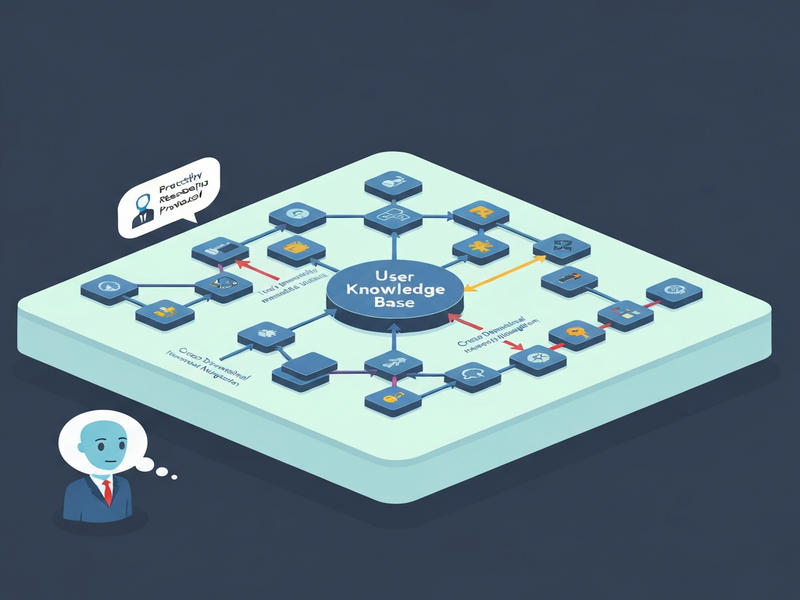
- Navigable Memory Store (NMS): A graph‑structured repository where user knowledge is encoded as nodes (facts, intents, entities) linked by associative edges. This structure mirrors how humans mentally map concepts, enabling flexible traversal.
- Cross‑Dimensional Navigation Interface (CNI): An API that allows the reasoning engine to issue multi‑step navigation commands—such as “follow “related‑to” edges two hops forward” or “backtrack to the last decision node”—thereby turning memory access into a programmable reasoning action.
- Proactive Reasoning Protocol (PRP): A set of heuristics and learned triggers that prompt the agent to explore the NMS based on conversational cues, even when the user does not explicitly request retrieval.
Collectively, these elements transform memory from a static lookup table into an active, searchable cognitive map that the agent can query, update, and reason over throughout a dialogue.
How It Works in Practice
At a high level, a MemCog‑enabled agent follows a cyclical workflow that intertwines reasoning and memory navigation:
- Contextual Encoding: The incoming user utterance is embedded and combined with the agent’s current internal state.
- Proactive Trigger Evaluation: The PRP scans the encoded context for signals (e.g., “I’m not sure”, “remind me later”, or domain‑specific patterns) that suggest a memory exploration is beneficial.
- Navigation Planning: If a trigger fires, the reasoning module formulates a navigation plan using the CNI—specifying which edge types to follow, depth limits, and any constraints.
- Graph Traversal: The NMS executes the plan, returning a subgraph that is semantically aligned with the current task.
- Integrated Reasoning: The retrieved subgraph is fed back into the LLM or symbolic reasoner, allowing it to incorporate the newly surfaced knowledge directly into the generation step.
- Response Generation & State Update: The agent produces a response and optionally augments the NMS with new nodes or edges derived from the interaction.
This loop repeats for each turn, meaning memory access can happen multiple times within a single user request, and the agent can dynamically adjust its search strategy as the conversation evolves.
What sets MemCog apart from prior retrieval‑augmented approaches is the bidirectional coupling between reasoning and memory: the agent decides *how* to search, and the search results immediately influence the next reasoning step. This eliminates the “search‑then‑answer” bottleneck and enables richer, multi‑hop inference.
Evaluation & Results
To validate their claims, the researchers introduced two families of benchmarks:
- Passive QA suites: Established datasets such as LoCoMo and LongMemEval, which test an agent’s ability to answer questions using long‑range context.
- ProactiveMemBench: A novel benchmark designed to measure how often an agent initiates memory retrieval without explicit prompts, and how useful those proactive hops are for downstream task success.
Across the passive QA benchmarks, MemCog achieved state‑of‑the‑art scores—92.98 on LoCoMo and 95.8 on LongMemEval—matching or surpassing the best retrieval‑augmented baselines. More strikingly, on ProactiveMemBench, MemCog outperformed the next best system by a margin of over 15 percentage points in proactive trigger accuracy and by 12 points in overall task completion rate.
These results demonstrate two key insights:
- Integrating memory as a cognitive process does not sacrifice raw retrieval performance; the graph‑structured store retains the ability to surface precise facts.
- Proactive memory exploration yields tangible gains in real‑world scenarios where users omit critical context, confirming the practical value of the PRP.
Why This Matters for AI Systems and Agents
For practitioners building enterprise‑grade conversational assistants, MemCog offers a blueprint for moving beyond “search‑then‑respond” architectures. By embedding memory navigation directly into the reasoning pipeline, developers can:
- Design agents that anticipate user needs, reducing friction in customer support and sales enablement.
- Leverage graph‑based knowledge bases (e.g., product catalogs, compliance rules) without flattening them into text passages.
- Implement UBOS platform overview features that require dynamic context stitching, such as multi‑step workflow automation.
- Enhance AI marketing agents with the ability to recall prior campaign performance and suggest optimizations without explicit queries.
- Integrate with Workflow automation studio to trigger downstream actions based on memory‑derived insights (e.g., auto‑populate CRM fields after a conversation).
In short, MemCog’s architecture aligns with the growing demand for agents that act as “cognitive partners” rather than passive information fetchers, opening new avenues for personalized, context‑rich AI experiences.
What Comes Next
While MemCog marks a significant step forward, several open challenges remain:
- Scalability of Graph Traversal: As the NMS grows to millions of nodes, efficient indexing and distributed traversal become critical.
- Learning Proactive Triggers: The current PRP relies on hand‑crafted heuristics; future work could explore reinforcement learning to discover optimal trigger policies.
- Cross‑Modal Memory: Extending the graph to incorporate audio, video, or sensor data would broaden applicability to multimodal assistants.
- Privacy and Governance: Navigable memory stores must respect data residency and user consent, especially in regulated industries.
Addressing these gaps will likely involve tighter integration with existing UBOS capabilities. For example, the OpenAI ChatGPT integration could serve as a reasoning engine that consumes graph‑structured context, while the Telegram integration on UBOS provides a real‑time channel for proactive memory notifications. By combining MemCog’s cognitive memory with UBOS’s orchestration layer, developers can prototype agents that not only remember but also act on that memory in a secure, scalable fashion.
Future research may also explore hybrid symbolic‑neural approaches, where the NMS supplies logical constraints that guide LLM generation, or the use of large‑scale foundation models to dynamically enrich the graph with inferred relationships. As the field converges on memory‑centric AI, MemCog’s principles are poised to become a foundational design pattern for the next generation of conversational agents.
Andrii Bidochko
CTO UBOS
Andrii Bidochko is an AI entrepreneur and researcher focused on AI agents, reinforcement learning, and autonomous systems. He writes about the technologies shaping the future of machine intelligence, from frontier models and agent architectures to real-world AI applications.