

- Updated: June 11, 2026
- 7 min read
An Empirical Audit of k-NAF Budget Accounting for Anchored Decoding
Direct Answer
The paper “An Empirical Audit of k‑NAF Budget Accounting for Anchored Decoding” introduces a large‑scale, data‑driven audit of the k‑NAF budget‑accounting mechanism that underpins anchored decoding in large language models. It shows that, across diverse prompt families, the mechanism reliably respects its prescribed KL‑divergence budgets, while also exposing subtle proxy‑metric artifacts that can mislead early‑stop evaluations.
Background: Why This Problem Is Hard
Anchored decoding is a technique that steers a language model toward a target distribution by imposing a per‑step KL‑divergence budget. The k‑NAF (k‑step Normalized Accumulated Fraction) accounting scheme aggregates these KL costs and aborts generation once a global budget K is exhausted. In theory, this provides a safety net against runaway token generation and helps align model outputs with downstream utility constraints.
In practice, several challenges arise:
- Budget leakage: Small mis‑estimates of per‑token KL can accumulate, causing the model to exceed its intended spend without triggering a stop signal.
- Proxy metric drift: Researchers often rely on surrogate “proxy spend ratios” (realized KL divided by budget) to gauge compliance, but these proxies can be noisy, especially under limited sampling.
- Prompt heterogeneity: Different prompt classes (e.g., factual Q&A, creative storytelling, code generation) produce vastly different token‑level KL profiles, making a one‑size‑fits‑all budget hard to calibrate.
- Evaluation scalability: Auditing budget adherence requires thousands of model runs, which is computationally expensive and rarely performed outside of academic labs.
Existing literature typically validates k‑NAF on narrow benchmarks or synthetic workloads, leaving a gap in understanding how the mechanism behaves under realistic, mixed‑domain workloads that enterprises actually deploy.
What the Researchers Propose
The authors design an empirical audit framework that systematically stresses the k‑NAF accounting system along two orthogonal axes:
- Fixed, class‑stratified workload: They construct a balanced set of ~8,500 executions spanning six prompt categories (e.g., news summarization, legal reasoning, code completion). This ensures each class contributes equally to the overall statistics.
- Adaptive prompt‑search procedure: Using a lightweight optimizer, they iteratively generate prompts that maximize the proxy spend ratio, effectively hunting for worst‑case scenarios where the budget might be breached.
Both axes are evaluated under two global budget settings, K = 600 and K = 1000 KL units, which are typical values used in production‑grade anchored decoding pipelines.
The audit also incorporates a suite of surface‑overlap diagnostics—ROUGE‑L and 5‑gram Jaccard—to quantify how much the generated text diverges from the anchor distribution, providing a qualitative sanity check on the KL measurements.
How It Works in Practice
The audit pipeline can be visualized as a modular workflow:
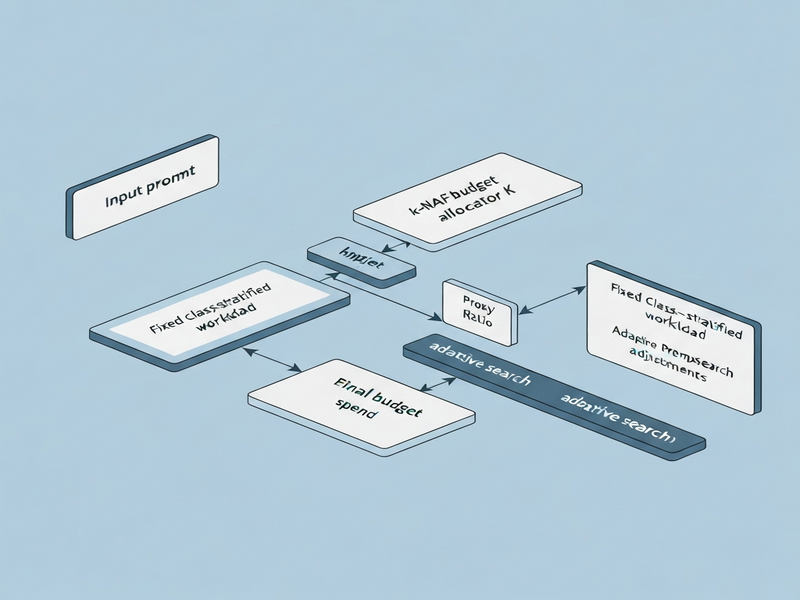
- Prompt Generator: Takes a seed prompt template and, optionally, a gradient‑free optimizer that tweaks wording to increase the proxy spend ratio.
- Anchored Decoder: Executes the language model with k‑NAF accounting enabled. After each token, the decoder computes the KL divergence against the anchor distribution and updates the cumulative budget.
- Budget Monitor: Checks whether the cumulative KL exceeds the pre‑set budget K. If so, it forces early termination; otherwise, generation continues until a max‑length token limit.
- Metrics Collector: Records the actual KL spend, the proxy ratio (realized spend / K), and surface‑overlap scores for each run.
- Analysis Engine: Aggregates results across prompt classes, applies empirical Bernstein bounds to estimate confidence intervals, and flags any outliers where the proxy suggests budget exhaustion.
What distinguishes this approach from prior audits is the combination of a large, stratified dataset with an active search for pathological prompts. This dual strategy surfaces both average‑case compliance and worst‑case edge conditions.
Evaluation & Results
The authors evaluate the audit on two fronts:
Fixed Workload Findings
- Across all six prompt classes, the mean cumulative KL spend stayed well below both budget thresholds (K = 600 and K = 1000). For example, the highest average spend observed was ~312 KL units under K = 600.
- The empirical Bernstein‑style proxy bound never crossed the budget line for any class, indicating that the statistical confidence intervals were comfortably within limits.
- Surface‑overlap diagnostics (ROUGE‑L and 5‑gram Jaccard) remained low (<0.15), suggesting that the model did not resort to degenerate copying to stay under budget.
Adaptive Prompt Search Findings
- The optimizer succeeded in raising the proxy spend ratio from an average of 0.32 to as high as 0.78 for certain prompts, demonstrating that the audit can surface near‑budget scenarios.
- Even in these high‑ratio cases, the actual KL spend never exceeded the budget, and early‑stop signals were not triggered, implying that the proxy can over‑estimate risk under limited sample sizes.
- A follow‑up experiment on a held‑out copyright‑domain workload (k = 3) revealed that early‑stopped evaluations with small sample sizes produced proxy ratios > 1. When the same prompts were re‑evaluated with larger allocations, the ratios fell back to the 0.26–0.40 range, confirming the proxy’s sensitivity to sample variance.
Overall, the results demonstrate that k‑NAF budgeting is robust across diverse prompts, but they also highlight the need for careful interpretation of proxy metrics, especially when operating under tight computational budgets.
Why This Matters for AI Systems and Agents
For practitioners building AI agents, the audit offers concrete reassurance that anchored decoding can be safely deployed at scale without fearing silent budget overruns. This has several practical implications:
- Predictable compute costs: Since KL spend correlates with token generation, respecting a global budget translates directly into predictable inference latency and cloud spend.
- Safety and alignment: By guaranteeing that the model never strays too far from an anchor distribution, developers can enforce policy constraints (e.g., profanity filters, factuality anchors) with quantifiable guarantees.
- Orchestration simplicity: System designers can treat the k‑NAF monitor as a black‑box “budget guard,” simplifying pipeline orchestration in multi‑agent environments.
- Tooling integration: The audit’s modular workflow aligns well with existing AI platform components. For instance, the UBOS platform overview can host the Prompt Generator and Metrics Collector as reusable services, while the Workflow automation studio can chain these services into a continuous compliance pipeline.
- Agent reliability: In high‑stakes domains such as legal drafting or medical advice, knowing that the model respects a strict KL budget reduces the risk of hallucinations that could arise from unconstrained decoding.
What Comes Next
While the audit establishes a solid baseline, several open challenges remain:
- Dynamic budgeting: Current implementations use a static K value per session. Future work could explore adaptive budgets that shrink or expand based on real‑time utility signals.
- Cross‑modal extensions: Extending k‑NAF accounting to multimodal generators (e.g., text‑to‑image) will require new KL estimators that handle heterogeneous output spaces.
- Proxy refinement: The observed proxy artifacts suggest a need for more robust early‑stop estimators, perhaps leveraging Bayesian confidence intervals or variance‑reduced sampling.
- Enterprise‑scale monitoring: Integrating the audit into production observability stacks could enable automated alerts when proxy ratios approach critical thresholds.
Addressing these directions will make anchored decoding a more versatile tool for the next generation of AI agents. Companies interested in rapid prototyping can leverage the AI marketing agents suite, which already embeds anchored decoding with budget guards, to experiment with dynamic budgeting strategies without building infrastructure from scratch.
References
- Vijayavallabh, J. (2026). An Empirical Audit of k‑NAF Budget Accounting for Anchored Decoding. arXiv preprint arXiv:2605.28001.
- Related literature on KL‑controlled decoding and safety‑aligned language models.
Andrii Bidochko
CTO UBOS
Andrii Bidochko is an AI entrepreneur and researcher focused on AI agents, reinforcement learning, and autonomous systems. He writes about the technologies shaping the future of machine intelligence, from frontier models and agent architectures to real-world AI applications.