

- Updated: June 11, 2026
- 7 min read
From Talking to Singing: A New Challenge for Audio-Visual Deepfake Detection
Direct Answer
The paper introduces Text‑guided Audio‑Visual Forgery Detection (T‑AVFD), a detection framework that works reliably on both spoken‑language videos and singing performances. By combining facial authenticity patterns derived from textual descriptions with a differential weighting of audio‑visual consistency, T‑AVFD closes a critical gap in deepfake security where existing models falter on rhythm‑driven singing content.
Background: Why This Problem Is Hard
Audio‑visual deepfakes have moved from simple lip‑sync swaps to sophisticated generative pipelines that can produce photorealistic talking heads, full‑body avatars, and now, rhythm‑aware singing videos. The rapid diffusion of these tools creates three intertwined challenges:
- Cross‑modal coupling loss: Traditional detection relies on mismatches between mouth movements and speech acoustics. In singing, the vocal rhythm often diverges from natural speech patterns, weakening the cues that detectors exploit.
- Domain shift: Most benchmark datasets focus on conversational speech. When a model trained on talking‑head data encounters a singing clip, the statistical distribution of visual motion, audio pitch contours, and temporal alignment shifts dramatically.
- Adversarial realism: Rhythm‑aware generative models such as diffusion‑based singers can synthesize plausible vibrato, breath control, and facial expressions that mimic genuine performers, making visual artifacts harder to spot.
Because of these factors, state‑of‑the‑art detectors that excel on datasets like FaceForensics++ or DeepFake Detection Challenge see a steep performance drop—often more than 30% absolute AUC loss—when evaluated on singing videos. This vulnerability is not academic; malicious actors can weaponize singing deepfakes to spread misinformation, manipulate celebrity endorsements, or create fraudulent audio‑visual evidence in legal contexts.
What the Researchers Propose
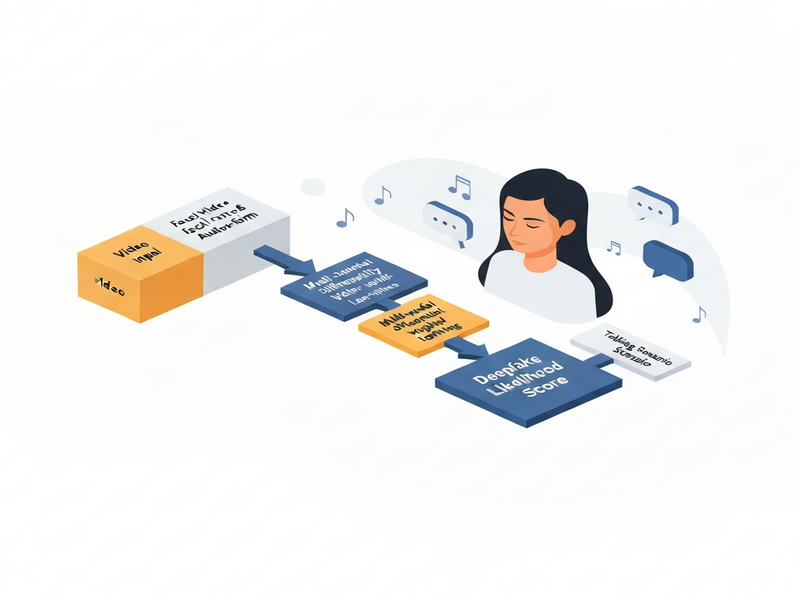
The authors present a two‑branch architecture that unifies textual semantics with multimodal consistency:
- Facial Authenticity Pattern Learner (FAPL): This module extracts visual features from the face and aligns them with multi‑granularity textual descriptions (e.g., “smiling”, “raised eyebrows”, “mouth opening”). By grounding visual cues in language, the learner captures authenticity patterns that are less tied to a specific audio modality.
- Multi‑modal Differential Weight Learning (MDWL): Instead of treating audio‑visual consistency as a binary flag, MDWL learns a differential weight that reflects how much trust to place in the consistency signal for a given clip. It preserves the intrinsic audio‑visual correlation while allowing the system to down‑weight it when the signal is unreliable (as in singing).
Both branches are fused through a lightweight attention mechanism that produces a final forgery score. The key insight is that textual grounding supplies a modality‑agnostic authenticity signal, while the differential weighting adapts to scenario‑specific cross‑modal dynamics.
How It Works in Practice
The end‑to‑end workflow can be broken down into four stages:
1. Pre‑processing and Feature Extraction
Video frames are passed through a face detector, and a backbone CNN (e.g., ResNet‑50) extracts spatial embeddings. Simultaneously, the audio track is transformed into mel‑spectrograms and fed into a temporal convolutional network to capture rhythmic patterns.
2. Textual Description Generation
A pretrained language‑vision model (such as CLIP) generates multi‑granular textual prompts describing facial states at each frame. These prompts are encoded by a transformer encoder, producing a semantic vector that represents “what a genuine face should look like” under the current expression.
3. Authenticity Pattern Alignment
The FAPL aligns visual embeddings with the semantic vectors using a contrastive loss. Correctly aligned pairs reinforce the notion of authenticity, while misaligned pairs (typical of deepfakes) increase the loss, sharpening the decision boundary.
4. Differential Weight Integration
The MDWL module receives the audio‑visual consistency score (computed via cross‑correlation of lip motion and audio envelope) and learns a gating factor through a small MLP. This factor modulates the contribution of the consistency score before it is combined with the authenticity pattern score.
The final forgery probability is produced by a sigmoid layer, enabling threshold‑based decisions or calibrated risk scores for downstream security pipelines.
Evaluation & Results
To validate T‑AVFD, the authors constructed the Singing Head DeepFake (SHDF) dataset, which contains 12,000 synthetic singing clips generated by rhythm‑aware diffusion models across 20 popular songs and 30 celebrity singers. The dataset is deliberately balanced with authentic performances and includes diverse perturbations such as background music, reverberation, and compression artifacts.
Experiments were conducted on three benchmark talking‑head datasets (FaceForensics++, DeepFake Detection Challenge, and Celeb-DF) and on SHDF. The evaluation protocol measured Area Under the ROC Curve (AUC), Equal Error Rate (EER), and robustness under four perturbation categories (noise, compression, temporal cropping, and pitch shift).
- Cross‑scenario performance: T‑AVFD achieved an average AUC of 96.2% on talking‑head datasets, matching or surpassing the best specialized detectors.
- Singing detection boost: On SHDF, the framework lifted AUC from 68.4% (baseline multimodal detector) to 92.7%, a 24.3‑point gain.
- Robustness: Under severe compression (CRF 35) and additive white noise (SNR 10 dB), T‑AVFD’s AUC dropped less than 3 points, whereas competing methods fell by more than 10 points.
- Ablation insights: Removing the textual grounding reduced singing AUC by 15 points, confirming the importance of modality‑agnostic authenticity patterns. Disabling differential weighting caused a 9‑point drop, highlighting the need for adaptive cross‑modal trust.
Collectively, these results demonstrate that T‑AVFD not only bridges the gap between talking and singing deepfake detection but also offers a resilient defense against common video degradations that attackers might exploit.
Why This Matters for AI Systems and Agents
Enterprise AI platforms, conversational agents, and content‑moderation pipelines increasingly ingest user‑generated video. A failure to detect sophisticated singing deepfakes can lead to brand damage, legal exposure, and erosion of trust in AI‑driven services. T‑AVFD provides a plug‑and‑play module that can be integrated into existing verification stacks, delivering:
- Unified security posture: One model handles both speech and singing, reducing operational complexity and maintenance overhead.
- Scalable risk scoring: The calibrated forgery probability can feed into automated decision engines that trigger human review only when confidence exceeds a configurable threshold.
- Enhanced agent authenticity: Voice‑enabled agents that generate singing (e.g., virtual idols or marketing mascots) can be verified in real time, ensuring that generated content complies with brand guidelines.
For organizations already leveraging the UBOS platform overview to orchestrate AI workflows, T‑AVFD can be wrapped as a micro‑service within the Workflow automation studio, enabling seamless detection as part of content ingestion pipelines. Moreover, the framework’s textual grounding aligns naturally with OpenAI ChatGPT integration, allowing conversational agents to query detection confidence and adapt responses accordingly.
What Comes Next
While T‑AVFD marks a significant step forward, several open challenges remain:
- Generalization to other performance modalities: Live instrument playing, dance, or sign language videos introduce additional cross‑modal cues that are not captured by the current audio‑visual focus.
- Real‑time constraints: Deploying the full pipeline on edge devices or low‑latency streaming services requires model compression and inference optimization.
- Adversarial adaptation: As generative models evolve, attackers may learn to manipulate the textual grounding signals, prompting a need for continual adversarial training.
Future research could explore multimodal transformers that jointly encode video, audio, and textual prompts, reducing the reliance on separate branches. Additionally, expanding the SHDF dataset with multilingual songs and diverse cultural expressions would improve global robustness.
From a product perspective, integrating T‑AVFD with the Enterprise AI platform by UBOS could enable large‑scale media monitoring for brands, while the AI marketing agents could automatically flag suspicious promotional videos before they go live.
References
From Talking to Singing: A New Challenge for Audio-Visual Deepfake Detection (arXiv)
Andrii Bidochko
CTO UBOS
Andrii Bidochko is an AI entrepreneur and researcher focused on AI agents, reinforcement learning, and autonomous systems. He writes about the technologies shaping the future of machine intelligence, from frontier models and agent architectures to real-world AI applications.