

- Updated: June 11, 2026
- 8 min read
Do Agents Think Deeper? – Mechanistic Investigation of Layer‑Wise Dynamics in Sequential Planning
Direct Answer
The paper “Do Agents Think Deeper? A Mechanistic Investigation of Layer‑Wise Dynamics in Sequential Planning” reveals that autonomous LLM agents do not use their depth uniformly; instead, they progressively recruit deeper layers as multi‑turn reasoning unfolds, showing a distinct depth‑allocation pattern compared to static single‑turn tasks. This matters because it uncovers a hidden lever—dynamic depth management—that can be exploited to build more efficient, reliable, and controllable AI agents.
Background: Why This Problem Is Hard
Large language models (LLMs) have become the backbone of modern AI agents, powering everything from code assistants to autonomous research bots. Yet, most mechanistic studies to date focus on one‑shot prompts, where a model generates a single answer in a single forward pass. In those settings, researchers have repeatedly observed that the deepest layers contribute little beyond the early ones, suggesting an inefficient use of model capacity.
When an LLM is turned into an agent—a system that iteratively plans, calls tools, updates a world state, and revises its own output—the computational graph becomes a sequence of interleaved forward passes. The agent must remember prior steps, correct mistakes, and adapt to new information. Existing interpretability tools struggle to capture this temporal dimension, and conventional evaluation metrics (e.g., BLEU, exact match) provide no insight into how depth is allocated across turns.
Consequently, developers lack a principled way to answer two critical questions:
- Do agents actually “think deeper” as tasks become more complex, or do they continue to rely on shallow heuristics?
- If depth is under‑utilized, can we redesign prompting or architecture to unlock hidden performance?
Answering these questions is essential for scaling agents to enterprise workloads where reliability, latency, and compute cost are tightly coupled.
What the Researchers Propose
The authors introduce a systematic, layer‑wise investigative framework that treats an entire agent trajectory as a first‑class object. Their approach combines three complementary techniques:
- Residual‑stream probing: Linear classifiers are trained on the hidden states of each transformer layer to predict high‑level semantic attributes (e.g., “planning intent”, “tool‑selection decision”). This reveals which layers encode which aspects of the reasoning process.
- Causal layer‑skipping interventions: By selectively bypassing specific layers during inference, the authors measure the downstream impact on the final output, quantifying each layer’s causal contribution.
- Effective‑depth measurement: A novel metric that distinguishes between “construction” (early semantic direction) and “refinement” (late‑stage stabilization), allowing the team to compute a construction‑refinement gap for each turn.
Crucially, the framework is applied to three distinct agent domains—Deep Research (literature synthesis), Code Generation (iterative debugging), and Tabular Processing (data cleaning)—to ensure that findings generalize across task families.
How It Works in Practice
The investigative pipeline can be visualized as a three‑stage workflow:
- Trajectory collection: The agent runs on a benchmark suite, producing a full log of prompts, tool calls, intermediate states, and final answers.
- Layer‑wise probing & intervention: For each forward pass in the trajectory, the residual stream of every transformer block is extracted. Probes are trained offline, while interventions are executed on‑the‑fly by masking selected layers.
- Depth analytics: The effective‑depth metric aggregates probe confidence scores and intervention impact across turns, yielding a per‑turn depth profile.
What sets this approach apart is its temporal granularity. Instead of treating a model as a black box that produces a single output, the authors dissect the *evolution* of internal representations as the agent iterates. This reveals emergent phenomena such as:
- Early turns relying heavily on shallow layers for coarse planning.
- Later turns activating deeper layers to resolve ambiguities introduced by tool feedback.
- Increasing long‑range dependencies, where a decision made in turn 1 influences the activation pattern of layers in turn 5.
Evaluation & Results
The authors evaluated four state‑of‑the‑art LLM families—Qwen, Minimax, GLM, and a baseline GPT‑4‑style model—across the three agent domains. Key findings include:
Progressive Layer Recruitment
Across all models, the proportion of active deep layers (layers ≥ 12 in a 24‑layer transformer) grew from roughly 15 % in turn 1 to over 55 % by turn 4. This trend was most pronounced in the Code Generation domain, where debugging cycles demand fine‑grained error correction.
Long‑Range Inter‑Layer Dependencies
Cross‑turn attention analyses showed that later turns formed strong attention links to hidden states from the first two turns, indicating that the model maintains a persistent “memory trace” that is accessed by deeper layers during refinement.
Residual Update Patterns
Residual updates shifted from additive feature accumulation in early turns to predominantly corrective adjustments in later turns. In other words, the model stopped building new information and started “undoing” or fine‑tuning earlier predictions.
Construction‑Refinement Gap
The effective‑depth metric uncovered a systematic gap: semantic direction (the “what” of the answer) solidified within the first two turns, while deep layers continued to work on stabilizing the answer’s format, consistency, and tool‑call correctness for up to three additional turns.
Model‑Family Specific Patterns
- Qwen & Minimax: Exhibited the widest construction‑refinement gap, suggesting they allocate a large portion of depth to post‑processing rather than initial reasoning.
- GLM: Showed a more balanced depth distribution that varied by domain; in Tabular Processing, GLM allocated depth early, while in Deep Research it behaved like Qwen.
Collectively, these results demonstrate that autonomous agents dynamically re‑configure their depth usage, contradicting the static‑depth assumption derived from single‑turn studies.
Why This Matters for AI Systems and Agents
Understanding depth dynamics unlocks several practical levers for AI practitioners:
- Latency‑aware prompting: If early turns can be satisfied with shallow layers, developers can truncate the model or use a smaller checkpoint for the first few iterations, reducing latency without sacrificing final quality.
- Cost‑effective scaling: Cloud providers charge per token and per compute cycle. By allocating deeper, more expensive layers only when needed, agents can achieve better cost‑performance ratios.
- Robustness engineering: The correction‑dominant phase identified in later turns suggests a natural “safety net” where deeper layers can be instrumented to detect and rectify hallucinations before final output.
- Tool orchestration design: Knowing that deeper layers are recruited after tool feedback, system architects can schedule expensive tool calls earlier to trigger the refinement phase sooner, accelerating convergence.
These insights map directly onto the capabilities of the UBOS platform overview, where modular workflow stages can be matched to the model’s depth profile, and the Workflow automation studio can be configured to invoke lighter inference for planning and heavier inference for refinement.
For businesses looking to embed AI agents into customer‑facing products, the findings also inform AI marketing agents design: early outreach messages can be generated quickly, while deeper personalization and compliance checks can be deferred to later, more compute‑intensive passes.
What Comes Next
While the study provides a compelling first look at depth allocation, several open challenges remain:
- Generalization to larger models: The experiments capped at 24‑layer transformers. It is unclear whether the same progressive recruitment pattern holds for 100‑plus layer models.
- Dynamic depth control mechanisms: Current agents rely on static architectures. Future work could integrate a controller that explicitly decides how many layers to activate per turn, akin to adaptive computation time.
- Cross‑modal agents: The paper focused on text‑centric tasks. Extending the analysis to multimodal agents (vision‑language, audio‑language) may reveal new depth dynamics.
- Human‑in‑the‑loop evaluation: Quantifying how depth adjustments affect user satisfaction and trust requires user studies beyond automated metrics.
Addressing these gaps will likely involve tighter integration between interpretability research and system‑level engineering. Platforms such as UBOS partner program can accelerate this effort by providing sandbox environments where researchers test adaptive depth controllers on real‑world workloads.
In the meantime, early adopters can experiment with the insights from this paper by:
- Segmenting agent workflows into “planning” and “refinement” phases.
- Deploying smaller model checkpoints for the planning phase and swapping in larger checkpoints for refinement.
- Monitoring residual update magnitudes to trigger early exit when correction‑dominant patterns subside.
These pragmatic steps can immediately improve both performance and cost efficiency, turning mechanistic findings into tangible product value.
Illustration of Layer‑Wise Dynamics
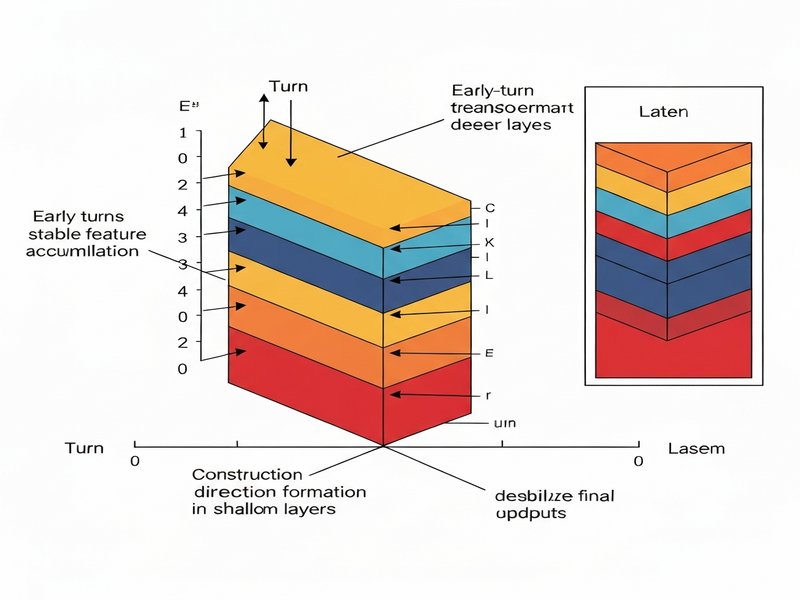
The diagram below visualizes the progressive depth recruitment across agent turns. Early turns (light blue) rely on shallow layers, while later turns (dark blue) activate deeper layers, illustrating the construction‑refinement gap.
Conclusion
The mechanistic investigation of layer‑wise dynamics in sequential planning reshapes our understanding of how LLM agents allocate computational depth. By revealing a progressive, task‑dependent recruitment of deeper layers and a clear separation between early construction and later refinement, the study equips AI engineers with actionable levers for building faster, cheaper, and more reliable agents. As the field moves toward adaptive depth control and multimodal reasoning, these insights will serve as a foundational reference for both research and product development.
Andrii Bidochko
CTO UBOS
Andrii Bidochko is an AI entrepreneur and researcher focused on AI agents, reinforcement learning, and autonomous systems. He writes about the technologies shaping the future of machine intelligence, from frontier models and agent architectures to real-world AI applications.