

- Updated: June 11, 2026
- 7 min read
A Unified Framework for the Evaluation of LLM Agentic Capabilities
Direct Answer
The paper introduces a Unified Evaluation Framework that standardizes how large‑language‑model (LLM) agents are benchmarked across diverse tasks, environments, and toolsets. By decoupling model capability from implementation scaffolding and environmental volatility, the framework delivers cleaner, comparable measurements that are essential for trustworthy deployment of AI agents.
Background: Why This Problem Is Hard
LLM agents are no longer experimental curiosities; they power customer‑support bots, autonomous workflow orchestrators, and safety‑critical decision‑support systems. Yet, assessing whether an agent truly understands a problem, plans effectively, or merely exploits benchmark quirks remains elusive. Existing benchmarks suffer from three intertwined issues:
- Coupled scaffolding. Benchmarks bundle a specific prompt template, tool‑integration layer, and execution engine with the model, making it impossible to tell if a high score reflects the model’s reasoning or the surrounding “scaffold”.
- Environmental volatility. Live APIs, fluctuating web content, and nondeterministic tool responses introduce noise that can inflate or deflate performance in unpredictable ways.
- Lack of unified metrics. Success is often measured by task‑specific criteria (e.g., exact answer match) without accounting for resource consumption, failure modes, or safety violations, limiting cross‑benchmark insight.
These shortcomings hinder reproducibility, obscure genuine progress, and make it risky for enterprises to adopt LLM agents in production environments where reliability is non‑negotiable.
What the Researchers Propose
The authors present a Unified Evaluation Framework that isolates three core dimensions of an LLM agent’s operation:
- Configuration System. A declarative schema that captures every variable—prompt style, tool catalog, environment snapshot—so that experiments can be reproduced exactly.
- Instruction‑Tool‑Environment (ITE) Format. Every benchmark is translated into a triplet: a natural‑language instruction, a set of callable tools (search, calculator, database), and a sandboxed environment that can be either live or a curated snapshot.
- ReAct‑style Execution Sandbox. Agents run inside a fixed ReAct loop (Reason → Act → Observe) that enforces a consistent interaction pattern, eliminating ad‑hoc orchestration differences.
By standardizing these components, the framework enables a clean separation between intrinsic model capability and extrinsic framework or environment effects. It also introduces a taxonomy for attributing failures to decision‑level (reasoning) versus execution‑level (tool misuse) errors, and adds resource‑usage metrics (tokens, latency, API calls) to the evaluation mix.
How It Works in Practice
The workflow can be visualized as a pipeline:
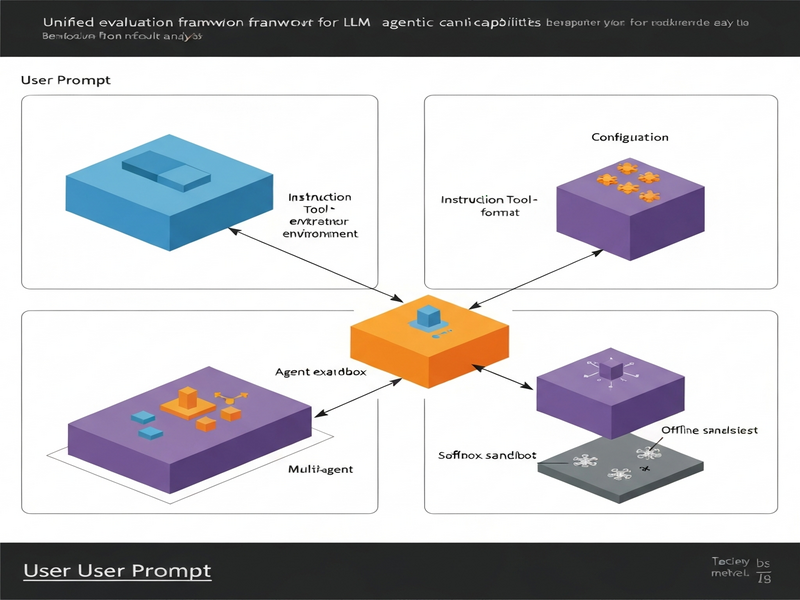
- Benchmark Ingestion. Researchers submit a benchmark description. The framework’s parser rewrites it into the ITE format, extracting the natural‑language goal, enumerating required tools, and selecting an environment mode (live or snapshot).
- Configuration Generation. A JSON/YAML file is produced that lists every parameter: model name, temperature, tool endpoints, sandbox limits, and the chosen environment version.
- Agent Execution. The LLM is wrapped in a ReAct loop. At each step, the model generates a reasoning trace, selects a tool, receives the tool’s output, and updates its internal state. The sandbox enforces timeouts, token caps, and logs all interactions.
- Metric Collection. After the episode ends, the framework computes the original benchmark’s success criterion (e.g., exact answer match) and augments it with unified metrics: total tokens, wall‑clock time, number of tool calls, and a failure‑type label from the taxonomy.
- Analysis Layer. Because every run is reproducibly configured, analysts can run ablation studies—swap the tool catalog, replace a live web search with a static snapshot, or change the ReAct policy—to quantify how much each factor shifts the final score.
This disciplined pipeline differs from prior ad‑hoc setups where researchers manually stitch prompts, write custom wrappers, and run agents against uncontrolled web services. The result is a “fair‑play” arena where the only variable is the LLM itself.
Evaluation & Results
The authors integrated seven widely cited benchmarks covering 24 domains, ranging from single‑agent question answering to multi‑agent negotiation and safety‑critical control loops. They evaluated 15 state‑of‑the‑art models—including open‑source and proprietary variants—over more than 400 K rollouts and 5 B tokens.
Key observations include:
- Scaffold impact. Changing the prompt template or tool‑selection policy altered success rates by up to ±12 percentage points, even when the underlying model remained constant.
- Environment volatility. Live web searches introduced a ±8 point swing in performance for retrieval‑heavy tasks, whereas using a curated snapshot reduced variance dramatically.
- Resource trade‑offs. Models that achieved higher accuracy often consumed 30‑50 % more tokens and incurred longer latency, highlighting the need for balanced budgeting in production.
- Failure taxonomy insights. Approximately 40 % of errors were execution‑level (e.g., malformed API calls), while 60 % stemmed from decision‑level reasoning flaws, suggesting that tool integration improvements alone cannot close the performance gap.
- Safety‑critical extensibility. By swapping a live robotics simulator for a deterministic snapshot, the framework successfully evaluated a control‑policy agent without risking real‑world damage, demonstrating its suitability for high‑stakes domains.
These findings confirm that benchmark scores are not pure reflections of model intelligence; they are composites of model, scaffold, and environment. The Unified Evaluation Framework makes these components observable and controllable.
Why This Matters for AI Systems and Agents
For practitioners building enterprise‑grade AI agents, the framework offers three immediate benefits:
- Transparent performance attribution. Teams can pinpoint whether a missed deadline was due to the LLM’s reasoning or an unreliable tool, enabling targeted engineering fixes.
- Reproducible compliance testing. Regulatory regimes increasingly demand audit trails for AI decisions. The framework’s configuration logs and sandboxed execution provide the provenance needed for compliance audits.
- Cost‑aware deployment planning. Unified resource metrics let ops teams forecast token budgets and latency budgets before committing to production workloads.
These capabilities align directly with the needs of modern AI‑first businesses. For example, the UBOS platform overview leverages standardized agent pipelines that can be evaluated with the same rigor, ensuring that AI marketing agents deliver consistent ROI. Moreover, the Workflow automation studio can import benchmark configurations to automatically validate new tool integrations before they go live.
What Comes Next
While the Unified Evaluation Framework marks a significant step forward, several open challenges remain:
- Dynamic environment modeling. Current snapshots capture a static view; future work should explore probabilistic environment generators that mimic real‑world drift without sacrificing reproducibility.
- Multi‑modal tool support. Extending the tool catalog to include vision, audio, and robotics APIs will broaden the framework’s applicability to embodied agents.
- Standardized safety metrics. Incorporating formal verification checks and adversarial robustness scores could turn the framework into a de‑facto safety certification suite.
Researchers and product teams can contribute new benchmark adapters via the open‑source repository, fostering a community‑driven ecosystem. Enterprises interested in early access can explore the sandbox through the Enterprise AI platform by UBOS, which already embeds the framework for internal model validation. Startups looking to prototype safe agents may find the UBOS for startups offering a low‑friction entry point, while developers can experiment with the Openclaw (Clawdbot, MoltBot) suite to see how multi‑agent dynamics behave under controlled evaluation conditions.
For a deeper dive into the methodology and raw results, consult the original arXiv paper. The authors have also released code and benchmark packs on GitHub, enabling anyone to replicate the study or extend it to new domains.
Call to Action
Ready to bring rigorous, reproducible evaluation to your AI agents? Visit the UBOS homepage to explore the Unified Evaluation Framework, try out pre‑built benchmark configurations, and join a community that values transparent, accountable AI.
Andrii Bidochko
CTO UBOS
Andrii Bidochko is an AI entrepreneur and researcher focused on AI agents, reinforcement learning, and autonomous systems. He writes about the technologies shaping the future of machine intelligence, from frontier models and agent architectures to real-world AI applications.