

- Updated: June 10, 2026
- 7 min read
TCP-MCP: Landscape-Guided Co-Evolution of Prompts and Communication Topologies for Multi-Agent Systems
Direct Answer
TCP‑MCP (Topology‑Coupled Prompting for Multi‑Agent Collaborative Problem‑Solving) introduces a unified co‑evolution framework that simultaneously optimizes agent prompts and the communication graph that connects them. By treating prompts and topology as a single searchable genome, the method delivers higher accuracy on standard benchmarks while cutting token usage by up to 5.7×, making multi‑agent deployments both more effective and more cost‑aware.
Background: Why This Problem Is Hard
Designing a performant multi‑agent system involves two interdependent decisions:
- Prompt engineering: Each agent receives a textual prompt that shapes its reasoning, knowledge retrieval, and response style.
- Communication topology: The graph that determines which agents exchange messages, when, and how often.
Historically, researchers have tackled these components in isolation. Prompt‑only methods focus on crafting the perfect instruction for a single LLM, while graph‑generation approaches treat the communication network as a static scaffold. This separation creates a feedback loop problem: an edge that looks promising on paper may be useless if the receiving agent cannot interpret the incoming message, and a well‑crafted prompt may be wasted if the agent never receives the right context.
Real‑world deployments amplify these challenges. Enterprises often run large fleets of agents to answer customer queries, orchestrate data pipelines, or perform autonomous reasoning. Token cost becomes a critical operational metric, and the combinatorial space of possible prompt‑topology pairs quickly exceeds manual tuning capabilities. Existing automated solutions either ignore cost constraints or rely on heavyweight debate‑style architectures that flood the system with redundant messages.
What the Researchers Propose
The authors present TCP‑MCP, a co‑evolutionary search framework that treats prompts and communication graphs as a single genome. The key ideas are:
- Landscape‑guided initialization: Before the main search begins, a lightweight probe samples the performance landscape to calibrate mutation rates and guide early exploration.
- Pareto‑front diagnostics: The algorithm optimizes three objectives simultaneously—task performance, token cost, and structural complexity—allowing it to surface solutions that balance accuracy with efficiency.
- Unified genome representation: Each candidate solution encodes a set of prompts (one per agent) and an adjacency matrix describing the communication edges. Evolutionary operators (crossover, mutation) act on both parts together, ensuring that changes in topology are immediately reflected in prompt adaptation.
In practice, TCP‑MCP runs on a single LLM backbone (DeepSeek‑V3.2 in the paper) so that improvements stem solely from the co‑design of prompts and topology, not from model scaling.
How It Works in Practice
Conceptual Workflow
- Population seeding: The system generates an initial pool of genomes using random prompts and random sparse graphs.
- Landscape probe: A short set of evaluation runs measures how sensitive performance is to prompt changes versus edge modifications. The probe adjusts mutation probabilities accordingly.
- Evolutionary loop: For each generation:
- Agents execute their assigned prompts, exchange messages according to the current graph, and produce a task‑level answer.
- Fitness is computed on three axes: accuracy on the target benchmark, total tokens consumed, and a penalty for graph density (to discourage overly complex topologies).
- Non‑dominated solutions form a Pareto front; these are selected for crossover and mutation.
- Termination: The loop stops after a fixed budget or when improvements plateau. The final Pareto set offers a menu of trade‑offs for deployment.
Component Interaction
Each agent in TCP‑MCP is a copy of the same LLM backbone but receives a distinct prompt. During a reasoning round, an agent:
- Processes its local input (e.g., a question or sub‑task).
- Generates a message conditioned on its prompt.
- Sends the message to downstream neighbors defined by the adjacency matrix.
- Incorporates received messages into its next reasoning step, effectively “reading” the context supplied by peers.
The co‑evolution ensures that if a new edge is added, the receiving agent’s prompt evolves to interpret that edge’s content, and vice‑versa. This tight coupling eliminates the mismatch that plagues traditional pipeline designs.
What Sets TCP‑MCP Apart
- Joint search space: Instead of a two‑stage pipeline (first design prompts, then design topology), TCP‑MCP explores them together, capturing cross‑dependencies.
- Cost‑aware optimization: Token usage is a first‑class objective, enabling practitioners to meet budget constraints without sacrificing accuracy.
- Scalable Pareto analysis: By presenting a frontier of solutions, the framework lets product teams pick the sweet spot for their specific SLA (e.g., latency vs. precision).
Evaluation & Results
Benchmarks and Scenarios
The authors evaluated TCP‑MCP on three widely used language‑model benchmarks:
- MMLU‑Pro: A professional‑level multi‑task language understanding suite.
- MMLU: The standard Massive Multitask Language Understanding benchmark.
- GSM8K: A grade‑school math problem set that tests reasoning and calculation.
All experiments used the same DeepSeek‑V3.2 model across baselines to isolate the effect of the co‑evolutionary design.
Key Findings
- TCP‑MCP achieved 82.66 % accuracy on MMLU‑Pro, 89.96 % on MMLU, and 96.61 % on GSM8K, surpassing automated graph‑generation baselines by 3–7 percentage points.
- When compared to debate‑style multi‑agent systems (which typically run multiple rounds of argumentation), TCP‑MCP delivered comparable or better accuracy while consuming up to 5.69× fewer tokens.
- The Pareto front revealed clear trade‑offs: a leaner graph (fewer edges) reduced token cost by ~30 % with only a marginal dip (<1 %) in accuracy, demonstrating the framework’s ability to tailor solutions to budget constraints.
- Ablation studies showed that removing the landscape‑guided initialization slowed convergence by ~40 % and produced less diverse topologies, confirming the importance of the early probe.
Why the Results Matter
These outcomes prove that jointly evolving prompts and communication structures is not a theoretical curiosity—it yields tangible performance gains and cost savings on real‑world tasks. For enterprises that bill per token or operate under strict latency budgets, the ability to shave off half a dozen tokens per interaction translates directly into lower cloud spend and higher throughput.
Why This Matters for AI Systems and Agents
Practitioners building AI‑driven products can extract several actionable insights from TCP‑MCP:
- Design efficiency: Instead of iterating on prompts and network diagrams separately, teams can adopt a co‑evolutionary loop to converge on a balanced solution faster.
- Cost‑aware deployment: By treating token consumption as an optimization objective, developers can guarantee that their agents stay within budget without manual throttling.
- Modular orchestration: The framework’s genome representation maps cleanly onto orchestration platforms that manage agent containers, making integration with existing workflow engines straightforward.
- Scalable evaluation: The Pareto‑front diagnostics provide a ready‑made dashboard for product managers to compare “high‑accuracy” vs. “low‑cost” configurations.
These capabilities align closely with the needs of modern AI platforms that aim to deliver UBOS platform overview services, where token efficiency and rapid iteration are competitive differentiators.
What Comes Next
While TCP‑MCP marks a significant step forward, several open challenges remain:
- Generalization across models: The current study uses a single LLM backbone. Extending the co‑evolution to heterogeneous model ensembles (e.g., mixing GPT‑4 with specialized retrieval models) could unlock richer collaboration patterns.
- Dynamic topologies: Real‑time environments may benefit from graphs that adapt on‑the‑fly based on incoming data streams. Incorporating reinforcement‑learning signals to reshape edges during deployment is an exciting direction.
- Human‑in‑the‑loop feedback: Integrating user corrections or preference signals could guide the evolutionary process toward more user‑aligned behaviors.
- Safety and interpretability: As prompts and edges co‑evolve, tracing why a particular message was sent becomes harder. Developing tooling to visualize the decision path will be crucial for regulated industries.
Developers interested in experimenting with co‑evolutionary agent design can start by leveraging the Workflow automation studio to prototype prompt‑topology genomes, then iterate using the built‑in evaluation dashboards.
For a deeper dive into the methodology, readers can consult the original arXiv paper, which provides full algorithmic details, hyper‑parameter settings, and additional ablation results.
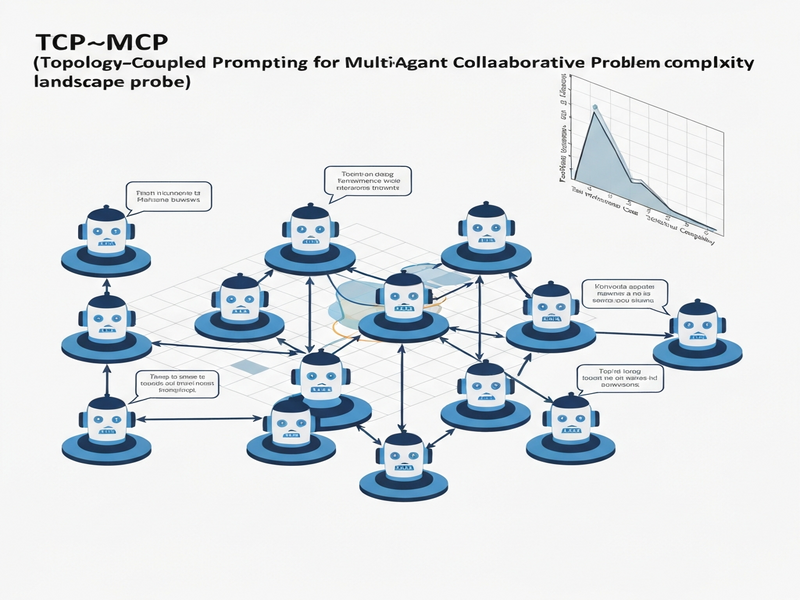
Illustration of TCP‑MCP Architecture
The diagram below visualizes the core components of the TCP‑MCP framework, highlighting the feedback loop between prompt mutation, topology adjustment, and Pareto‑front selection.
Call to Action
Ready to experiment with cost‑aware multi‑agent designs? Explore the Enterprise AI platform by UBOS for scalable deployment, or start a free trial on the UBOS pricing plans page. Harness the power of co‑evolutionary prompting today and stay ahead in the rapidly evolving AI landscape.
Andrii Bidochko
CTO UBOS
Andrii Bidochko is an AI entrepreneur and researcher focused on AI agents, reinforcement learning, and autonomous systems. He writes about the technologies shaping the future of machine intelligence, from frontier models and agent architectures to real-world AI applications.