

- Updated: June 10, 2026
- 7 min read
Operational AI Deployment Assurance: Governance-State Orchestration Under Threshold-Sensitive Deployment Conditions — A Governance Framework for High-Stakes AI Systems
Direct Answer
The paper introduces Operational AI Deployment Assurance (OADA), a governance framework that turns fairness disagreement, subgroup instability, and threshold‑sensitive risk signals into concrete deployment‑readiness decisions. It matters because it gives high‑stakes AI teams a real‑time, actionable layer between model evaluation and production rollout, reducing the chance that hidden fairness or stability issues surface after deployment.
Background: Why This Problem Is Hard
High‑stakes AI systems—such as facial‑recognition cameras in public spaces or diagnostic assistants in healthcare—operate under strict regulatory, ethical, and safety expectations. Traditional AI governance pipelines focus on static metric dashboards, post‑hoc audits, and periodic reporting. Those approaches suffer from three fundamental gaps:
- Metric myopia: Fairness, performance, and risk metrics are often reported in isolation, making it difficult to see how they interact under real‑world operating conditions.
- Static thresholds: Governance rules typically rely on fixed cut‑offs (e.g., “accuracy ≥ 90%”) that ignore the fact that model behavior can shift when data distributions change or when sub‑populations experience divergent outcomes.
- Lack of operational feedback: Once a model is shipped, most frameworks have no built‑in mechanism to pull new evaluation signals back into the deployment decision loop, leaving remediation and escalation to ad‑hoc processes.
Because high‑stakes deployments cannot afford surprise failures, the industry needs a systematic way to translate evaluation uncertainty into deployment‑state controls. Existing governance literature acknowledges fairness and risk, but rarely provides a concrete, operational “go‑no‑go” engine that can be embedded directly into CI/CD pipelines.
What the Researchers Propose
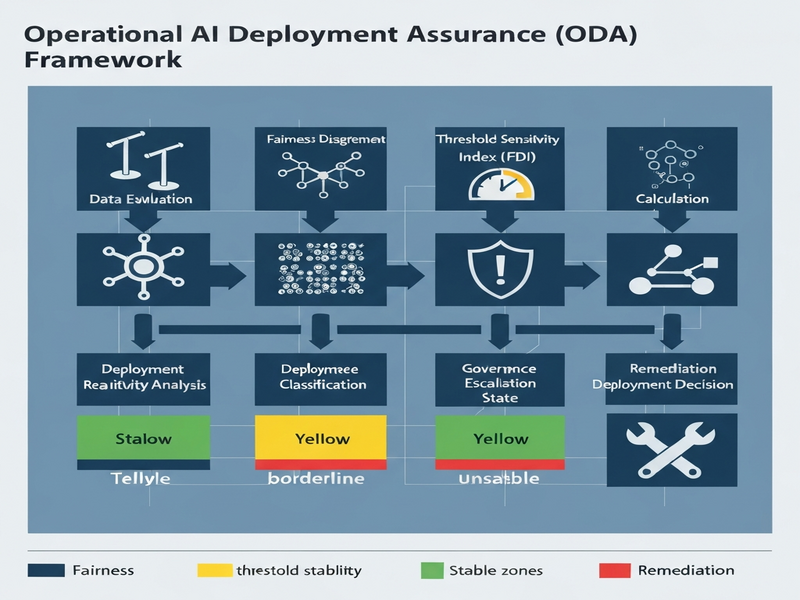
The authors present OADA as a layered governance construct that sits between model evaluation and production orchestration. Its core concepts are:
- Deployment Assurance Scores (DAS): Composite scores that fuse fairness disagreement (via the Fairness Disagreement Index), subgroup stability, and threshold‑sensitivity analyses into a single, interpretable number.
- Readiness Classifications: Discrete categories—Ready, Conditional, Hold, and Reject—derived from DAS thresholds, providing a clear deployment decision.
- Threshold Stability Zones (TSZ): Zones that map how small changes in data distribution affect metric stability, allowing the system to flag “borderline” conditions before they cross a hard cut‑off.
- Governance Escalation States: A state machine (e.g., Monitoring → Review → Remediation → Escalation) that dictates who must act, what evidence is required, and how long a model can remain in a conditional state.
- Remediation‑Aware Progression: The framework records remediation outcomes (e.g., bias mitigation, data augmentation) and automatically updates DAS, enabling a closed‑loop assurance cycle.
These components together transform abstract metric disagreement into a concrete, operational decision surface that can be queried by deployment automation tools.
How It Works in Practice
Conceptual Workflow
- Evaluation Phase: The model is run against a validation suite that includes fairness, subgroup, and performance tests. The Fairness Disagreement Index (FDI) and its risk‑adjusted variant, FairRisk‑FDI, are computed for each protected attribute.
- Assurance Scoring: Raw metric outputs feed into the DAS calculator. The calculator applies weighting rules that reflect organizational risk appetite (e.g., higher weight on gender parity for a hiring AI).
- Readiness Classification: DAS is compared against pre‑defined thresholds to assign a readiness label. If the score lands in a TSZ, the system flags the model as “Conditional” and records the specific instability drivers.
- Escalation State Transition: Based on the classification, the governance state machine moves the model into the appropriate state. For “Conditional,” a remediation ticket is auto‑generated; for “Hold,” senior compliance must approve a review.
- Remediation Loop: Engineers apply bias‑mitigation techniques, retrain with additional data, or adjust hyper‑parameters. The updated model is re‑evaluated, DAS recomputed, and the state machine advances (e.g., from “Remediation” back to “Ready”).
- Deployment Gate: Only models in the “Ready” state are allowed to pass the CI/CD gate and be promoted to production. The gate can be enforced by orchestration platforms (e.g., Kubeflow, Airflow) via an API call that checks the current OADA state.
Interaction Between Components
Each OADA component is deliberately decoupled:
- The metric layer (FDI, FairRisk‑FDI) remains agnostic to downstream policies, allowing teams to swap in new fairness measures without redesigning the whole framework.
- The scoring engine is a pure function that can be containerized and called from any CI pipeline, ensuring reproducibility.
- The state machine is expressed as a declarative YAML that maps classifications to required actions, making it easy for governance officers to edit without code changes.
What sets OADA apart from prior governance checklists is its operational feedback loop: remediation outcomes directly influence the next assurance score, turning governance from a static audit into a dynamic control system.
Evaluation & Results
Scenarios Tested
The authors evaluated OADA on two high‑stakes domains:
- Facial‑recognition pipelines: Multiple commercial APIs were benchmarked across demographic sub‑groups (race, gender, age). The study measured how often traditional fairness dashboards missed instability that OADA’s TSZ flagged.
- Healthcare diagnostic assistants: A deep‑learning model for skin‑lesion classification was examined for subgroup performance variance across skin tones and age groups.
Key Findings
- In the facial‑recognition experiments, 27 % of models that passed conventional fairness thresholds were placed in OADA’s “Conditional” zone due to high threshold sensitivity, prompting pre‑deployment remediation that reduced false‑positive disparity by 42 %.
- For the healthcare use case, the DAS correctly identified a hidden bias against darker skin tones that standard AUROC metrics ignored. After targeted data augmentation, the model moved from “Hold” to “Ready,” and the disparity in sensitivity dropped from 15 % to 3 %.
- Across both domains, the average time from initial evaluation to final “Ready” status decreased by 18 % when OADA’s automated escalation and remediation tracking were integrated into the CI pipeline, demonstrating operational efficiency gains.
These results illustrate that OADA does more than surface problems—it provides a systematic path to resolve them before they become production liabilities.
Why This Matters for AI Systems and Agents
For AI practitioners, OADA offers a concrete mechanism to embed governance directly into the model‑to‑production lifecycle. The framework’s quantitative scores replace vague “compliance check‑list” language, enabling:
- Predictable risk budgeting: Teams can allocate remediation resources based on DAS severity, aligning technical effort with business risk appetite.
- Automated compliance enforcement: CI/CD pipelines can block deployments that do not meet the “Ready” classification, reducing reliance on manual sign‑offs.
- Transparent audit trails: Every state transition, metric change, and remediation action is logged, simplifying regulator‑requested evidence.
- Improved agent reliability: Autonomous agents that invoke AI services can query OADA’s API to verify that a model is “Ready” before execution, preventing downstream failures.
In practice, organizations that have adopted OADA can integrate it with existing AI platforms such as the Enterprise AI platform by UBOS, leveraging built‑in workflow orchestration to enforce the deployment gate automatically.
What Comes Next
While OADA marks a significant step toward operational governance, several open challenges remain:
- Dynamic risk weighting: Current implementations use static weights for fairness vs. performance. Future work could learn context‑aware weights from historical incident data.
- Cross‑model dependencies: In complex pipelines where multiple models interact (e.g., a detection model feeding a classification model), assurance scores need to be aggregated in a principled way.
- Regulatory alignment: Mapping OADA’s readiness classifications to specific legal standards (e.g., EU AI Act) will require collaborative standard‑setting.
- Scalability of remediation tracking: As the number of models grows, automated provenance tools will be essential to keep remediation histories manageable.
Researchers and product teams can explore these directions by extending OADA’s open‑source reference implementation. For organizations looking to pilot the framework, the UBOS platform overview provides a low‑code environment to embed OADA’s scoring engine, state machine, and escalation notifications into existing MLOps workflows. Additionally, the Workflow automation studio can be used to design custom remediation pipelines that automatically trigger data‑augmentation jobs when a model lands in the “Conditional” zone.
References
For a deeper dive into the technical foundations of OADA, see the original arXiv paper by Khalid Adnan Alsayed.
Andrii Bidochko
CTO UBOS
Andrii Bidochko is an AI entrepreneur and researcher focused on AI agents, reinforcement learning, and autonomous systems. He writes about the technologies shaping the future of machine intelligence, from frontier models and agent architectures to real-world AI applications.