

- Updated: June 10, 2026
- 6 min read
SkillGrad: Optimizing Agent Skills Like Gradient Descent
Direct Answer
SkillGrad introduces a gradient‑descent‑inspired framework that treats an LLM agent’s skill package as a tunable parameter, allowing systematic, loss‑driven improvement of reusable procedural knowledge. By converting execution failures into text‑based gradients and applying momentum‑stabilized updates, SkillGrad reliably upgrades skills faster and more consistently than heuristic‑only methods.
Background: Why This Problem Is Hard
LLM agents increasingly rely on skills—structured, reusable snippets that encode domain‑specific procedures such as spreadsheet manipulation, data extraction, or API orchestration. Skills are attractive because they keep the core model lightweight while offering plug‑and‑play adaptability. In practice, however, three intertwined challenges undermine their utility:
- Reliability gaps: Skills sourced from third‑party repositories or generated on‑the‑fly often contain outdated assumptions, missing edge‑case handling, or outright bugs.
- Evolution bottleneck: Traditional skill‑evolution pipelines rely on manual reflection or rule‑based heuristics, which lack a principled objective function and therefore produce unpredictable improvements.
- Scalability constraints: As the number of skills grows, maintaining consistency across versions becomes a combinatorial nightmare, especially when each skill interacts with others in a larger workflow.
Existing approaches—such as reinforcement‑learning‑based fine‑tuning of the entire model or ad‑hoc prompt engineering—either demand massive compute or fail to isolate the procedural knowledge that skills encapsulate. Consequently, enterprises that wish to deploy domain‑specific agents face a costly cycle of trial, error, and re‑deployment.
What the Researchers Propose
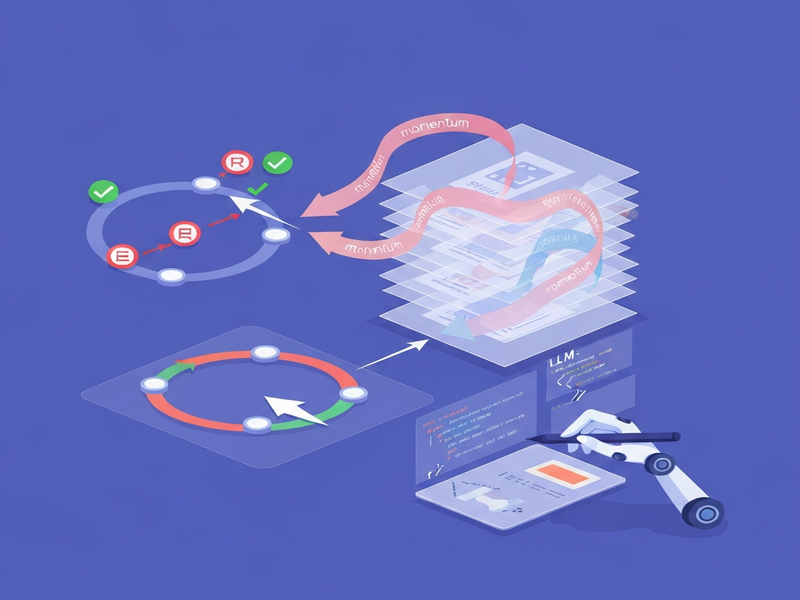
SkillGrad reframes skill improvement as an optimization problem akin to gradient descent in continuous parameter spaces. The core insight is to treat the entire skill package—a collection of structured files, prompts, and execution templates—as a single “parameter vector” that can be nudged toward lower loss based on real‑world task outcomes.
The framework comprises four tightly coupled components:
- Trajectory‑Level Loss Collector: During task execution, the agent records a loss signal that captures deviation from the expected result (e.g., incorrect spreadsheet formula, mismatched table schema).
- Automatic Diagnostic Engine: A lightweight LLM parses the loss evidence and generates a natural‑language “gradient” describing the direction of correction (e.g., “use absolute cell references instead of relative ones”).
- Momentum Memory Overlay: Recurrent diagnostic patterns are accumulated in a persistent memory structure, providing a momentum term that smooths noisy updates across iterations.
- LLM‑Based Patcher: Leveraging a second LLM, the system translates the textual gradient into concrete, layer‑aware edits—adding, deleting, or modifying skill definitions while preserving syntactic integrity.
By iterating through this loop, SkillGrad progressively refines the skill package without ever retraining the underlying LLM, preserving model generality while sharpening domain expertise.
How It Works in Practice
Conceptual Workflow
The end‑to‑end process can be visualized as a five‑stage pipeline:
- Initialize Skill Package: Developers load a baseline set of skills—often sourced from open repositories or generated via prompt‑based synthesis.
- Execute Target Task: The agent attempts the task (e.g., answering a WikiTableQuestions query) using the current skill set.
- Collect Loss Evidence: Execution logs are examined for mismatches, exceptions, or performance penalties, producing a scalar loss value.
- Diagnose Gradient: The diagnostic engine interprets the loss and emits a natural‑language suggestion for improvement.
- Apply Momentum‑Stabilized Patch: The patcher, guided by both the fresh gradient and the accumulated momentum overlay, edits the skill files. The updated package is then fed back into the next iteration.
Interaction Between Components
Each component communicates through well‑defined JSON messages, ensuring modularity. For example, the loss collector outputs {"task_id": "...", "loss": 0.42, "trace": "..."} , which the diagnostic engine consumes to produce {"gradient": "replace relative cell references with absolute ones"} . The momentum overlay maintains a running average of recent gradients, weighting them to dampen outliers before the patcher receives the final edit instruction.
What Sets SkillGrad Apart
- Parameter‑Level Optimization Without Model Retraining: Traditional fine‑tuning adjusts billions of weights; SkillGrad only mutates a few kilobytes of skill definitions.
- Textual Gradient Generation: By keeping the gradient in natural language, the system leverages the LLM’s own reasoning capabilities, avoiding the need for handcrafted loss gradients.
- Momentum‑Based Stabilization: Borrowing from deep learning optimizers, the memory overlay reduces oscillations caused by noisy execution feedback.
- Layer‑Aware Patching: The patcher respects the hierarchical structure of skill files (e.g., top‑level prompts, sub‑routines), ensuring edits remain syntactically valid.
Evaluation & Results
Benchmarks and Testbeds
Researchers evaluated SkillGrad on two widely recognized benchmarks:
- SpreadsheetBench Verified: A suite of spreadsheet manipulation tasks that require precise formula generation and cell navigation.
- WikiTableQuestions: A question‑answering benchmark over semi‑structured Wikipedia tables, demanding robust table‑parsing skills.
Both benchmarks were run using two backbone LLMs (a 7B and a 13B model) to demonstrate model‑agnostic benefits.
Key Findings
- SkillGrad consistently outperformed the strongest training‑based skill‑evolution baseline by an average of 6.7 percentage points in task accuracy.
- Ablation studies revealed that removing the momentum overlay reduced performance by roughly 2.3 points, confirming its stabilizing effect.
- Contrastive diagnosis—where the engine compares the current failure against a library of known patterns—contributed an additional 1.8‑point gain.
- Across both LLM sizes, the number of optimization iterations required to reach peak performance was halved compared to heuristic‑only methods.
These results demonstrate that a gradient‑descent‑style loop can extract more value from existing skills than brute‑force fine‑tuning, while keeping compute costs modest.
Why This Matters for AI Systems and Agents
SkillGrad’s approach reshapes how enterprises think about agent maintenance and scalability:
- Rapid Skill Refresh: Teams can automatically adapt skills to evolving data schemas or regulatory changes without redeploying the entire model.
- Cost‑Effective Customization: Because only the skill package is edited, compute‑intensive model retraining is avoided, lowering cloud‑spend for large‑scale deployments.
- Modular Orchestration: Updated skills can be swapped in real time within orchestration platforms, enabling continuous delivery pipelines for AI agents.
- Enhanced Reliability: Momentum‑driven updates reduce regression risk, leading to more predictable agent behavior in production.
Practically, developers building UBOS platform overview can integrate SkillGrad as a backend service that continuously refines the skill libraries powering their workflow automation studio. This creates a feedback loop where agents learn from their own mistakes, mirroring human iterative improvement.
What Comes Next
While SkillGrad marks a significant step forward, several avenues remain open for exploration:
- Cross‑Skill Dependency Modeling: Future work could extend the momentum overlay to capture interactions between multiple skills, preventing contradictory updates.
- Multi‑Objective Optimization: Incorporating latency, memory footprint, or security constraints into the loss function would enable balanced trade‑offs.
- Human‑in‑the‑Loop Verification: A lightweight UI for domain experts to approve or edit suggested patches could blend automation with expert oversight.
- Domain‑Specific Extensions: Applying SkillGrad to code generation, robotic process automation, or conversational tutoring could broaden its impact.
Organizations interested in experimenting with SkillGrad can start by leveraging the Workflow automation studio to prototype skill packages and feed execution traces into the optimization loop. As the community contributes more diagnostic patterns, the momentum memory will become richer, accelerating convergence for new domains.
References
For a complete technical description, see the original SkillGrad paper.
Andrii Bidochko
CTO UBOS
Andrii Bidochko is an AI entrepreneur and researcher focused on AI agents, reinforcement learning, and autonomous systems. He writes about the technologies shaping the future of machine intelligence, from frontier models and agent architectures to real-world AI applications.