

- Updated: June 10, 2026
- 6 min read
Prefix-Safe Bayesian Belief Tracking for LLM Reasoning Reliability: Separating Calibration from Ranking
Direct Answer
The paper introduces Sequential Bayesian Belief Tracking (SBBT), a prefix‑safe framework that separates probability calibration from ranking when estimating the eventual success of long‑chain reasoning in large language models (LLMs). By treating observations as calibrated evidence, SBBT delivers more reliable confidence scores and improves the ability to rank correct versus incorrect solutions.
Background: Why This Problem Is Hard
LLMs excel at generating multi‑step reasoning traces, yet they often lack trustworthy estimates of whether a final answer will be correct before the answer is revealed. Practitioners need two distinct signals:
- Calibration: How well the model’s confidence aligns with actual success probabilities.
- Ranking: The ability to order multiple candidate traces so that the most promising ones appear first.
Existing prefix‑safe baselines—such as raw scalar scores or simple self‑verification tags—tend to conflate these signals. They either over‑confidently assign high probabilities to incorrect traces or fail to exploit structural cues that could improve ranking. Moreover, most methods treat each observation in isolation, ignoring the sequential nature of reasoning where early tokens can dramatically shift the likelihood of eventual success.
What the Researchers Propose
The authors propose a unified, two‑state Bayesian tracker that updates a belief about eventual success (y=1) as each new token or meta‑observation arrives. The framework consists of three conceptual components:
- Prefix‑Safe Observations: Any evidence that can be extracted from the current prefix without peeking at future tokens (e.g., scalar confidence scores, self‑verification statements, hidden cluster identifiers).
- Likelihood Calibration Module: A lightweight model that maps raw observations to calibrated likelihoods, ensuring that the evidence is statistically sound.
- Two‑State Belief Engine: A Bayesian update rule that maintains a probability distribution over “eventual success” vs. “eventual failure” and recursively refines it as new evidence arrives.
This separation allows SBBT to improve raw probability quality (calibration) while also providing a pathway for richer, structure‑aware signals to boost ranking performance.
How It Works in Practice
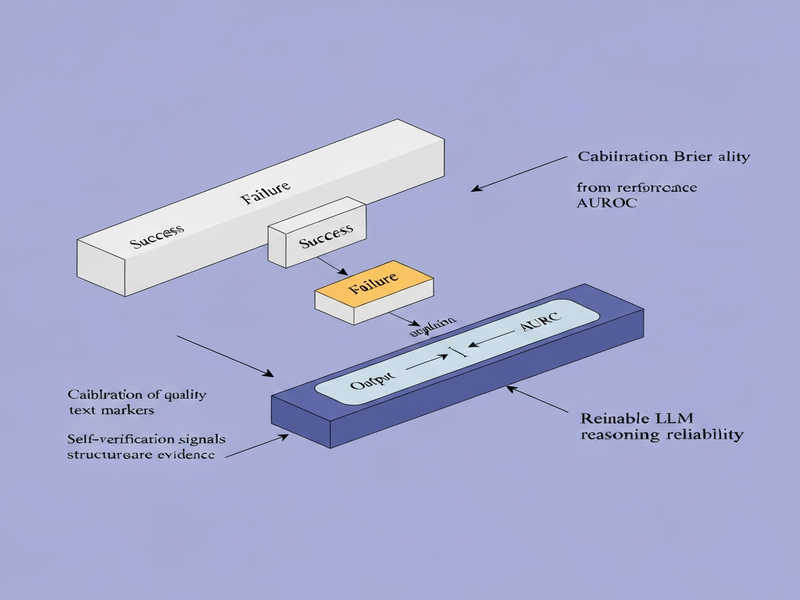
The operational workflow can be visualized as a pipeline that processes a reasoning trace token‑by‑token:
- Generate Prefix: The LLM produces a partial reasoning trace
o₁:t. - Extract Observations: From this prefix, the system pulls a set of prefix‑safe signals—scalar confidence, self‑verification markers, token‑pooling probes, or latent‑trajectory features.
- Calibrate Likelihoods: Each raw observation passes through the likelihood calibration module, which outputs a probability that the observation would appear under the “success” hypothesis versus the “failure” hypothesis.
- Bayesian Update: The two‑state belief engine combines the calibrated likelihoods with the prior belief, yielding an updated posterior
P(y=1 | o₁:t). - Iterate: Steps 1‑4 repeat for each new token until the trace terminates, producing a final confidence estimate that reflects the entire reasoning process.
What sets SBBT apart is its strict adherence to prefix safety, which guarantees that no future information leaks into the belief update, and its modular calibration layer that can ingest heterogeneous evidence types without redesigning the core Bayesian engine.
Illustration of SBBT Workflow
Evaluation & Results
The authors evaluated SBBT on four challenging math‑oriented benchmarks that feature long reasoning chains:
- MATH‑500: A curated subset of the MATH dataset.
- GSM8K: Grade‑school math problems with step‑by‑step solutions.
- AIME 2025: Advanced competition problems requiring deep multi‑step reasoning.
- RIMO‑N: Reasoning‑Intensive Multi‑Option Natural language tasks.
Two primary metrics were reported:
- Brier Score (lower is better) to assess calibration quality.
- AUROC (higher is better) to evaluate ranking ability across traces.
Key findings include:
- When only scalar scores were fed into SBBT, the Brier score improved consistently across all datasets, confirming that the Bayesian update sharpens probability calibration.
- Introducing structure‑aware observations (e.g., self‑verification markers, hidden cluster IDs) yielded a notable AUROC lift—up to +0.110 on the hardest AIME 2025 setting—demonstrating that richer evidence can enhance ranking once the baseline calibration is already strong.
- Ablation studies showed that removing the likelihood calibration step degraded both Brier and AUROC, underscoring its central role.
Overall, the experiments validate the authors’ hypothesis: scalar evidence primarily boosts calibration, while structured, prefix‑safe signals are essential for improving ranking when a strong calibrated baseline already exists.
Why This Matters for AI Systems and Agents
For developers building autonomous agents, reliable confidence estimates are a safety cornerstone. SBBT offers a plug‑and‑play inference layer that can be wrapped around any LLM‑driven reasoning module, providing:
- Real‑time, calibrated success probabilities that inform decision‑making loops (e.g., whether to request human review).
- A systematic way to incorporate diverse evidence—such as Chroma DB integration for vector‑based similarity cues or ElevenLabs AI voice integration for multimodal verification—without breaking the prefix‑safe guarantee.
- Improved ranking of candidate solutions, which is critical for AI marketing agents that must select the most persuasive copy among many generated drafts.
By decoupling calibration from ranking, system architects can prioritize safety (through well‑calibrated probabilities) while still leveraging sophisticated evidence for performance gains. This aligns with emerging AI governance frameworks that call for transparent, auditable confidence reporting in autonomous workflows.
What Comes Next
While SBBT marks a significant step forward, several avenues remain open:
- Scalability to Massive Token Streams: Extending the Bayesian engine to handle millions of tokens efficiently, perhaps via streaming approximations.
- Cross‑Modal Evidence Fusion: Integrating visual or auditory cues (e.g., from the ChatGPT and Telegram integration) to enrich the observation set.
- Adaptive Likelihood Models: Learning calibration functions that evolve with the underlying LLM’s distribution shift over time.
- Open‑Source Toolkits: Packaging SBBT as a reusable component within the UBOS platform overview, enabling rapid experimentation for startups and enterprises alike.
Future research could also explore how SBBT interacts with reinforcement‑learning‑based agents that dynamically select which observations to query, turning belief tracking into an active learning problem. As the community pushes toward more trustworthy AI, frameworks like SBBT will likely become a standard part of the inference stack.
References
- Song, Z., Li, Y., & Liu, Y. (2026). Prefix‑Safe Bayesian Belief Tracking for LLM Reasoning Reliability: Separating Calibration from Ranking. arXiv preprint arXiv:2605.27712.
- OpenAI. (2023). ChatGPT Technical Report. OpenAI.
- Brown, T. et al. (2020). Language Models are Few-Shot Learners. NeurIPS.
- Gupta, A. & Singh, R. (2022). Calibration of Neural Networks. Journal of Machine Learning Research.
Andrii Bidochko
CTO UBOS
Andrii Bidochko is an AI entrepreneur and researcher focused on AI agents, reinforcement learning, and autonomous systems. He writes about the technologies shaping the future of machine intelligence, from frontier models and agent architectures to real-world AI applications.